THE INFLUENCE OF CHRISTIANITY ON THE
IRIQUOIS CONFEDERATION
[Document subtitle]
Brian
Lutz
REL:
2121
LUTZ 1
Brian lutz
Professor James Johnson
REL 2121
10 November 2014
1. The Land of Religious Opportunity
The Native American Religious landscape is undoubtedly a mixture of countless
influences and events that have formed an unfinished portrait that continues to develop today.
When looking at the spread of Christianity one of the many questions that arise is why they went
to the Americas in the first place. Prior to Columbus, most of Europe’s gold came from the Gold
Coast which is a location on the west coast of Africa. Spain’s greed to find new sources grew
desperate by the disruption of the Inquisition. The first example in the Americas of European
influence can be seen in the discovery of Potosi, a city in the country Bolivia that supplied the
precious metals, such as silver, for most of the European coins; therefore, leading to the rise of
capitalism in Europe. “Potosi made the money that irrevocably changed the economic
complexion of the world” (Weatherford, 6-12). The irony in this discovery is that the silver and
gold that was literally mined with slave labor of the Indians. In fact, this metal was also used to
adorn the beautiful churches in Europe. The American Indians indirectly helped create these
outstanding places of worship, built with slave labor, moreover; “eight million Indian lives were
lost so that the churches of Europe, could have their gilded altars and statues” (Weatherford, 6-
12). Moreover, this would lead to the first significant European presence in the new world, which
began with Christopher Columbus’s First voyage in 1492. In the textbook, America’s Religions
from Their Origins… Peter Williams states that, “Only a few years after Columbus’s, opening up
LUTZ 2
of the New World for European settlement, the papacy divides this so called “territory” into
spheres of influence with the Portuguese, through papal mediation in what becomes known as
the Treaty of Tordesillas in 1494” (Williams, 158-160). Through history, we know that,
European colonist did not colonize in a void at every turn and with every geographical
expansion, Europeans encountered people who were Americans first. Peter Williams, also writes
that, “The nature of these encounters were diverse and included disease, enslavement, and
assimilation by missionary work and intermarriage. Conversely, Europeans also encountered
well established Nations that would become pivotal to the success of the colonies formation”
(pg. 161). As the Spanish Catholic settled in the southern rim of North America during the
colonial period, the French, known as the Jesuits, were similarly active in the north. Their
primary area of activity is what is now considered the providence of Québec; therefore, The
Iroquois and Europeans suffered a period of acclimation due to the proselytism of Christianity
through Catholic and Anglican missions. “Native Americans experienced as individuals, and
communities adaptations to fluctuating conditions. Of course, Native Americans were not the
only ones engaged in changing social conditions. Missionaries, uncertain of the Great spirit, also
found themselves straddling both worlds” (Nicholas and Joel).
2. The Three Myths of the Iroquois
LUTZ 3
The confederacy of the Haudenosaunee (Iroquois) “which means people of the
longhouse” was created with religious authority long before the Europeans found the coasts of
America. “Some historians, would estimate the league as old as 1450” (Wilson, 100-102).
“There are three great myth’s that define the basis of the Iroquois Confederacy” (Vecsey, 83).
The first, is the creation story. According to the Iroquois, the creation myth for varies slightly
from each telling to the next. This is mainly because the Iroquois kept its history by word of
mouth (Gaynor). Borade, states that, “They did not have the need to write their stories or
agreements down on paper; therefore, the conversations and dialogues prior were as important as
the agreements themselves” (Gaynor). The general knowledge, however, remains constant.
• The Iroquois Creation Account
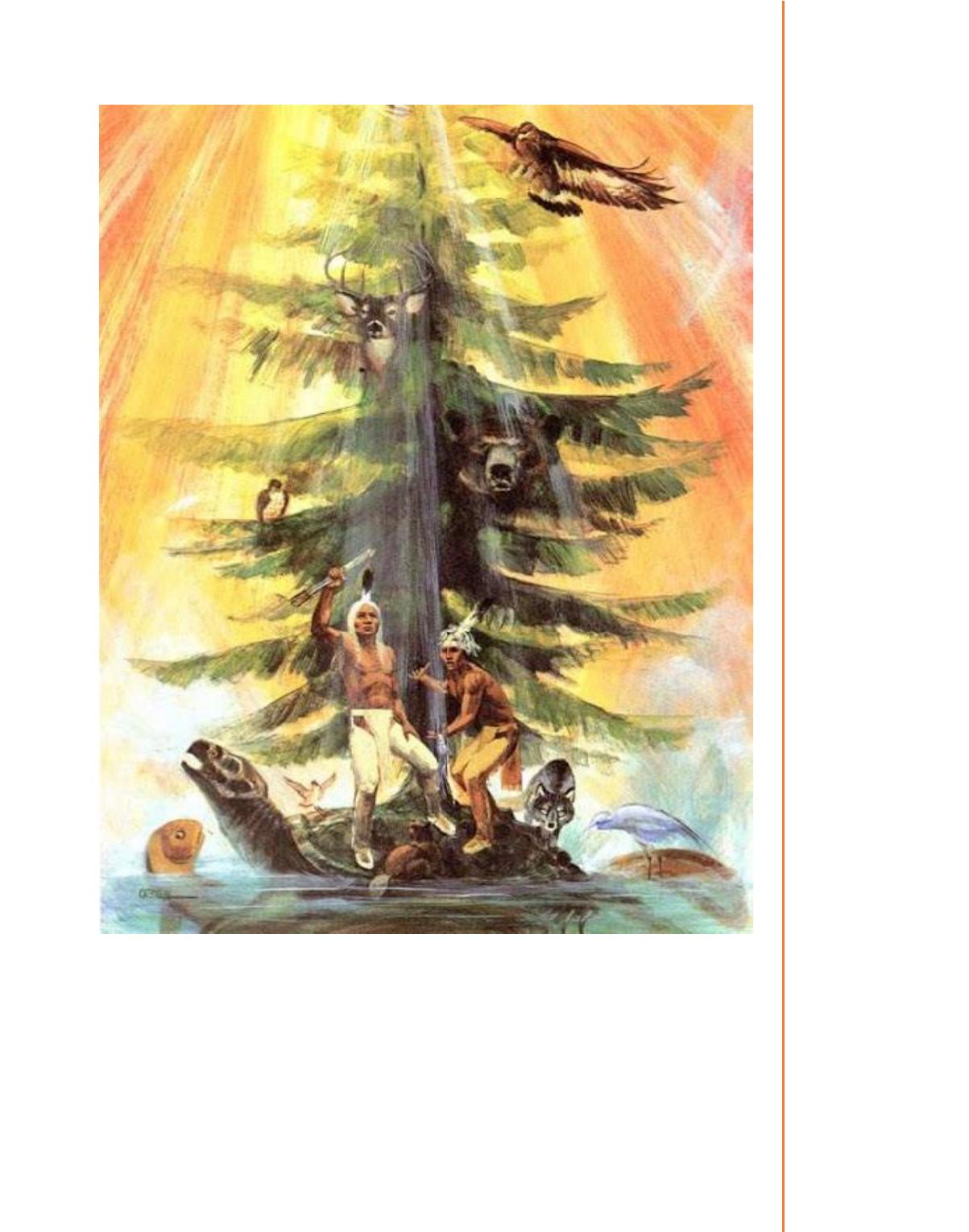
“In the distant past, long before the world was created the earth was covered by deep water.
People dwelt in the cloud world above the great sky dome. One day, the great chief, who
became ill, dreamed that uprooting a great sacred tree would cure him. He further
commanded that his pregnant daughter look into the hole at the world below. While in the
process, the great ruler pushed her into the darkness below. The creatures of this world were
stirred into action, as the water fowls caught her fall, the beaver called upon the turtle to bear
land for Sky woman. Afterwards, the water fowls gently placed her upon dry ground. Time in
this new world passed, and she gave birth to twins. The handsome good twin was born first
and, he was called “Teharoniawako’ (Holder of the heavens). The ugly evil twin forced
himself out through his mother’s armpit, killing her in the process. He was called “Sawiskera’
(Mischievous one). Teharoniawako, then buried their mother, into the ground and thus the
saying mother earth was created. The two sons were in constant opposition, the handsome one
created all that was good and made sure nothing suffered. On the other hand, the ugly one
LUTZ 4
created all that was bad, often jumbling what his brother created, such as, making rivers and
mountains crooked. Eventually this duel came to a head, teharoniawako defeatd his brother in
a duel with a set of deer antlers, and banished him in a corner of the world. It came to be that,
Teharniawako ruled the day and that Sawiskera ruled the night. Yet, sometimes sawikera
sends out wicked spirits, and their persistence ensures, that good and evil coincide”
(Wilson, 99-100)
The second myth, is the founding of the Iroquois League. It is said by some, “that the
Iroquois regard the league legend as a gospel or a bible” (Richter, 84-85). In this story, the
Iroquois Prophet says, he brought tranquility to the land. “Deganawidah’s message spoke of
“righteousness, civil authority, and peace” (Wilson, 100). Through this great law, he “persuaded
the chiefs to abandon their feuds, reform their minds, and unite” (Fenton, 15). To form the Five
Nations: consisting of the Mohawk, the Oneida, and the Onondaga, the Cayuga, and the Seneca,
Indian tribes (and later, a sixth: the Tuscarora). The third great Myth is the Teachings of the
Prophet Handsome Lake. “When Native peoples first came in contact with European religions
they recognized parallels between the white man’s God and their Great Spirit” (Hartz, 20). Such
as, an existence of a heaven and hell, the incorporative belief that there is a creator who is at
battle with evil and finally the belief that the body has a soul. It is important to note however,
that Christianity influenced the idea that the sacred is a supreme ruler and not a spirit found in
everything. Additionally, many Christian’s scorned differences such as, “animal spirits and
agricultural idols that clashed with ideologies of Christian doctrine” (Wilson, 106). Throughout
the United States, Christianity was never welcomed with open arms, and the Iroquois culture is
no different. The religion of the longhouse has never been the same because of the incorporation
of both: Sky women and Christianity.
LUTZ 5
3. Missionary work through Proselytism
“Regardless of the Christian Religious denominations Europeans insisted on revealing an
religious belief found throughout the Judeo-Christian Bible” (Richter,84-85). Many nations
sought to spread Christianity through Proselytism. The Europeans, first thought that perhaps,
these native people were descendants of the lost tribes of Israel, and it was their duty to spread
the good news to these people. “Unfortunately, the early settlers, were unable to communicate
because of conflicting practices, doctrines, and language barriers” (Fenton, 248). While the
French had the most success in spreading the Christian faith, the Anglicans would prove to be a
competing factor due to economic success. For many Iroquois, the first encounter of Christianity
can be seen as a catalyst to the start of the splintering of the confederacy. That would forever
change the Confederacy that was said to be founded by divine declaration.
3.1 The Dutch
The Iroquois were first encountered by the white man around 1609 during the height of Dutch
exploration. In 1649, a Dutch proselytizer named Johannes Megapolensis completed his tenure
as a pastor in the region known as Rensselaerswyck, which is now part of upstate New York.
“While completing his pastoral services as a preacher, he had come across many Iroquois, and
had surprisingly been outwitted by their inquisitive questions. Megapolensis message against
“Sins of theft, drunkenness, lewdness and murder”’ (Richter, 106), made little sense to a people
who did not drink and shared their possessions freely. The native Iroquois were just as
inquisitive as any Christian skeptic would be of them: “Why do so many Christians pray?”
(Megapolensis, 178). They would ask as they laugh at us,” (megapolensis, 177) he wrote, and it

LUTZ 6
is easy to understand why. These experiences as described by Father Megapolensis, were merly
fallacies to the Iroquois, who saw their teaching as flawed. The Dutch Reform, however, was
only one of several religious denominations who found their way to Iroquia. “The French Jesuits
and English Anglicans would make strong religious footholds among the Iroquois following the
void left by the Dutch” (James and James, 13).
3.2 The Relentless French Jesuits
As Christianity was undergoing changes in Europe in 1534 a group of Spanish
soldiers established what are now known as “Jesuits” as a means of combating the incursions
of Protestantism at the beginning of the Reformation; therefore, the drive for freedom of
religion from a monarchial king drove Religious groups to the new world. “The French
Jesuits that spread the Gospel in America, distinguished themselves from other Catholic