MARCH 2014 tHe MAnAgeMent ACCountAnt 73www.icmai.in
During January 2008, the maiden public
issue of Reliance Power Limited, In–
dia, was oversubscribed 73 times and
garnered an astronomical $190 billion. It created
many world records. It was the largest subscription
of any IPO (initial public offering) anywhere in
the history of global capital markets with a record
five million applicants. It became 10 top listed
companies in India with the largest number of
shareholders in any listed company in the world.
The high growth Reliance Group companies
are known for producing stock-market gains
from the moment they are listed. No issue since
its inception in the year 1965 had failed to date
in the stock market. So the highly oversubscribed
issue was keenly awaited to open on February 11,
2008 in the twin stock exchanges National Stock
Exchange (NSE) and Bombay Stock Exchange
(BSE) of Mumbai, India.
But for the first time in history of Indian stock
markets the Reliance magic did not work. For a
few moments on the opening day, Reliance Power
surged 19% to 538 rupees ($10.94) from the IPO
price of 450 rupees ($9.15). After the initial surge
of four minutes the dream vanished and RPL
dived to 355rupees ($7.23) per share never to re–
turn even close to the issue price. By the close of
the day, it was down 17% at 372.50 ($7.57) rupees,
Four billion of its market capitalization wiped out
and with it billions of rupees of investors’ wealth.
The aftermath
In the following days, the nightmare worsened as
another $5 billion of the market capitalization was
lost. The blow was severe and went far beyond
Reliance Power. The listing affected all the group
companies of the Reliance Group.
As a face saving measure Reliance Power Ltd
issued free bonus shares to all categories of share–
holders, excluding the promoter group (compris–
ing of Reliance Energy Ltd.(REL) and the ADA
Group), in the ratio of 3 shares for every 5 shares
held. The proposed bonus offering resulted in re–
duction of the cost of Reliance Power shares with
an offer price of Rs. 269 ($5.47) per share for retail
investors, 40% lower than the IPO price of Rs.
430($8.74) and Rs. 281($5.71) per share for other
investors, and 37% lower than the IPO price of
Rs. 450 ($9.15). REL announced buyback of the
shares to prevent the shares to slide further which
didn’t happen although. The performance of Re–
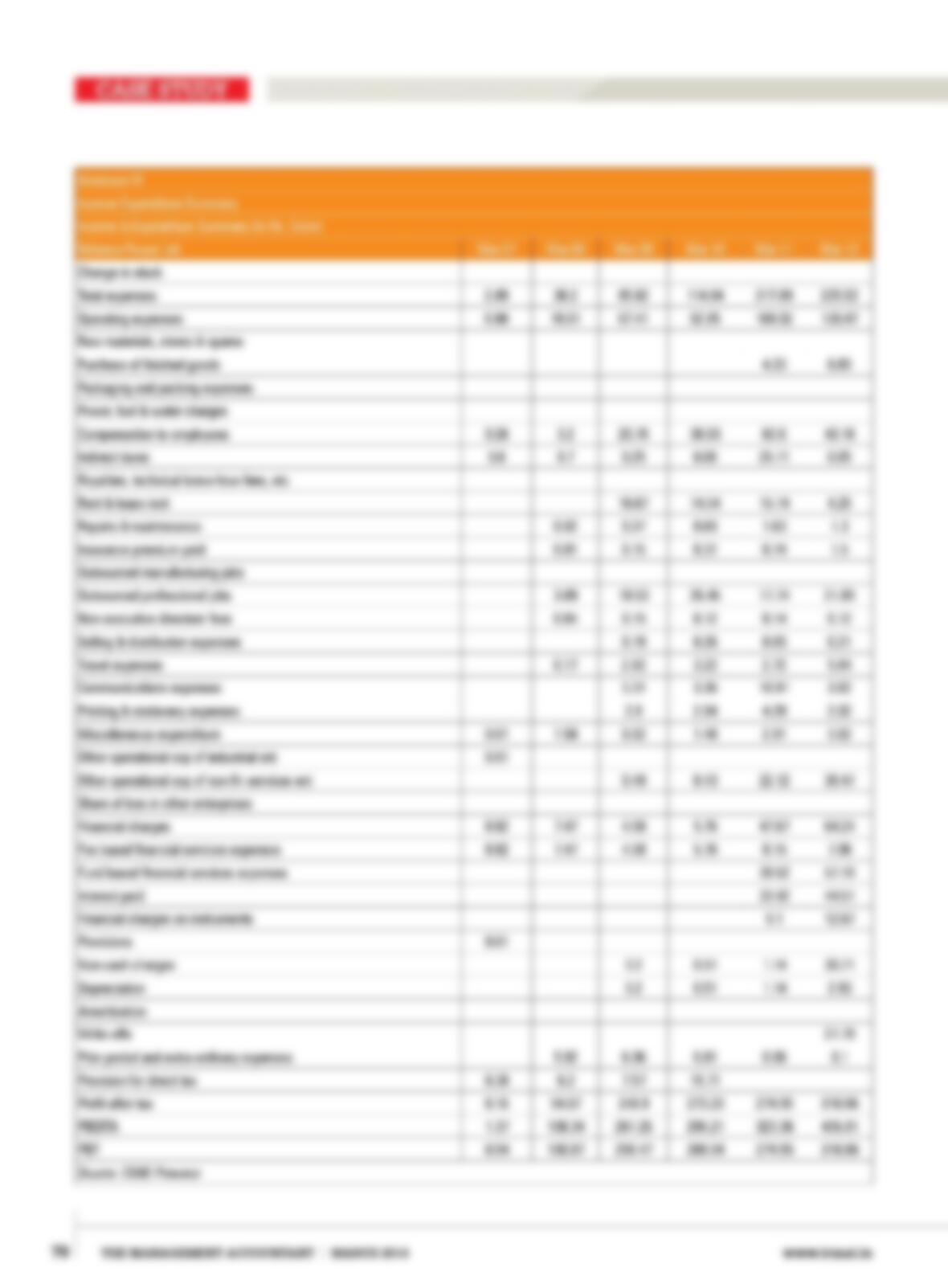
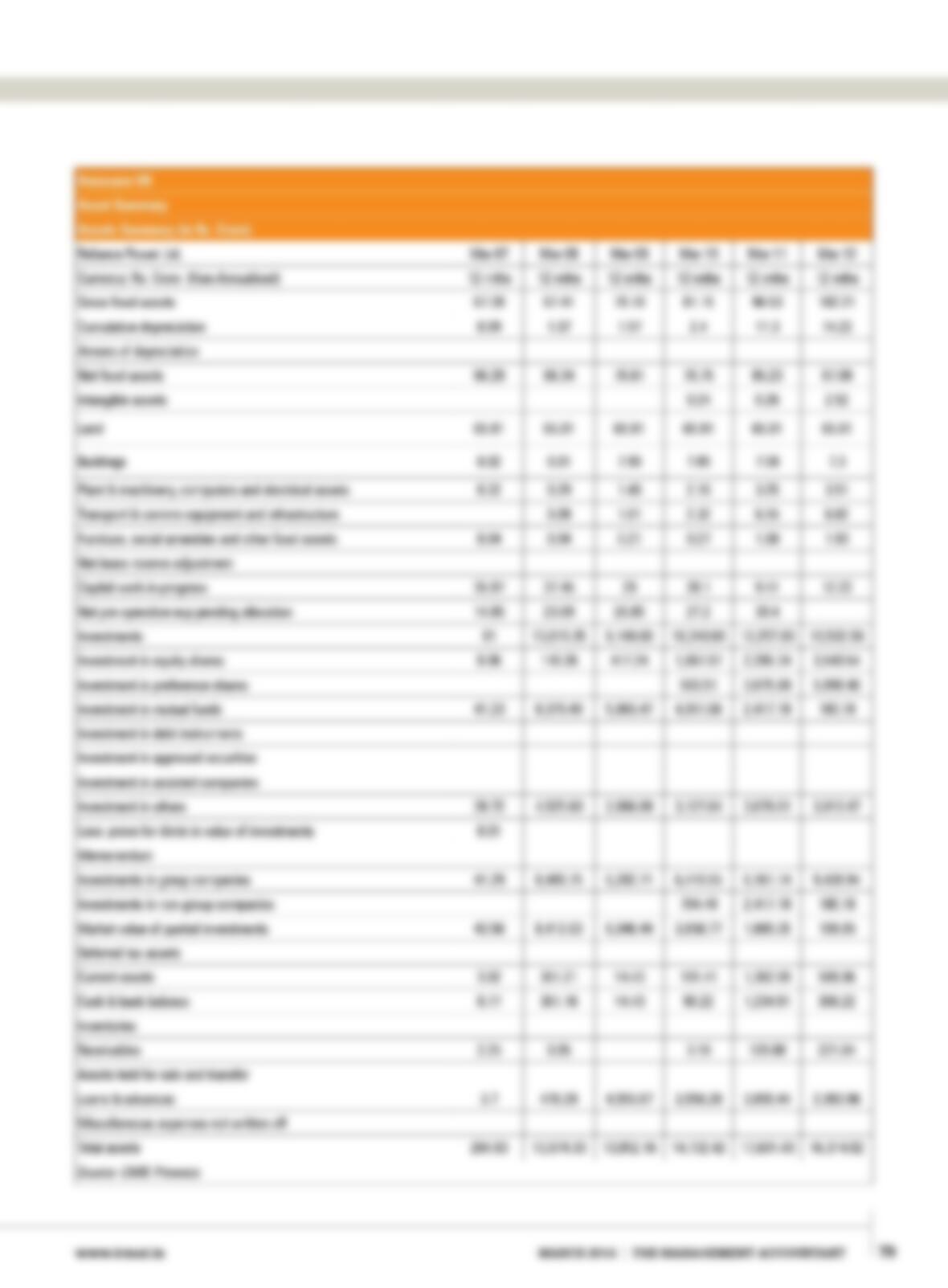
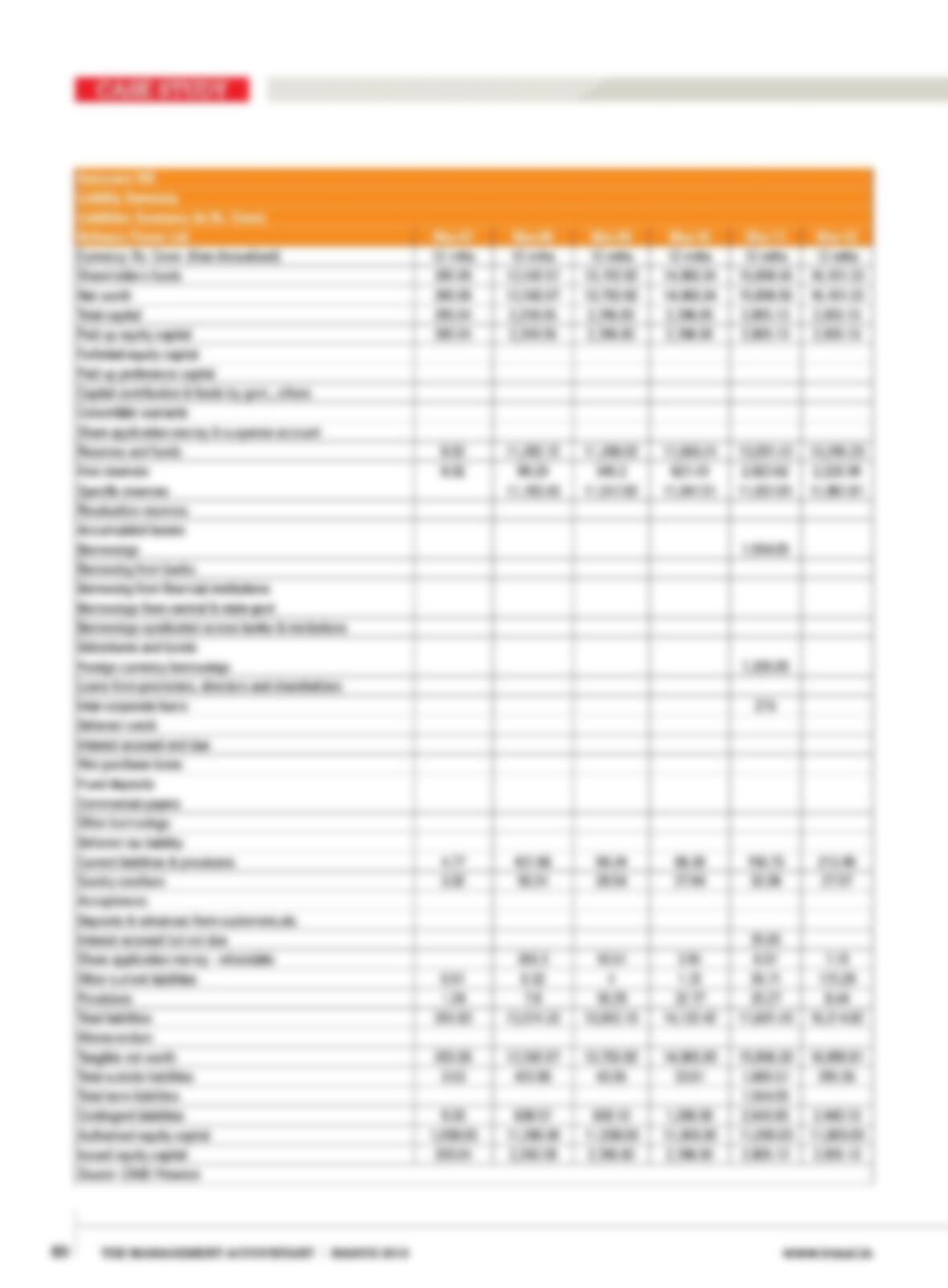
liance Power Ltd. after the IPO was good (Annex–
ure VI to IX) but not so excellent to support this
exorbitantly high IPO Pricing.
Post mortem
Several analysis and reasons were ascribed to the
Reliance Power debacle.
1) Reliance Power was a new company. It had
almost no assets and cash flow. It was riding on
the Reliance brand name and also the euphoria
in India’s stock markets. This was further aggra–
vated through the exorbitant price quoted in the
grey market before the issue. The “Power On, In–
dia On” slogan created hype and tried to portray
over dependence of India’s economic growth on
DEBACLE OF RELIANCE POwER
IPO – A CASE STUDY
Dr. Biraj Kumar
Mohanty
Associate Professor
ICFAI Business
School, Hyderabad
Pradip Banerjee
Faculty
National Institute of
Industrial Engineering
(NITIE), Mumbai
taxatIoncaSe Study

the management accountant maRch 2014
74 www.icmai.in
availability of power.
2) Indian investor considers IPO as a means of making
quick money. The shares are sold out immediately on open–
ing of the issue. This may be a reason of the Reliance Power
debacle.
3) The IPO was not helped by a souring in global market
mood as the reverberations of the US subprime and cred–
it crisis swept around the world. Between January 4, when
the IPO was announced, and the listing date of February
11, the benchmark Sensex index fell over 4,000 points, or
almost 20%, from historic highs of around 20,686 points to
16,630.91 points.
4) It was observed that few Mauritius-based foreign institu–
tional investors (FIIs) and a domestic bank ooaded almost
their entire shareholding in the company within minutes of
the opening bell.
Trading data indicated that as much as 23.77 million shares,
10.4% of the total 228 million shares sold through the Re–
liance Power IPO, changed hands on the twin bourses of
Mumbai (Bombay Stock Exchange and National Stock Ex–
change) within the first four minutes. Sell orders were made
at progressively declining prices. It was pointing towards a
pre-mediated manipulation in the dealings although an in–
vestigation by Securities Exchange Board of India (the reg–
ulatory body of Indian Stock Market) cleared the dealings
as genuine.
5) Reliance Power’s downfall was linked to aggressive
pricing of the IPO. Analysts suggested that it was over-
valued when compared with peer companies in India.
For instance, the IPO price was 450 against the price of
NTPC, (the government power company) at Rs.250/-.
RPL was planning a 28000 MW power plant in 2017
and did not have a single operational power plant whereas
NTPC had 27350 MW of operational power plant in the
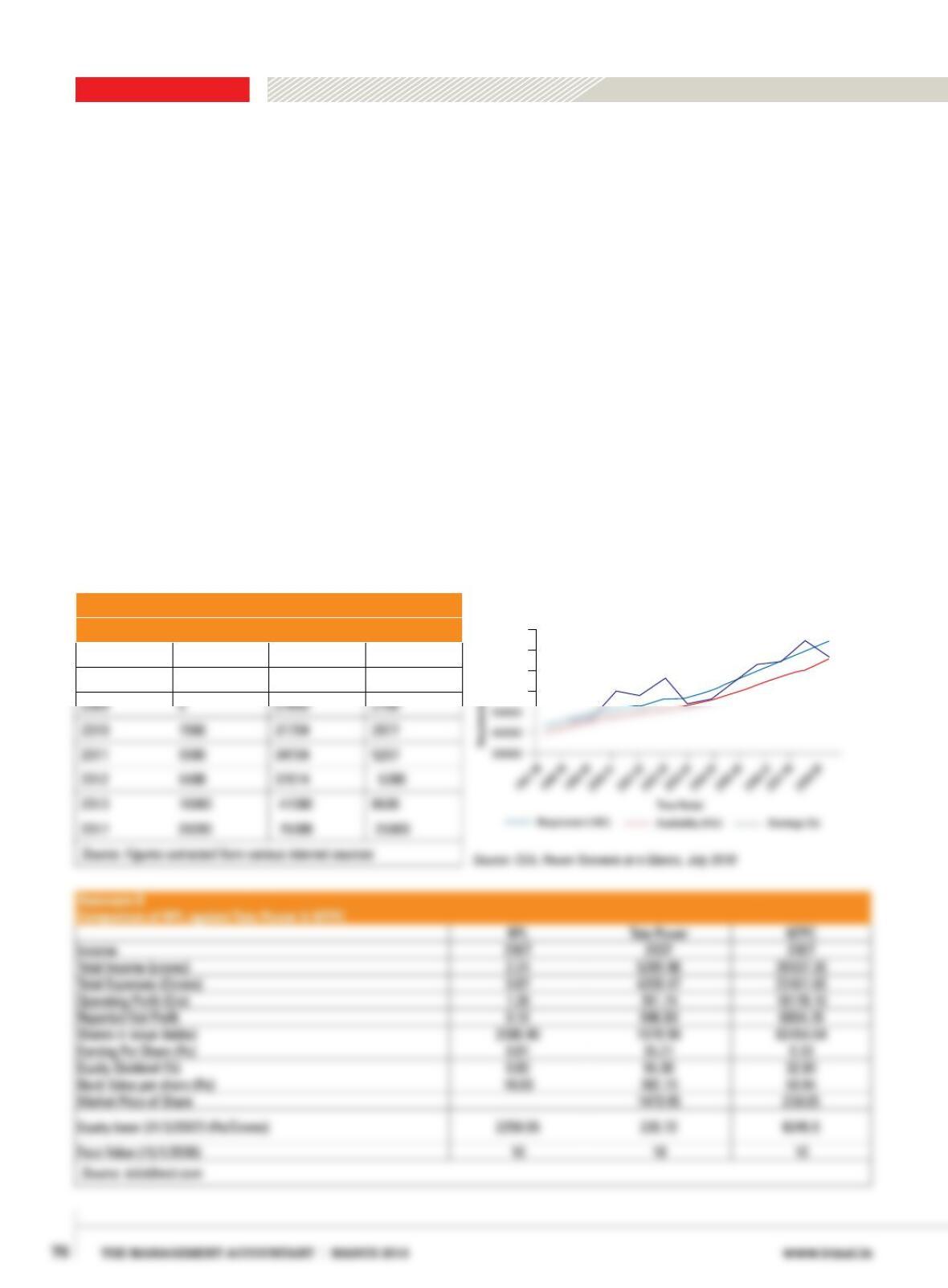
year 2007. (Annexure I). Comparison of the financials of
Tata Power and NTPC also did not show a very promis-
ing picture of RPL. (Annexure II)
On the contrary, it was advocated that the retail investors
may have been swayed by the hype, but that cannot be told
about the Foreign Institutional Investors (who have got all
the expertise and knowhow of valuation of shares).
Background of the Issue
Power Sector in India
The Indian power sector has grown significantly since
1947 and India today is the third largest producer of pow-
er in Asia. The power generating capacity has increased
from 1,362 MW in 1947 to over 160,000 MW by mid of
2010. Despite significant growth in electricity generation
over the years, the shortage of power continues to ex-
ist primarily on account of growth in demand for power
outstripping the growth in generation and capacity addi-
tions in power generation.
Historically, India has experienced shortages in energy
and peak power requirements. The average energy deficit
was 9.1 percent and the average peak power deficit was 12.8
percent between 2003 and 2010. According to projections
made in the National Electricity Plan, demand for power is
expected to grow at an average annual rate of 9% during the
11th Plan period (2007-12) and at an average annual rate
of 7% during the 12th Plan period (2012-17).The gap be–
tween demand and supply has not decreased in the last few
years, leading to persistent power shortages. The prevailing
and expected electricity demand and supply imbalance in
India presents significant opportunities in the power gener–
ation sector. (Annexure III).
Indian power sector has been regulated for almost a cen–
tury through ‘The Electricity Act 1910’ and subsequently
‘The Electricity (Supply) Act 1948’. By and large it was state
controlled through the state electric boards and the perfor–
mance of power sector was dismal during this period. As the
Indian Economy started opening up to private sector and
foreign players power sector also attracted lot of investment.
The year 2003 marked a new beginning of reforms in the
Electricity Sector in India with enactment of the Electricity
Act with lot of regulatory changes. The Central Govern–
ment came out with National Electricity Policy on 6th Feb–
ruary 2005. Now 100 percent Foreign Direct Investment
(FDI) is allowed in generation, transmission and distribution
segments. Incentives are given to the sector through waiv–
er of duties on capital equipment under the Mega Power
Policy. These policy initiatives have resulted in building up
investor confidence in the power sector and have created an
ideal environment for increased participation by the private
sector.
During December 2012, “Cabinet Committee on Invest–
ments (CCI)” was formed to enable Greenfield projects to
get the required clearances in a timely manner, including
those related to land acquisition. Eight states have revised
their power tariffs and another eight are supposed to revise
during 2013-14. A framework for Fuel & Power Purchase
Cost adjustment (FPPCA) has been approved in many of
the states during 2011-12. But still power companies are
facing the acute shortage of coal and banks do not extend
loan to power companies easily due to its lack of viability
on many account.
Reliance Group
The Reliance Group, founded by Dhirubhai H. Amba-
ni (1932-2002), is India’s largest private sector enterprise,
with businesses in the energy and materials value chain.
Group’s annual revenues are in excess of US$ 58 billion.
The flagship company, Reliance Industries Limited, is a
Fortune Global 500 company and is the largest private
taxatIoncaSe Study

MARCH 2014 tHe MAnAgeMent ACCountAnt 75www.icmai.in
sector company in India.
Backward vertical integration has been the cornerstone of
the evolution and growth of Reliance. Starting with textiles
in the late seventies, Reliance pursued a strategy of back–
ward vertical integration – in polyester, fibre intermediates,
plastics, petrochemicals, petroleum refining and oil and gas
exploration and production – to be fully integrated along
the materials and energy value chain. The Group’s activities
span exploration and production of oil and gas, petroleum
refining and marketing, petrochemicals (polyester, fibre in–
termediates, plastics and chemicals), textiles, retail, telecom,
finance, entertainment and special economic zones.
Reliance enjoys global leadership in its businesses, being
the largest polyester yarn and fibre producer in the world
and among the top five to ten producers in the world in
major petrochemical products. Reliance Companies are
widely known as cash rich zero debt companies. After the
demise of Dhirubhai Ambani , the business of Reliance
Group was divided among the two sons of the founder. The
elder brother Mukesh holds companies in Petroleum and
Poly Yarn whereas Younger brother Anil holds telecom and
power business. (Annexure IV)
Both brothers have cashed in on the goodwill of Dhirub–
hai, who died in 2002 after shaping India’s equity culture
by attracting millions of retail investors in a market that was
then dominated by financial institutions. Through repeated
public offerings of Reliance Industries since its IPO in 1977,
none of the issues went below their issue price. Dhirubhai
revolutionized the country’s capital markets by generating
billions of rupees in wealth for those who put their trust in
his companies.
Reliance Power
The younger brother Anil Dhirubhai Ambani holds the
power business. The company was incorporated in January
1995 as Bawana Power Private Limited and many times
changed its name to be finally known as Reliance Power
Limited.
The Reliance Anil Dhirubhai Ambani Group (ADAG)
intends Reliance Power to be its primary vehicle for invest–
ments in the power generation sector in the future. Other
companies of the ADAG group like REL, RNRL and Re–
liance Energy transmission have associative arrangement to
draw upon considerable expertise and resources that they
possess in the Indian energy sector. But they do not have
non-compete agreement between them. These companies
will provide Engineering, Procurement and Construction
(EPC) services, fuel sourcing and transmission services for
some of RPL projects. RPL also expects to enter into off-
take arrangements with its affiliates, including REL and Re–
liance Energy Trading.
RPL has started with an ambitious growth plan. It wants
to develop power plants on various energy sources like Hy–
dro, Coal, and Gas in various locations of the country. Simul–
taneously work has started at various plant sites. But during
the time of issue none of the plants were operational. .
Securing adequate supplies of fuel is critical to the success
of a power project. It intends to secure fuel for the projects
by seeking captive fuel sources, procuring long-term con–
tracts with domestic and foreign suppliers and entering into
supply arrangements with its affiliates, including RNRL.
RPL will source the coal needed for its 3,960 MW Sasan
project from three captive mines in the Singrauli coalfields.
RPL intends to seek supplies of coal for its supercritical
coal-fired projects, Shahapur Coal (1,200 MW) and Kr–
ishnapatnam (4,000 MW), through RNRL or third parties.
In addition, it is planning to seek supplies of natural gas from
RNRL for its gas-fired projects at Shahapur (2,800 MW)
and Dadri (7,480 MW), primarily from its rights to KG
Basin gas reserves. RPL is also considering opportunities
for securing fuel for other power generation projects with
the supplies expected to be available from CBM exploration
activities led by RNRL.
RPL intends to sell the power generated by these projects
under a combination of long-term and short-term PPAs to
state-owned and private distribution companies and indus–
trial consumers.
It also aims at achieving optimal project operating effi–
ciency through supercritical technology (beginning with
Sasan UMPP) to reduce the amount of required coal sup–
plies for the coal-fired projects and combined cycle gas tur–
bine technology to increase output for gas-fired projects.
To finance the ambitious power projects RPL has floated
the mega issue with all the turmoil in the IPO market.
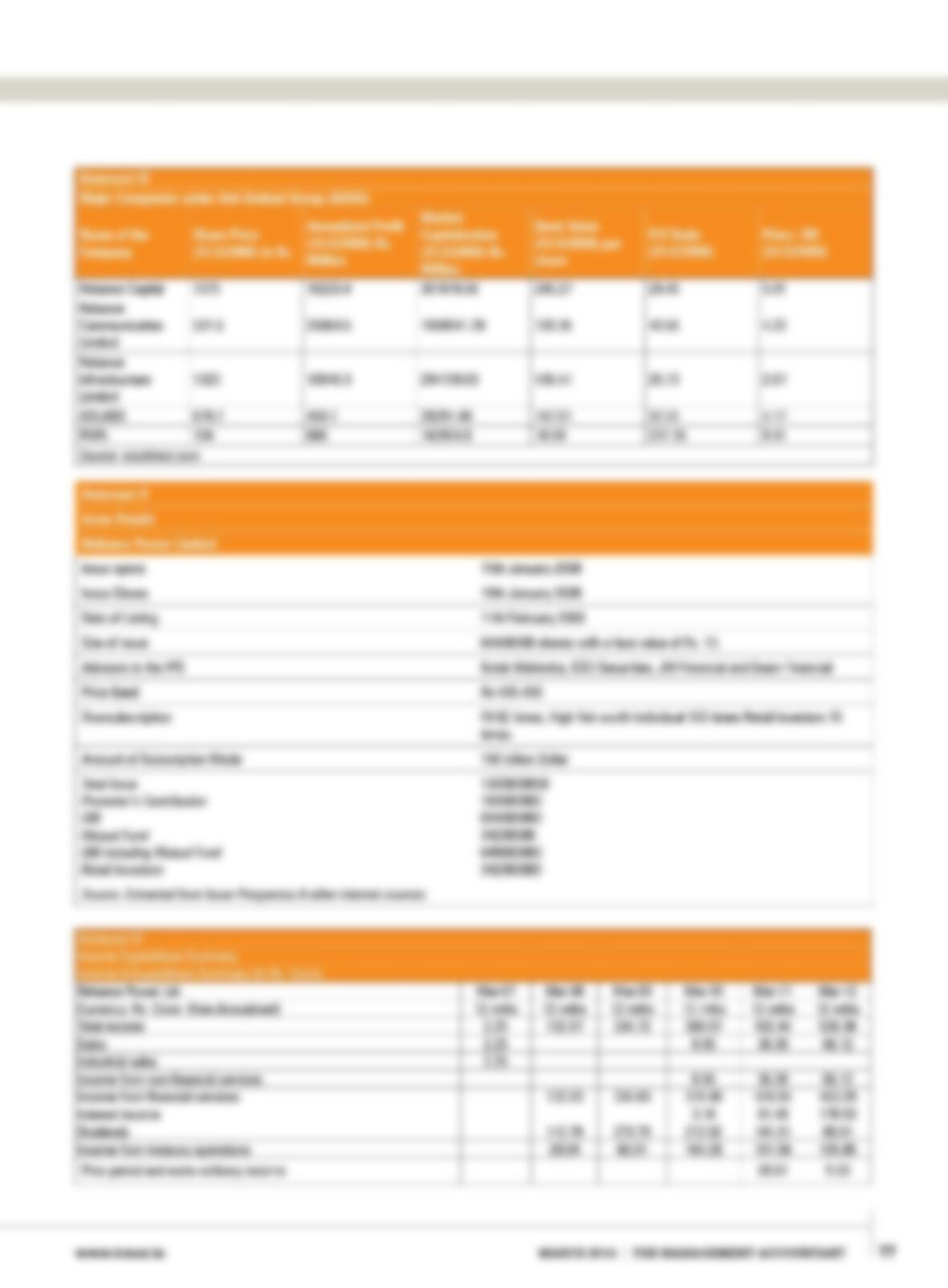
(Annexure V)
An extract from an analysis by K.R. Balasubramanyam in
Business Today, dated January 29th 2013 is depicted below
to exhibit the present scenario of Reliance Power Limited.
Billionaire entrepreneur Anil Ambani’s ambitious venture,
Reliance Power Limited, is slowly picking up. But investors
are miles away from recovering even half their investments,
let alone make profits.
Anil Ambani later issued three bonus shares for every
five shares that retail investors held, diluting his own stake
in the company. He now controls 75 per cent of the Mum–
bai-headquartered company. The stock was trading at Rs
93.40 on the Bombay Stock Exchange (NSE) at 2 pm on
Tuesday, January 29. The retail investor, who got a small dis–
count in the IPO price, will recover his investment only if
the stock touches Rs 271. On the performance front, the
company, led by Jayarama Chalasani, has been doing well.
The 3,960 MW Sasan ultra mega power project is expected
to go on-stream in the next few weeks, ahead of schedule.
The 1,200 MW Rosa power project in Uttar Pradesh oper–
ated at 103 percent load factor. At Rs 493 crore in the Oc–
tober-December quarter, EBITDA (earnings before interest,
taxes, depreciation and amortisation) rose 252 percent, deliv–
ering a profit of Rs 266 crore at the net level. Announcing
the results on January 25, Chalasani said: “The third quarter
has proved to be an excellent one for the company as we
turned in outstanding operational and financial numbers.”
Valuation & Investor Dilemma
Behavioral finance advocates that valuation of a share should
never be guided by subjective analysis. Although in this case
the indomitable reputation of reliance group, their ability to
grow at unparalleled speed, expertise in executing the pro–
ject are some of the important factors to be considered for
the valuation of IPO, a base price must be found out which
may be leveraged with the above factors. Analysts suggest
various base to value the IPO. They are
1) Dividend Discounting
2) Net worth
3) Market price of Competitors
4) Market Price of existing group companies.
It is imperative for each investor to adopt some or oth-
er method to get a base figure of the price and further
inflate or discount it on his own perception. If in general
efficient market hypothesis rules the market, an en mass
suicidal subscription & debacle may not be the roost of
the day.
It was a good performance, but analysts believe the price
at which the stock is trading is fair. The stock, they say, will
move up the price curve only if its liquidity and profits im–
prove dramatically, to reflect in its book value and earnings
per share.
Industry analysis, Promoter’s reputation in the market,
critical factors (power purchase agreement & captive supply
of coal in this case) may be few factors an investor will like
to analyze before investing in an IPO. As it seems, in spite of
all kinds of analysis the investor cannot safeguard his invest–
ment as exemplified in this case. Few failures of mega IPOs
like this have an adverse impact on the primary market of
the country.
Annexure I
Capacity Reliance Power, NTPC and Tata Power
Year/Company RPl NTPC Tata Power
2008 027350 2623
900000
800000
700000
600000
Power Supply Position
taxatIoncaSe Study
Annexure III: Power requirement vs. supply over the years