Running head: REFLECTIVE ESSAY 1
Reflective Essay
Julie Stenger
Columbus State University
REFLECTIVE ESSAY 2
Introduction
On November 14-15, 2017, I observed five classes at Little Mill Middle School in
Cumming, GA. The classes that were observed were either resource classes or inclusion classes
for math and language arts. The two resource classes were math related with one 7th grade glass
and one 8th grade class.
Resource and Inclusion Classes
Both of the resource classes appeared to be the exact opposite in meeting student needs
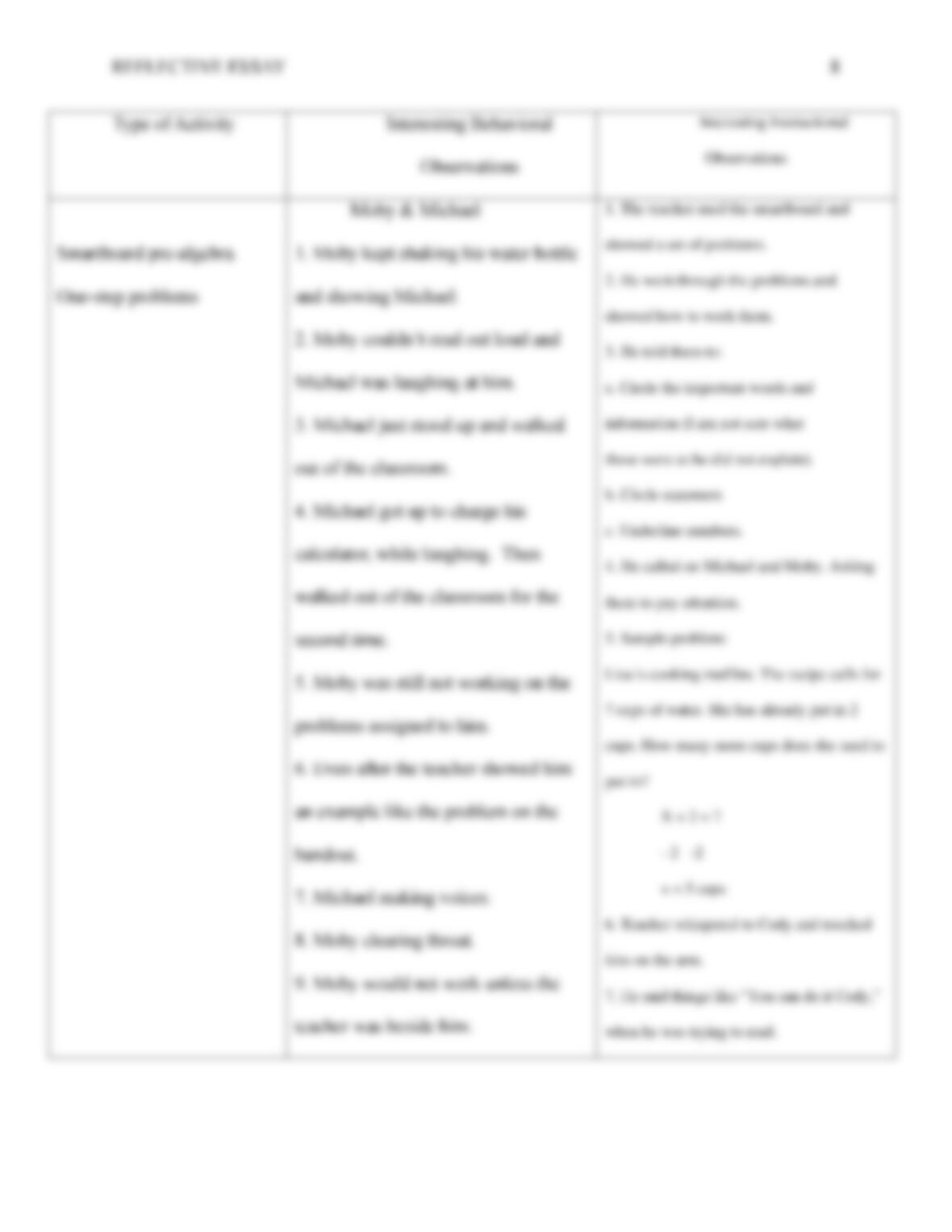
and handling behavioral issues. The 7th grade math class had two students that were constantly
talking or making disturbances during the class instruction. One of the students made the
comment that he did not know how to do it. The lesson was not tailored to his ability level, so the
student did not know where to begin. It appeared that the teacher was teaching over their heads.
It is possible that these two students were not ready for learning pre-algebra one step problems.
The teacher needed to teach to their level until reaching a point of understanding. No
differentiation of instruction was given. The only correction was the teacher correcting the
students when they were disruptive. There was no sign of tallying for punishments or rewards.
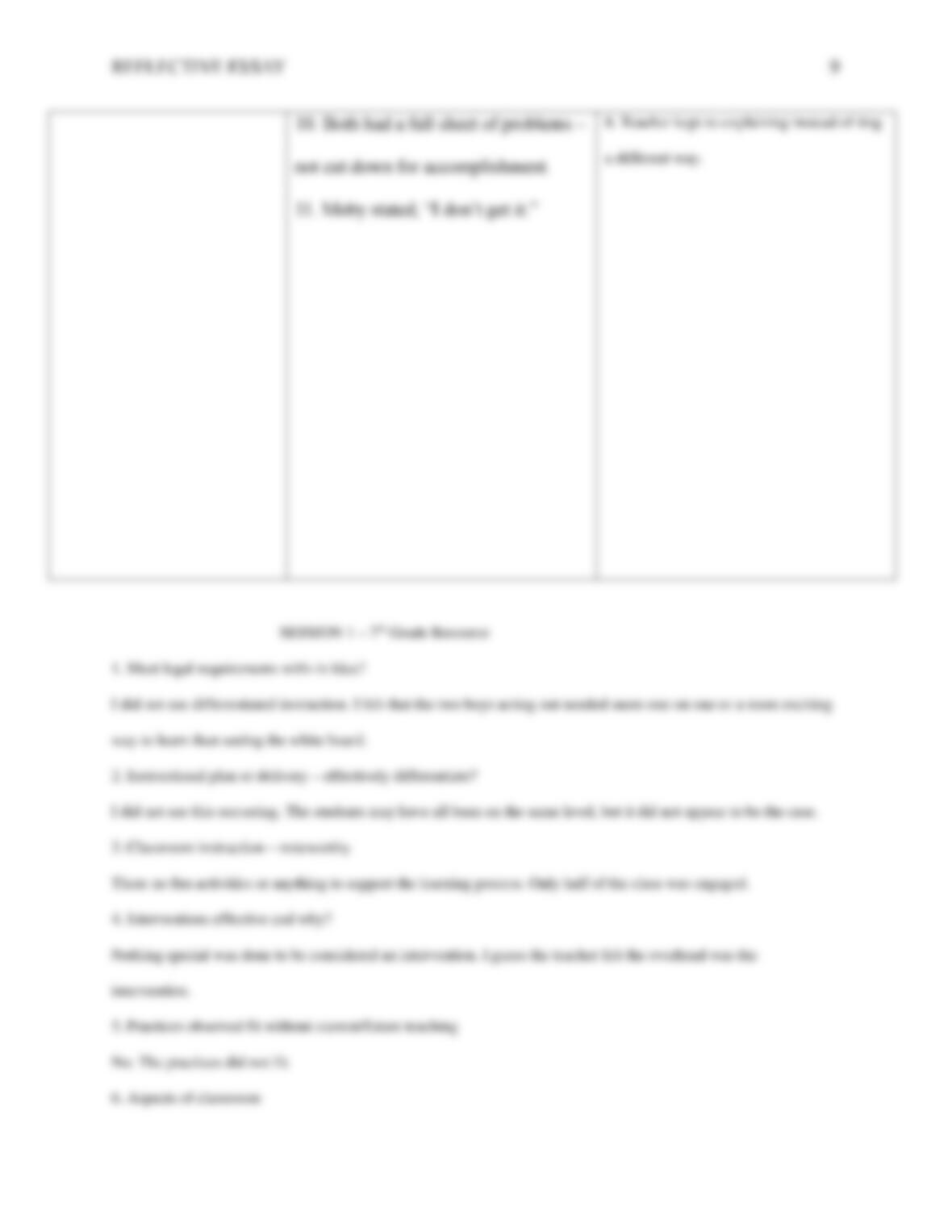
The teacher talked with Moby (the student that did not understand) and pointed to a problem
written on the board and told him to work the problem like the one on the board. The student still
did not understand, so pointing to a problem on the board appeared to be useless. If it were my
classroom, I would have at least provided the student with his level math problems or create a
scaffold program geared to the student. No interventions were implemented. In the beginning, I
was thinking that there was a behavioral issue with these students. However, as the class
progressed it was clear that the students were lost and the teacher was not meeting their needs.
This teacher appeared to need behavioral and intervention training. He was showing the students
REFLECTIVE ESSAY 3
how to work through the problem with them circling the important words, circling the statement,
and underlining the numbers. The problem was that I did not know what the important words
were to circle and it appeared that these two students did not either. He did not explain in detail
how to decide what the important words were in the math statement. The teacher did however
touch Moby’s arm and tell him that he could do it. The teacher kept explaining the same way,
instead of trying a different way.
The second resource classroom seemed to meet the students’ needs. He started off with a
Kahoot.com online quiz. The students interacted by using their computers. They clicked on an
answer and the smartboard overhead gave the number of people with the correct answer which
was zero. The teacher explained the information to the students, then tested them again. The
score was zero again. Then the teacher started over again teaching rise over run and slope. He
went through every symbol and explained them and the history. Then he went over several
problems with the class with oral instructions. The students appeared to understand and were
answering correctly with the teacher giving positive praise. Then the teacher had the students
work on the last ten problems on their own. He went around the room to watch them practicing
the work. There were no behavioral issues in this class and all students appeared to be on task.
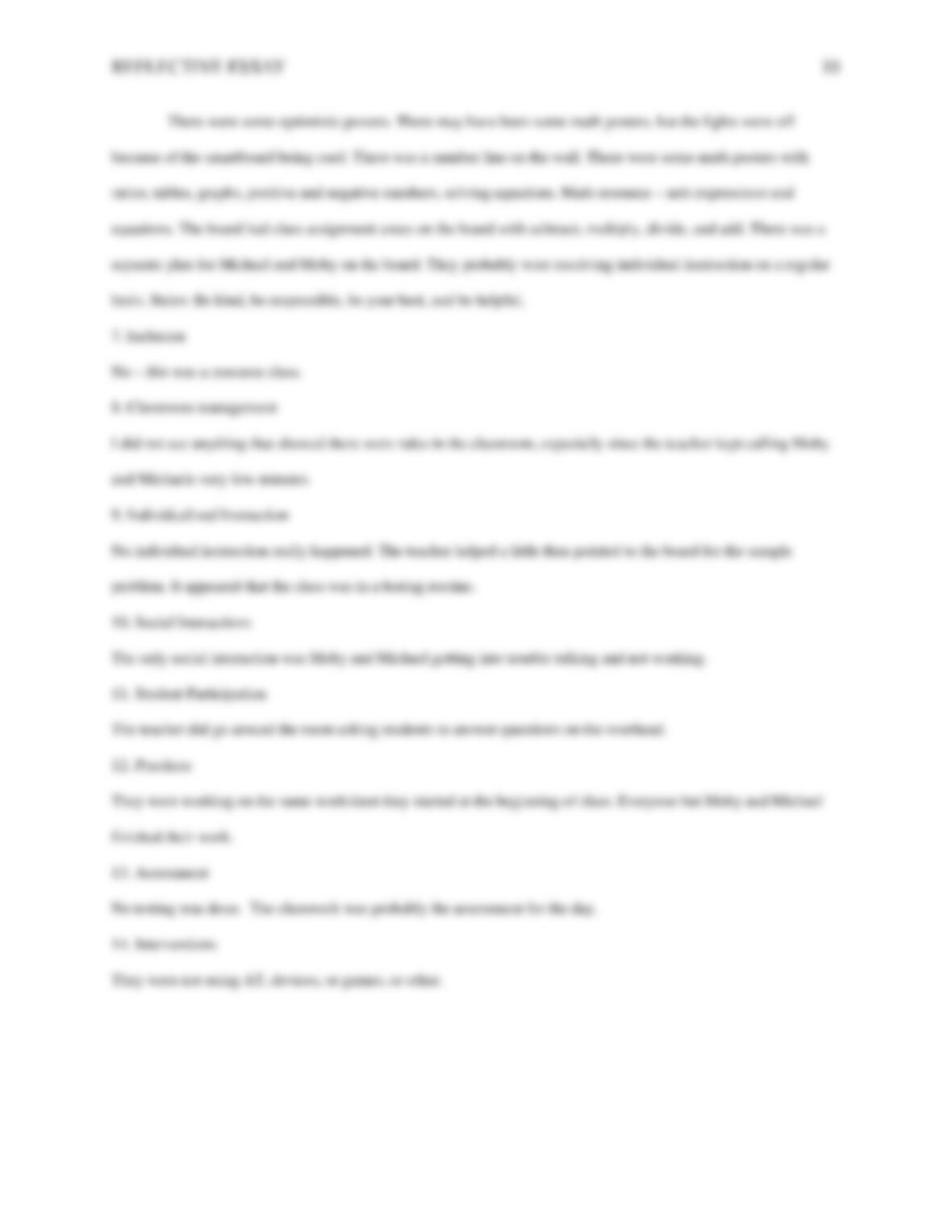
There were rules written on the board, but since no behaviors occurred it was hard to know what
the behavior plan looked like in this classroom. The teacher kept going lower for the students
each time they tested low. At the end, it was clear that the students understood the material. This
teaching was more like my style, but I did not use the overhead testing for daily documentation
of understanding. This is a good idea to keep for future use.
The remaining three lessons were with inclusion classes and they all appeared to be
focusing on the needs of the students. The classes were 7th and 8th grade language arts and 8th
REFLECTIVE ESSAY 4
grade math. The two language arts classes were having tests. The 8th grade language arts test did
not have anything going on, because they were having a test. However, I did notice that the
students had a ‘What are you thankful for…” wall. They had sticky notes all over the wall
talking about things they were thankful for in relation to Thanksgiving. The students were self-
sufficient and independent in this class. I did not see the teacher handing out the test or telling
them to be quiet. Everyone seemed to know what to do. I am not sure what the rules were for this
class, but would like to know how they created a self-run classroom.
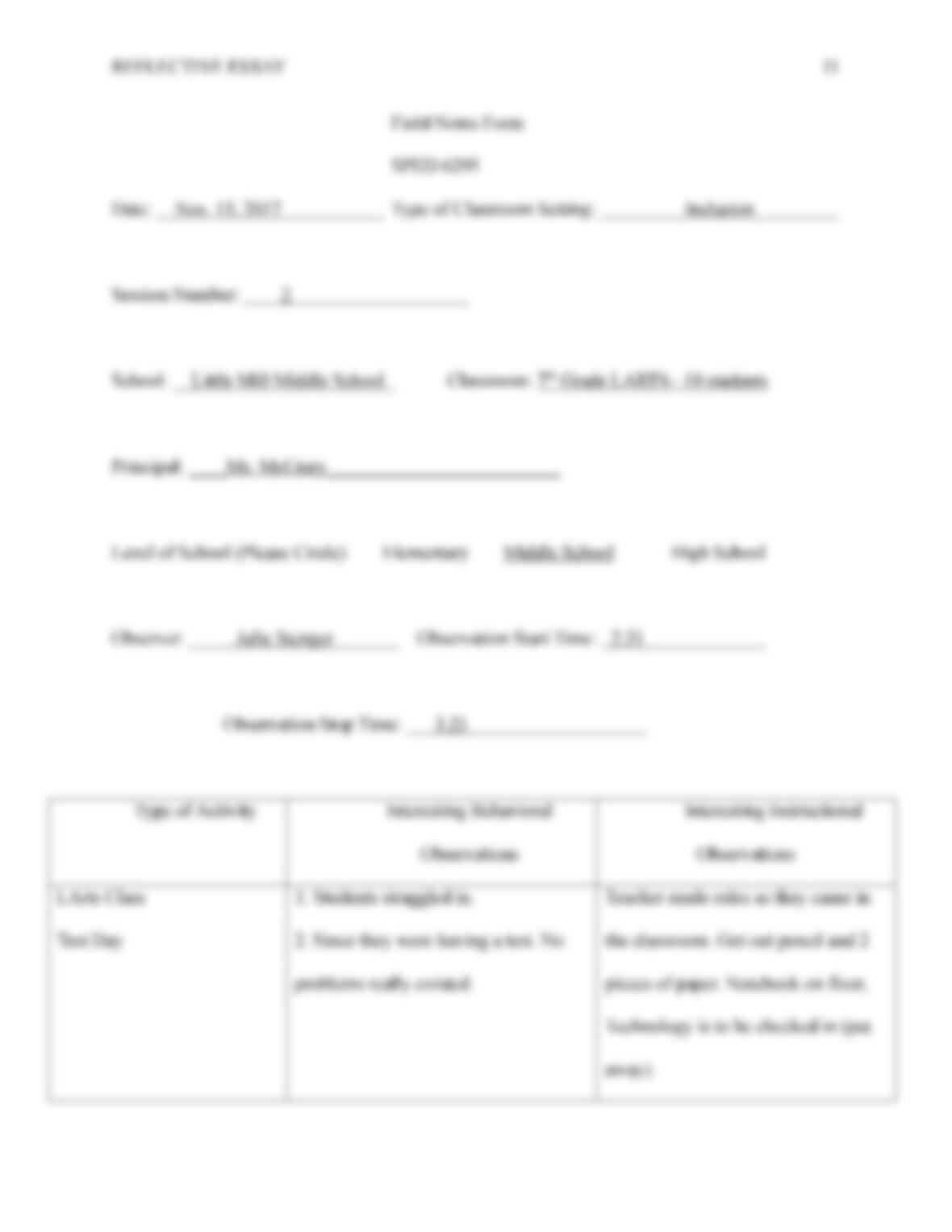
The 7th grade language arts class was also having a test, but the teacher had students
straggling in talking, but no real problems existed. The teacher made rules as they came into the
classroom regarding their needing a pencil and two pieces of paper. Next, they were told to put
their notebook on the floor. When they completed their tests, they could read a book, complete
missed assignments, or incomplete assignments. The Special Education teacher pulled the
students from the room. When we entered the other room, there were dividers and a table setup
in the middle of the room where students could not see each other. Each student was issued a test
at their level, which showed that their accommodations were followed for testing level, privacy,
and a quiet area. The teacher explained which questions to answer and which ones to disregard
for their accommodations. Differentiated testing was clearly used and they were given extra time
as well. The teacher talked with me about some of the things they were doing for the students.
Legal requirements were clearly followed. I never thought to setup the middle of the room in a
way that students could sit all around it and still have privacy or quiet areas for testing. This
setup is something that I would like to implement for future use. The teacher happens to be the
person in charge of AT as well.
REFLECTIVE ESSAY 5
The 8th grade math (algebra) class had an inclusion setup. The two teachers were a team
so that one teacher taught the first half of the class with practice problems on the overhead. The
other teacher taught the last half of the class period. A few students (three) raised their hands and
someone was there to help them work through the steps. The class was moving so quickly that I
could see that the reason students were raising their hands was related to the speed of the class.
Math is a timed subject during testing, so maybe they were trying to get students to work faster
because of the testing criteria. Since I was only observing for the day, there was no way to know
if the teachers had taught the steps in a slower and more of a scaffold approach. Since there were
2-3 students raising their hand, they should have taken the students aside and worked with them
in a more one-on-one approach. The teacher finally went back and broke the steps down further
and at a slower pace after seeing students struggling. I did not feel that they met legal
requirements, since they did not pull students aside. If students are struggling they should have
had less problems to work. The legal guidelines here did not appear to be followed, because of
no clear view of differentiated instruction. The students had a teacher come by to see them, but it
was not clear if they were understanding the problems toward the end of class. There were not
behavioral issues and all students were engaged in the lesson, so there probably unseen rules that
were a part of this classroom.
Overall the rules were being followed, but one to two classes showed that they were
clearly giving differential instruction and were meeting the needs of their students immediately.
The students observed in all of the classes were not doing group work or socializing as
much until toward the end of class or the beginning of class. I would like to see more interaction
with class lessons. Students in these classrooms seemed to have fewer behavioral problems. The
classrooms as a whole were more organized in structure and with their instructional techniques
REFLECTIVE ESSAY 6
with the students. They made sure the students understood the material and kept reviewing until
the children clearly appeared to master the material being learned. These classrooms appeared to
show more of a caring personality with the way the teachers and students interacted. I would like
my classroom to follow in this category. Also, I was impressed with the Kahoot.com online quiz
idea. It might be a good warm-up for pretesting, testing, and posting review.

REFLECTIVE ESSAY 7
Field Notes Form
SPED 6295
Date: __Nov. 15, 2017___________Type of Classroom Setting: _____Resource______
Session Number: ___1___________School: __Little Mill Middle School____________