MBA 671 Case Assignment #1 – Reed Supermarkets Amy R. Collins
1
1. What is Reed’s position in the Columbus market?
In order to identify Reed Supermarket’s position in the Columbus market, marketing
professionals use six steps to identify position and develop positioning strategies (Grewal &
Levy, 2020, p. 286). In completing these steps, they can produce a perceptual map to help
evaluate their position in market with respect to their competitors, work to identify position
changes they would like to make to increase market share, and develop strategies on how to
achieve that position change.
Reed Supermarket has been considered a high-end supermarket for at least twenty years, with a
focus on quality produce including a large organic portion, excellent customer service, and
beautiful stores. Reed Supermarket held 14% of the market share in Columbus in 2010, but held
15% market share in 2005. Reed typically attracts higher-end shoppers, a fact established by
noting that the median income of a Reed Shopper was 12% higher than the area household
average. The demographics are older, more affluent and smaller households, noting that 20% of
their shoppers have pets. Reed’s estimated annual sales in 2010 was $660M, the highest sales of
any other single competitor. The CEO’s push to increase Reed’s market share to 16% led
Marketing Vice President Meredith Collins to investigate positioning and use market research to
develop a strategy (Quelch & Carlson, 2011, pp. 2-7).
In the development of a perceptual map to further characterize Reed’s position in the market, we
first want to determine the consumer’s perceptions and evaluations of Reed in relation to
competitors. In Exhibit 3 in our Harvard reading, we see comparisons of quality and price. I’ve
used data from 2010 in this exhibit to create the following perceptual map staring (*) the
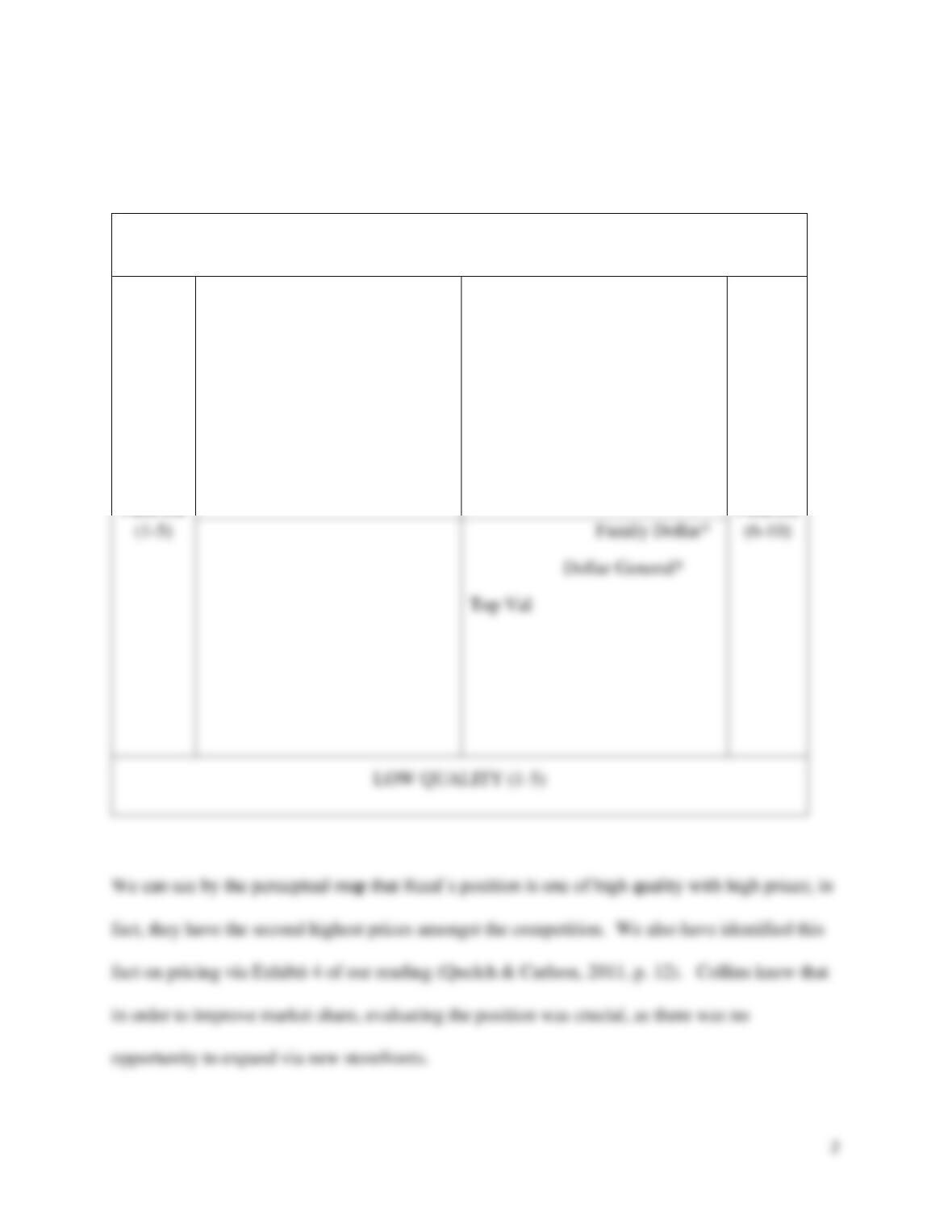
MBA 671 Case Assignment #1 – Reed Supermarkets Amy R. Collins
competition which has made strategic market changes in the last 5 years and seen as a possible
threat.
HIGH QUALITY (6-10)
HIGH
Whole Foods*
REED
Delfina
Galaxy
Trader Joes*
Costco Walmart
Aldi*
LOW