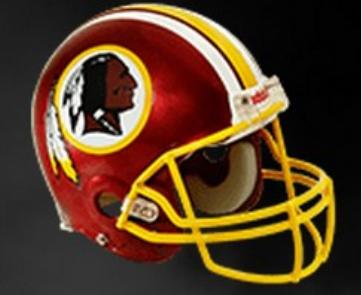
What’s In a Name?
Powerful Forces Are on the Warpath
Against a Professional Sports Team Brand
Juliet: “What’s in a name? That which we call a rose
By any other name would smell as sweet.”
William Shakespeare: Romeo and Juliet (II, ii, 1-2)
Introduction
Even before its National Football League (NFL) season began, the Washington Redskins
professional football team was facing a number of difficult scrimmages – powerful forces
attacking from different angles – all part of a broader effort to force the team to change its brand
name, logo, and mascot. Supporters believed that the team’s name – Redskins – and its logo
“represent the very best of the noble qualities exemplified by Native Americans.”1 But for
detractors, the name was thought to be “a stubborn disregard for the feelings of Native
Americans who find it demeaning and offensive and an irrational fear of losing your NFL
identity.”2
All entities involved knew that the Washington Redskins’ name controversy was decades old –
dating to the early 1970s when several prominent Native Americans led a movement to help
those living on Indian reservations in the United States to gain greater control over issues
concerning their communities such as education and economic affairs. Jack Kent Cooke, who
owned the Redskins team and the franchise from 1974 (about the time the controversy began
publicly) until 1997, had always been adamant about keeping the name. The subsequent
Redskins team owner, Dan Snyder, appeared to be equally insistent that the name should not be
changed.
Although there had been some signals in earlier years, the issue seemed to be reaching a critical
point, and Dan Snyder found himself at the center of the controversy. He once had instructed
reporters to use capital letters when quoting him, saying that he will “NEVER change the [team]
name.” He felt strongly about his pledge to keep the team’s current brand name, logo, and
1

mascot, but he also felt that it was his duty – as team owner– to evaluate both sides of the issue
at hand. He was, after all, also the primary investor in Red Zebra Broadcasting – home to the
Redskins Radio ESPN. In 1996, he had become the youngest ever CEO of a New York Stock
Exchange listed company (Snyder Communications) at the age of 32. He felt it was incumbent
upon him to learn more about whether a brand such as the Washington Redskins should continue
to take a stand.3
Origin of the Term “Redskins”
Some scholars believed that the term “redskins” was coined to differentiate Native Americans by
the tone of their skin color. Others maintained that the name referred to the color of body paint
used by certain Indian tribes for ceremonial and other purposes. European settlers used the term
to identify all Native American parties while negotiating treaties. The name was also used to
identify people’s origins by skin color such as white men, black men, and red men.
Ives Goddard, a senior linguist and curator emeritus at the Smithsonian Institution, asserted that
the term “redskins” was originally benign in meaning, and indicated early positive relations
between Native Americans and “whites” (European settlers). Goddard cited historical instances
where Native Americans identified themselves as red men, or RED-SKIN, and redskins.4
Johnathan Buffalo, historic preservation director of the Meskwaki Nation, an Indian tribe,
maintained that tribal members in the 1800s used the term “redskins” simply to identify
themselves — just as they identified others as “whiteskins” or “blackskins” — without any
derogatory connotation.5
A linguistic analysis of 42 books published between 1875 and 1930 indicated that negative
contexts in the use of “redskin” were significantly more frequent than positive contexts; whereas
the use of the word “Indian” to refer to Native Americans in similar contexts was more
balanced.6 American dictionaries classified the term “redskin” as offensive and disparaging.7 8
Nevertheless, NFL Commissioner, Roger Goodell, defended the team’s name by affirming:9
The Washington Redskins name has from its origin represented a positive
meaning distinct from any disparagement that could be viewed in some other
context. For the team’s millions of fans and customers, who represent one of
America’s most ethnically and geographically diverse fan bases, the name is a
unifying force that stands for strength, courage, pride and respect.
The argument for an independent, non-derogatory meaning of the term in the context of the
team’s name was rebutted by the U.S. Patent and Trademark Office’s Trademark Trial and Appeal
Board (USPTO TTAB), which rejected the Washington Redskins’ legal argument in 2014 by
stating that dictionary definitions and general usage of “redskin” place the term in a negative
context.10
Public Opinion
Roughly two-thirds of the U.S. public did not think the name was disrespectful, but that
percentage had been falling – albeit slowly – for a number of years.11 One poll found that eight
out of 10 Redskins fans felt the team name should remain the same, and there was some evidence
2
that a name change could undermine support from the team’s most avid fans.12 Other polls found
that percentage to be somewhat lower. Among other factors complicating the thorny issue: The
media reported that “Red Mesa Navajo High School in Arizona [located on the largest Indian
reservation in the United States] is proud of its football team’s moniker: the Redskins.”13 In
contrast, California’s State Assembly “approved legislation barring California public schools
from using the Redskins name for teams and mascots.”14
Controversy aside, Redskins team and staff members continued to show up every summer on
schedule at their state-of-the-art Bon Secours Virginia Health System training camp facility in
Richmond, Virginia, to prepare for each season. Despite the success of training camp events –
both from the perspective of fans and from the perspective of the City of Richmond and Bon
Secours – team owner Dan Snyder faced a number of lingering concerns as the next season was
about to begin, including 1) potential legal and regulatory actions emanating – somewhat
ironically – from the team’s historical home town of Washington, D.C., 2) policy changes on the
part of publishers and broadcasters regarding use of the team’s name, 3) a growing number of
negative editorials in major U.S. newspapers and media outlets, and 4) the changing tide of
public opinion.
Even President Barack Obama had taken sides, saying publicly that “the Redskins should change
their name.”15
Despite his apparently immutable position, Dan Snyder couldn’t help but consider the marketing
and public relations challenges that were facing the historic and valuable Redskins brand.
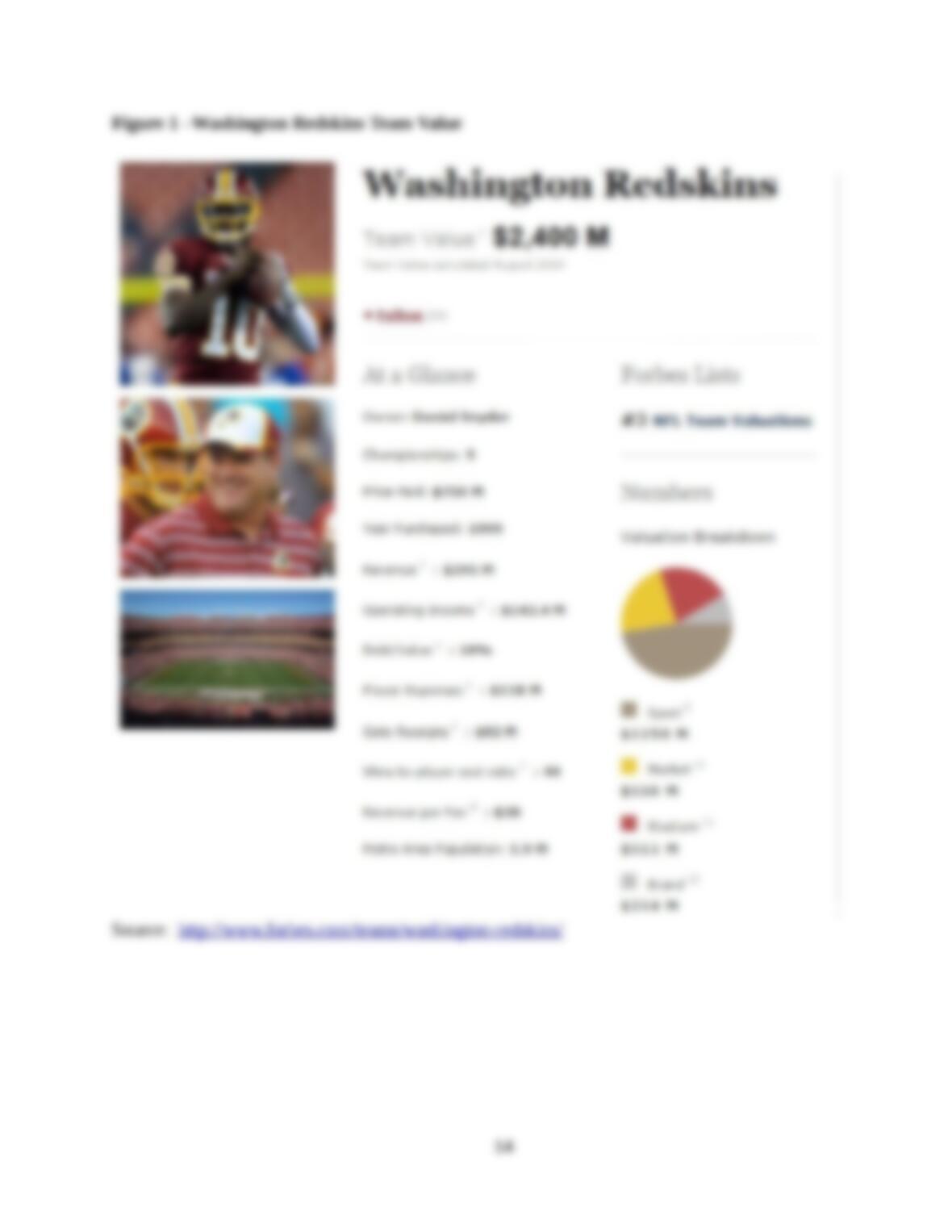
Dan Snyder purchased the team in 1999 for $750 million. In recent years, Forbes
magazine had estimated the value of the Redskins team to be as much as $2.4 billion
(Figure 1). The Redskins brand itself was estimated to comprise $214 million of that
valuation.16 The Redskins team was thought to be the third most valuable NFL franchise
(out of 32 teams), behind the Cowboys (#1) and the Patriots (#2). How would this
controversy affect the brand’s value in the marketplace?
A relatively steady stream of distracting publicity was a problem. All one had to do was
to conduct the internet search “Washington Redskins name controversy” to get a plethora
of search results from news and opinion sources describing one complaint or another
from entities representing both sides of the controversy. Was this unwanted distraction a
temporary phenomenon, or would it persist?
Although most Redskins’ sponsors appeared to be willing to “sit out” the controversy
over the team’s name,17 a number of them periodically stirred up some fiscal uncertainty
for the franchise/brand. Could the team count on the continued support of key corporate
sponsors?
Should Brands Take a Stand?
3
With the growth of the internet and social media, it had become more and more difficult for
brands to avoid controversy by “taking a stand” on almost any issue. The list of brands that –
either intentionally or unintentionally – had attracted the wrath of disapproving consumers
continued to grow:18
Chick-fil-A, a privately-owned fast food company, was closed on Sundays and made no
apologies for letting it be known that Christian values guided how it conducted business.
In-N-Out Burger, whose chain’s founder was a born-again Christian, had been taking a
pro-Christian stance for years, including imprinting references to Bible verses on drink
cups and celebrating Christmas with an iconic radio jingle with an overtly Christian
message.
Lowe’s never anticipated that when it bought advertising time on the reality series “All-
American Muslim,” the retail giant would get caught between consumers who were angry
that the company pulled its advertising support and others who disapproved of the series
altogether.
The Pepsi Refresh project was intended to fund community non-profit organizations
without political ties, but project managers inadvertently approved a number of
applications “from groups with loose ties to political parties,” so some very vocal
consumers were upset.
Starbucks CEO Howard Schultz was not one to shy away from controversy, having stated
publicly and forcefully on a number of occasions his company’s unwavering support for same-
sex marriage, and serving as the face of the Starbucks’ campaign to encourage customers to talk
about race relations by asking baristas to put the slogan “Race Together” on coffee cups. But
negative publicity forced Mr. Schultz to backtrack. Starbucks stopped the in-store, cup-labeling
aspect of its “Race Together” campaign fairly quickly, based on social media backlash; however,
it did not abandon its support for the controversial cause. Mr. Schultz vowed to continue
Starbucks’ support for improving race relations.19
It had become apparent to business leaders that the digital/social media had likely forever
changed the dynamics of cause marketing. In the past, cause marketing was a fairly safe “bet” in
terms of motivating employees, solidifying a place in the community, mobilizing consumer
interest, and boosting the bottom line. However, consumers had become quick to take to social
media to point out when either unforeseen circumstances or changing public opinion rendered a
company’s cause-marketing strategies counterproductive. No longer could CEOs and CMOs
assume that “everybody loves a good cause.” Rather, they would have to:20
Be realistic – Understand that selling a cause and a product are two different things and,
in many cases, cannot be perfectly aligned.
4
Ask hard questions – What will the brand or company do if the good cause becomes
tarnished? What happens if profits decline? The leadership team should be able to
debate the overall value of the effort in the larger corporate context.
Gather perspectives – Don’t be myopic, get out of the corporate silo. Consult with
customers, front line employees, and other relevant publics to get their opinions about the
risks and benefits of the plan.
Be flexible – Make sure that the cause marketing campaign is adaptable enough to
counter whatever pressures the competition and other external forces exert.
Have courage – Understand that most cause marketing campaigns – either well-
conceived or imperfect – eventually will come to an end.
Although the team-name controversy was not a “cause” in the traditional sense, Mr. Snyder and
his executive team felt they were engaged in a cause on behalf of Redskins’ fans, supporters, and
sponsors. Also, they thought it might be possible to learn something about dealing with
controversy from cause marketers like Starbucks.
After all, most brands tended to shy away from controversy, but some brands found ways to
benefit from it. Co-authors Melissa Dodd and Dustin Supa observed: “When companies engage
in controversial social-political issues they ultimately risk the loss of profits and attention of