The Steps it Took to Get the Meat
to the Market
Sariah Avila
AnSci 200
T-TH 8:30
Introduction
There is a high demand for red meat products here in the United
States. Many people nationwide consume red meat products, however,
not many know what goes into getting those products at the stores.
There is an entire process that goes on behind the scenes. It is what
happens at the farm and the harvesting facilities that gets the red meat
products to the consumers. This entire process starts in the hands of
the producer that raises the animal for a few months, then the next
stakeholder is the packer, who is responsible for the carcass of the
animal and transporting the wholesale meat to the stores and then to
the consumers.
In this project I will go in depth in what steps it took to get the
animal at the farm to the meat in the package in the store. In order to
do this, I will go through the perspective of the producer, buying an
animal, feeding it, then selling it when it is market ready. Then I will go
through the perspective of the packer, buying the live and market ready
animal, then harvesting it and getting wholesale cuts that will
eventually become retail cuts. Finally, I will go through the perspective
of the consumer, purchasing the retail cuts at the store.
Through this process I will so where money and value are gained
or lost. I will see who benefits most from the process and where the
most money is made, depending on species.
Red meat is vital to our modern society, because not only is it
tasty, but it also adds lots of nutritional value. Meat is high in countless
nutrients needed by the human body and it can easily be consumed
and broken down. It makes getting the vitamins and nutrients
necessary very convenient for the consumer.
Table of Contents
I. Producer Perspective
a. Purchase Prices
b. Feed Costs
c. Overhead Costs
II. Packer Perspective
a. Carcass Values
b. Wholesale Values
III. Consumer Perspective
a. Retail Cuts
b. Grocery Store Value
c. Retail Price Chart for Beef
d. Retail Price Chart for Pork
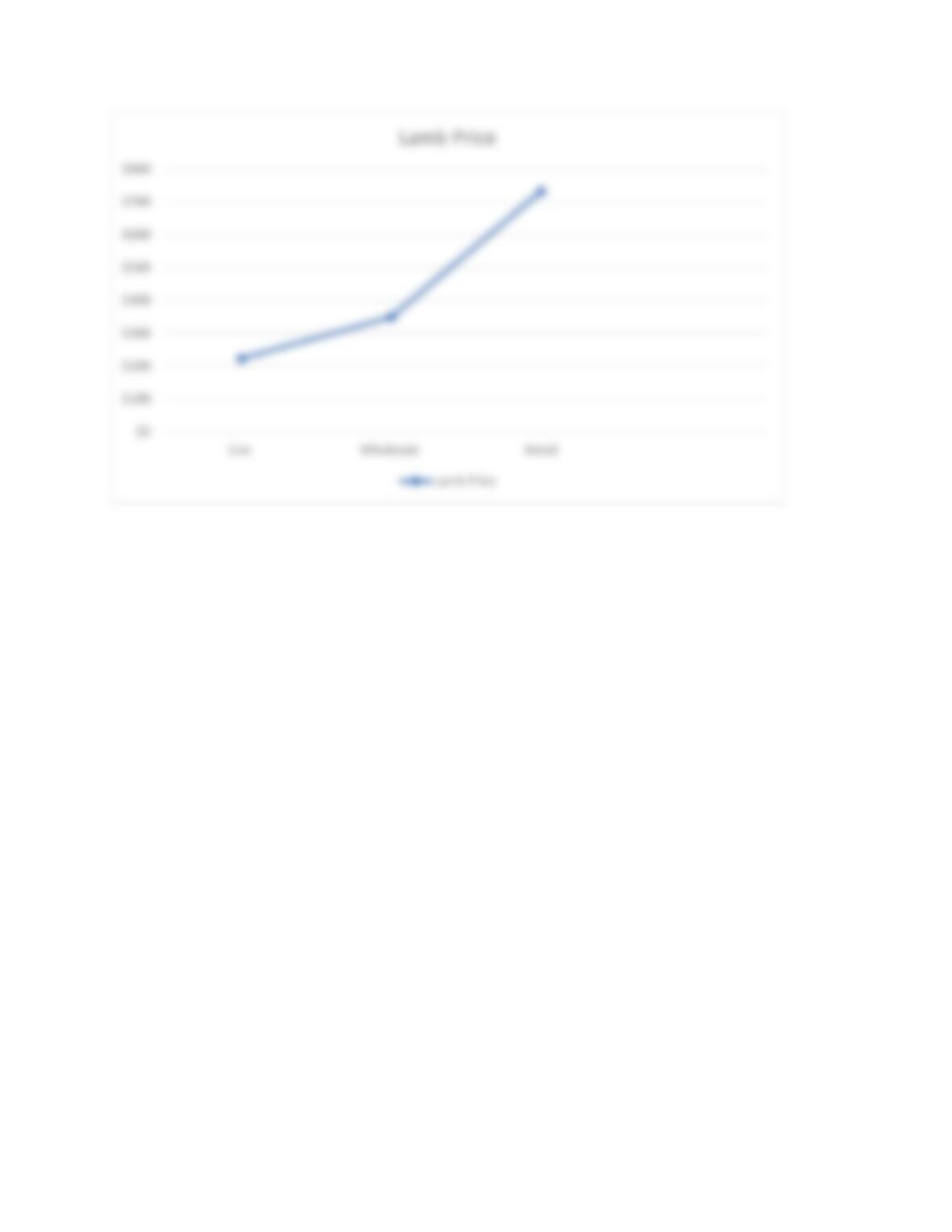
e. Retail Price Chart for Lamb
IV. Summary
a. Opinion on meat value
V. Supplemental Information
a. Charts and Graphs
VI. Works Cited
I. Producer Perspective
This project begins at the auction yard. Starting with the steer.
To buy a steer at the Escalon Livestock Market on Monday,
September 16th of 2019, ranging from 500-600 pounds is on
average 1.95 a pound. That would make the purchasing price
$1,170 for a 600-pound steer.
After purchasing a steer, the next order of business is to feed it.
For feed, we will need 2,500 pounds of grain. At Melvin T.
Wheelers and Sons, located in Modesto, one 50-pound sack of
the Farmers Best Feed-Beef Grower is $13.75. It would take 50
sacks of grain to raise the steer to market weight so that means
that is would cost $687.50 to cover the grain costs for the
steer. The steer will also need to be fed alfalfa hay 3-4 times a
week, which would require 5 bales to get the steer to market
weight. Also, at Melvin T. Wheelers and Sons feed store, a bale
of #2 quality alfalfa hay costs $13.50 making the total cost of
alfalfa for the steer $67.50. The next necessary item to feed
out the steer is grass hay, after doing some searching, I could
not find a price by the ton of grass hay. The quote that I got
was from Bertuccio Hay service in Merced, the price per bale of
grass hay was $11.00 and each bale weighs about 100 pounds.
To get the necessary 6 tons you would need 120 bales at 100
pounds. The total price for grass hay to feed the steer would be
$1,320. Adding all the feed prices, the grain, alfalfa and the
grass hay, come out to $2,075. There is no labor cost for
raising the steer, our time is donated, but there is an overhead
cost of 150 dollars.
After feeding out the steer and getting him to the proper
weight and maturity, it is time to sell him, so now we need to
go back to the sale yard. The only numbers that I could find for