Rain Harvesting in
Australia
Kenya Lopez
HNRS 3300 The Politics of Water
Professor Jeremy Busacca
1
Transforming the Future
In the last years, the attention of many communities has been changing to one of
the most importance resources our humanity needs to survive. “Water.” The water
available for consumption in rivers and lakes are being depleted at advance rate that many
of them do not reach the sea any more. Underground reservoirs are also limited. Others
had disappeared, such is the case of the Aral Sea in Central Asia. The press talks about
concept that we wouldn’t see it three to four decades ago, as “water scarcity,” “water
shortage,” “water importation.” Now, we can even track where our water goes in imported
and exported goods with the “water footprint” concept. Our global water problems are not
new, since 1985, Boutros Boutros-Ghali who became Secretary-General of the United
Nations years later announced that “the next war in the Middle East will be fought over
water, not politics.” More recently in 2013 Ban Ki-moon the current secretary of the United
Nations warned in 2013 that our world “was on course to run out of freshwater unless
greater efforts were made to secure water supplies.” (Richter 9) In response to the
multiple necessities regarding water scarcity, many countries are using different methods
to improve their problems. For example, Saudi Arabia is the number one country
using desalination plants, Israel is the global leader in water reuse, and China is
the actually investor of millions of dollars in projects diversions and dam constructions.
Another not too common method used in a few states is Rainwater Harvesting (RWH)
being Australia one of the principal countries that uses it as an integral part of sustainable
water management.
2
Australia had one of the most remarkable recent critical droughts periods in the
world was in the Southeastern area from 2001 to 2009. It was called the “Millennial
Drought,” according to the Australian Goverment’s Bureau of Meteorology, this period
was the longest uninterrupted period below median rainfall in this area since
1900. Australia was shock, and its people was scared. One of the positive action from this
critical time was that the government acted quickly by making a series of measures and
adjustments in the way their water was used. The aim was to reduce consumption, and a
better sustainable water management. Using RWH as one of the options which requires
inducing, collecting, storing and conserving local surface runoff for agricultural
production, domestic uses and groundwater recharge. (Ramhman and Hajani) The
Australian Bureau of Statistics reported that “over 2.3 million Australian households used
a rainwater tanks as a source of water in 2013.” (ABS Web) A more recent data belongs to
the Rainwater Harvesting Association of Australia which is the national representative
body of the Australian RWH industry organization which supports 5.1 million Australians
who own a rainwater tank. Therefore, the question for this modern and creative method but
at the same time simple would be: Is rainwater harvesting through the use of charged
systems truly working as a solution for water conservation in Australia?
To understand why RWH is so important in this country, we must first understand
its climate. After Antarctica, Australia is considered the second driest place in the
world. Nearly 20 % of Australia’s land mass is classified as desert. As well as having a low
average annual rainfall, which is also variable. The rainfall pattern is concentric around the
extensive arid core of the continent, with rainfall intensity high in the tropics and some
coastal areas. (Australia Government WEB) The mean annual rainfall in arid regions
is typically below 300 mm, (approximately 18 inches) the problem in these areas is that
evaporation rate can be as high as 2000 mm annually (approximately 122 inches.) That’s
way capturing water for different purposes is so important.
Australia catch rain water by installing roof drainage system. The New South
West Government throughout out the department of Planning & Environment published
the Interin Rainwater Harvesting System Guidelines in May 2015 to make sure that
citizens have the necessary information regarding, rainwater tanks, storage, treatment,
distribution, inspection and maintenance. There are three different roof drainage system.
First, Gravity systems comprises one or more tanks distributes around a building fed
directly by downpipes. The tanks are typically located under or near downpipes. Multiple
gravity fed thanks on a site can be connected by below ground pipes to regulate the
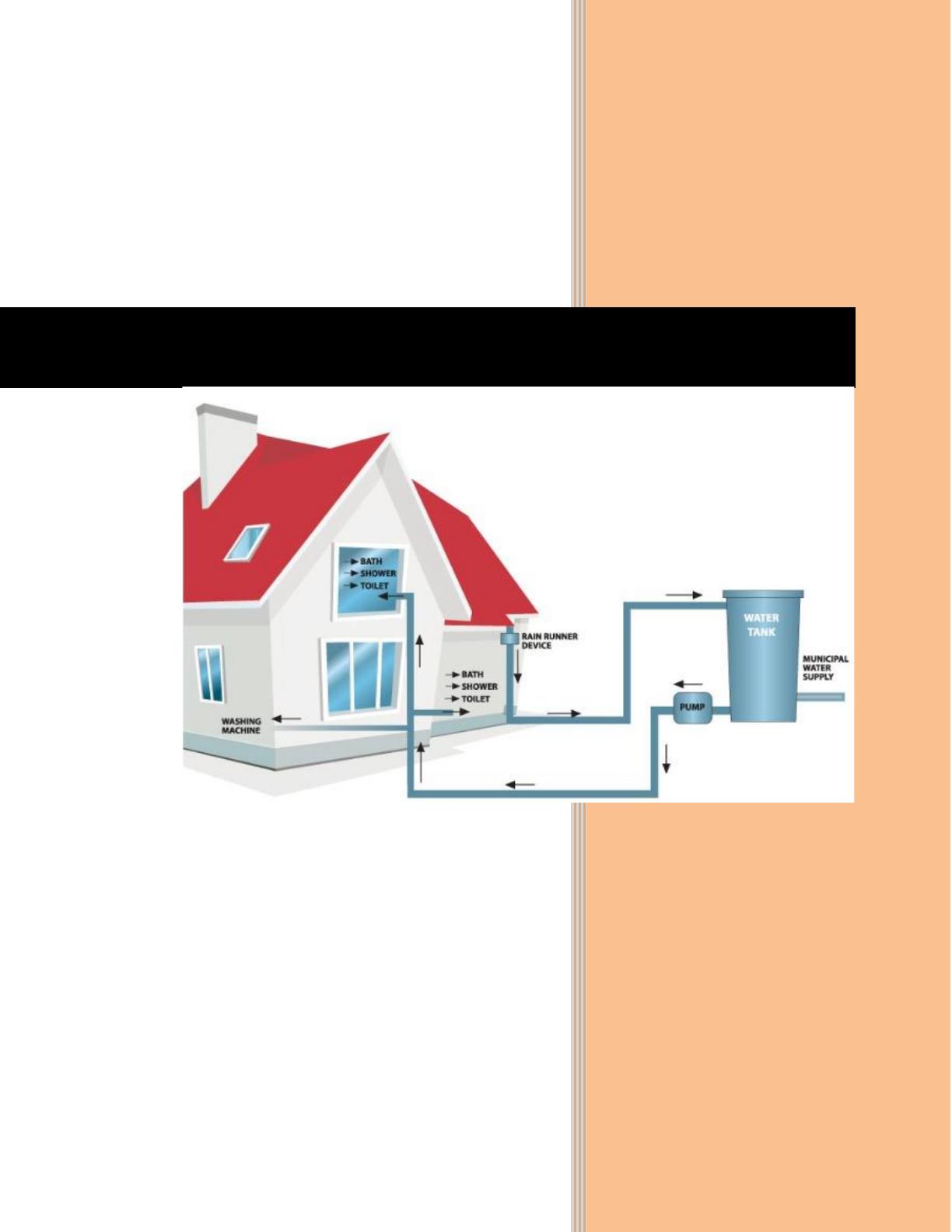
storage in each tank to the same level. Second, Charged Systems are commonly installed