1
Halyna Mashura
GSS 3240
20 March 2016
Life during Deportation
Imagine one day waking up and having your whole world flipped upside down, being a
normal citizen with neighbors who adored you, a steady job, a beautiful home and loving family.
Than an announcement that you have lost all your rights, followed by your businesses, and
ultimately your home. This prefaced one of the most haunting events in the history of the world.
The industrial murder of millions of Jews known as the Holocaust. When delved into, this mass
murder would not have been possible if it wasn’t for the combination of resources between the
military and the train stations, specifically the Reichsbahn and Ostbahn (German and polish
railways). Together these two would use roughly 2000 trains to implement the radical notion of
what was the “Final Solution”. As Gigliotti perfectly concludes in her book The train journey:
Transit, captivity, and witnessing in the Holocaust, “The deadly use of railways was history
making for Germany, and marked the end of the Jewish people in Europe” (Gigliotti, 36). 1It is
this part of the Holocaust that I fixate on in my research, concentrating on the various
deportations of the Jewish population all throughout Europe. Through the use of various books
and the irreplaceable testimonies of survivors through their memoirs to gain knowledge on the
dehumanization they had to undertake through their deportation, how they were made to feel like
animals. As well as events that occurred before, during, and after transport and how ethics at
times were called into play.
1 Gigliotti, S. (2009). The train journey: Transit, captivity, and witnessing in the
Holocaust. New York: Berghahn Books.

2
Before diving into the memoirs and personal accounts of the survivors used in this study,
the feeling to introduce the deportations from a German perspective is paramount to grasping the
heresy of the events intertwined with “resettlement”. Resettlement, a word when seen too many
is innocent in intentions, but throughout history it is closely associated with atrocity. As Gigliotti
informs us, for the Nazi’s the ingenious implementation of this word was vital for the execution
of the final solution, due to the innocence of its meaning the idea of just being resettled for most
helped prevent panic and rebellion of Jews which if occurred would result in what the Nazi’s
considered as a waste of resources. As Gigliotti explains the reluctance to use resources was not
for the most part the case, “roundups for deportation, surveillance of deportees in transit…were
accompanied with deliberate and random acts of perpetrator violence, abuse, and killings”(4)2 .
The process of deporting Jews were never spontaneously performed, they were months in
advance planned, well organized and financially prosperous for the rail companies involved. As
Gigliotti notes “in train inventories Jews were referred to as Stücke, quantities to be identified”
(37)3, to these monopolies on killing, Jews weren’t even humans, they were objects to be
transferred. A question provoked is how was this all paid for? Where did the money come from
that paid for these journeys because after all the rail companies did not do this for free and the
Nazi government did not want to allocate all its resources to this process? Than the answer came,
as Gigliotti explains: Jews would have their belongings confiscated upon arrival at the station by
the Nazis. This created a partially true notion that the Nazi’s kept what they took for themselves.
As true as that may be it is not the truth in entirety, the soldiers could keep whatever was left,
however it was after the fee for transport was paid in entirety. A fee that included for adults: 4
2 Gigliotti, S. (2009). The train journey: Transit, captivity, and witnessing in the
Holocaust. New York: Berghahn Books.
3 Gigliotti, S. (2009). The train journey: Transit, captivity, and witnessing in the
Holocaust. New York: Berghahn Books.

3
pfennig per kilometer; children: 2 pfennig per kilometer; Soldiers: 1.5 pfennig per
kilometer; as well as a fee for the supply of the trains. Himmler’s answer to all this was simple,
they used the Jews belongings to cover the fee’s in question, the Jews not only were being sent to
their demise but also were being forced to pay for it 4. Even in the movie Schindler’s List you
see upon Jew’s arrival to the train station that they are forced to just leave all of their belongings
and get on the train. All of those belongings are eventually going to be searched and picked
through by the German’s which essentially forced the Jew’s to unknowingly pay for their own
transportation to the death camps. 5
Transitioning now to the core part of my research, the aspects around the events of the
cattle cars and the process of being deported of which, if not for the testimonies of many would
forever of been lost if it was up to the Nazi’s, due to their plight to falsify any and all information
the world might find on the way the deportations were performed. In The Train Journey Gigliotti
shows us through the use of pictures of Nazi photography of the events during deportation. All of
which never show any unrest, suffering and everything looks sanitized and organized with
cooperating masses.6 Something that couldn’t have been more from the truth and thankfully the
truth behind these events were brought to the limelight through the testimonies of many
survivors. The Nazis effects on Jews range from mental to physical abuse all revolving around
an idea that their victims were less than humans, they were equals to, if not lower to that of
animals and deserved the same and at times even less rights.
4 Gigliotti, S. (2009). Pgs 37-40., The train journey: Transit, captivity, and witnessing in the
Holocaust. New York: Berghahn Books.
5 Spielberg, S., Zaillian, S., Neeson, L., Kingsley, B., Fiennes, R., Keneally, T., Universal City
Studios., … MCA Universal Home Video (Firm). (1994). Schindler’s list. Universal City, Calif: MCA
Universal Home Video.
6 Gigliotti, S. (2009). Pg 7., The train journey: Transit, captivity, and witnessing in the
Holocaust. New York: Berghahn Books.
4
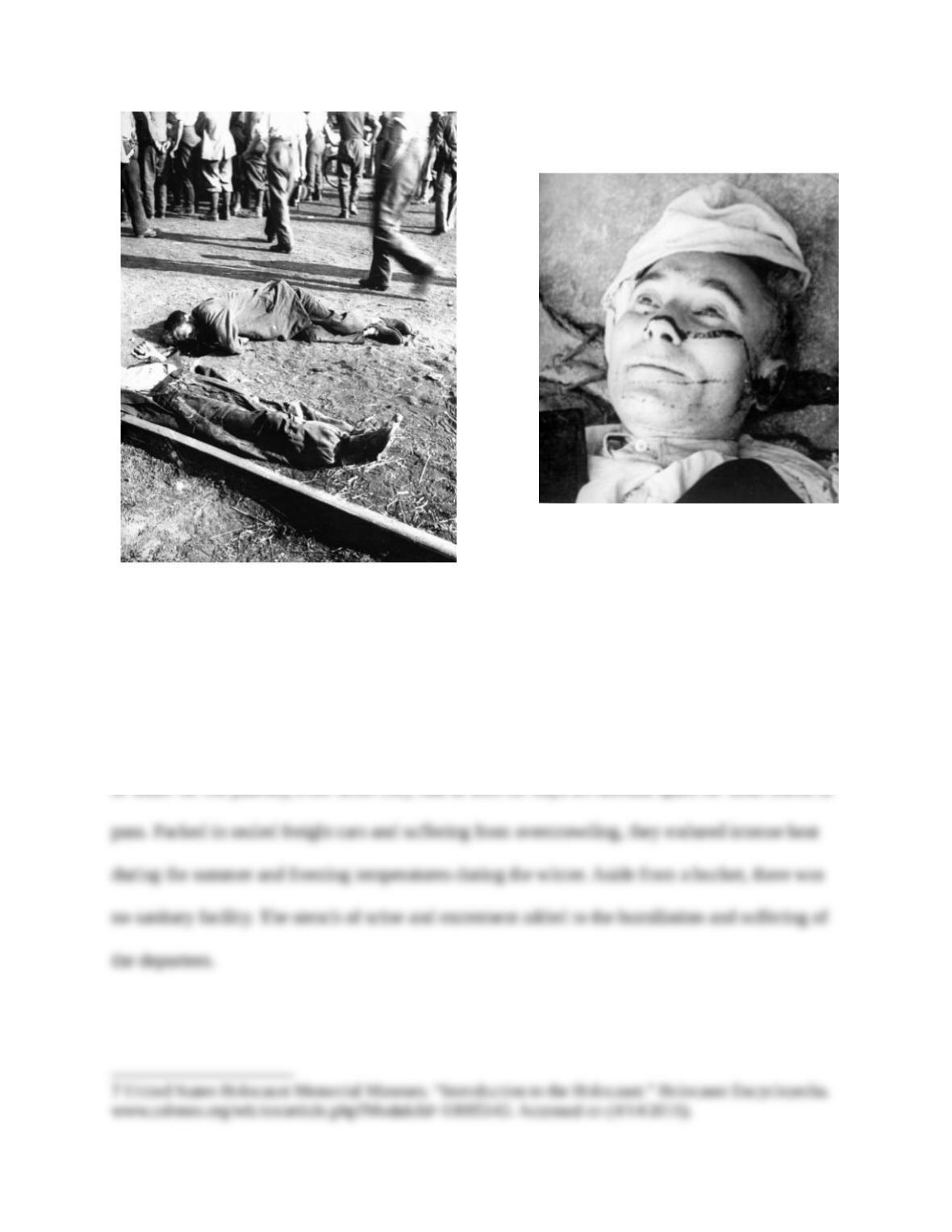
Jewish victims killed during a deportation action, Siedlce, 1942 Jewish victim killed during
the “Gehsperre,” Lodz Ghetto, 1942
In an article from the encyclopedia on the United States Holocaust Memorial Museum7
they write about being inside the railroad cars: “German railroad officials used both freight and
passenger cars for the deportations. German authorities generally did not give the deportees food