Question 1 (1 point)
Saved
Suppose that both Spain and France can produce, and will consume, cured meat [C—
charcuterie in French] and wine [W]
One worker in France can produce 1,000 kilograms of C or 500 litres of wine per
period
One worker in Spain can produce 500 kilograms of C or 50 litres of wine per period
Can Spain and France gain from specialization according to the comparative
advantage of each?
Question 1 options:
No, specialization and trade cannot not help France, as France has absolute advantage in both goods (is
more efficient at both).
Yes, France has comparative advantage in C, Spain has comparative advantage in W, both can gain
from specialization.
No, specialization will not help Spain, as France has absolute advantage in both goods (is more efficient
at both).
Yes, Spain has comparative advantage in C, France has comparative advantage in W, both can gain
from specialization.
Question 2 (1 point)
Saved
The Bree–X Corporation uses labour to produce good X according to the production
function
The price of X is 48, the wage paid per unit of labour is 4.

Profit for Bree-X is computed as PXQX – wLX, where PX is the price of good X, QX is the
quantity produced and sold, w is the wage rate, and LX is the amount of labour
employed.
What quantity of labour would be employed, and what quantity of output would be
produced, when Bree-X is making maximum profit?
Question 2 options:
LX < 20, QX > 5
LX < 20, QX < 5
LX > 20, QX < 5
LX > 20, QX > 5
Question 3 (1 point)
Saved
Bree D., owner of Bree-X from the previous question, likes to consume X, but also
values leisure. She calculates her available time each week as 108 hours (leaving her
roughly 8 and a half hours for sleep and anything else each day). She divides this
time endowment of 108 hours between work and leisure.
For every hour she works, she earns a wage of 4.
She buys X at a price of 48/unit.
Her income from other sources is 144.
Bree‘s utility function defined over X consumed and leisure (R) is U(X,R) = XR
(multiply the two).
What is Bree’s utility-maximizing amount of labour supplied?
Question 3 options:
L < 20
40 < L
30 < L < 40
20 < L < 30

Question 4 (1 point)
Saved
Refer to questions 2 and 3.
The relative wage that clears both the market for X and the labour market
(implements a Pareto-efficient plan) is
Question 4 options:
12
4
1/12
48
Question 5 (1 point)
Saved
Consider an economy in which there are two kinds of people, Type “A”, all of whom
are identical, and Type “B“, all of whom are likewise identical. Type “A” people are
different from Type “B” people.
Two goods, Good X and Good Y, are produced and consumed in this economy, using
two factors of production, capital (K) and labour (L).
Each Type “A” person has 30 units of capital, all of which will be supplied to firms that
produce either X or Y, at any rental rate (price of capital). Each Type “A” person will
supply 24 units (person-hours) of labour per time period, at any price of labour (wage
rate).
Each Type “B” person has no capital, but will supply 56 units of labour per time
period, at any price of labour (wage rate).
(The supply of each factor is perfectly price-inelastic).
Every person (of either type) supplies factors to the firm paying the highest rent or
wage, with the result that the rent (price of capital) and wage (price of labour) is the
same, irrespective of which firm acts as employer.

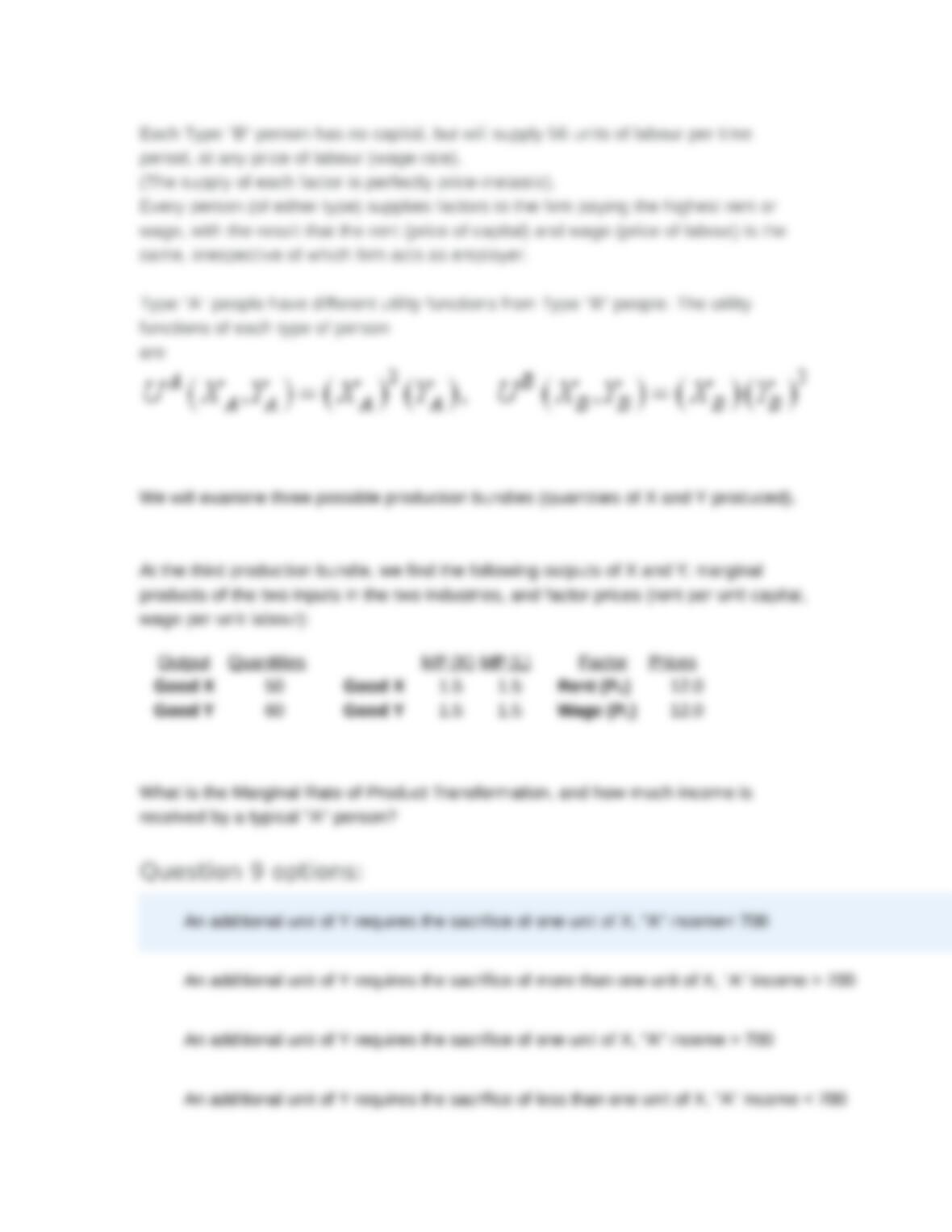
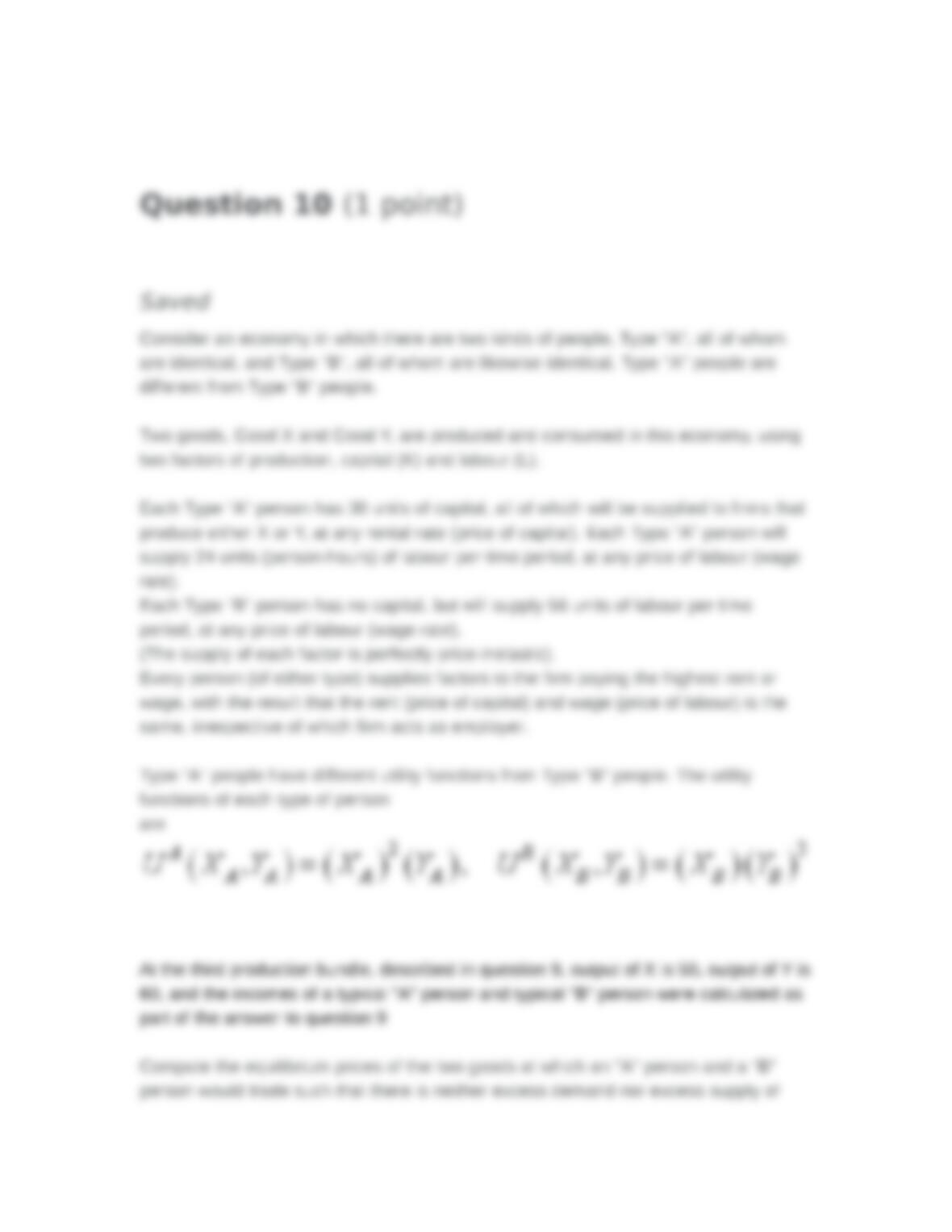
Type “A” people have different utility functions from Type “B” people. The utility
functions of each type of person
are
We will examine three possible production bundles (quantities of X and Y produced).
At the first production bundle, we find the following outputs of X and Y, marginal
products of the two inputs in the two industries, and factor prices (rent per unit capital,
wage per unit labour):
Output Quantities MP(K)MP(L) FactorPrices
Good X 25 Good X 0.36 3.96 Rent (PK)1.8