Quasi-Experimental
Designs
Chapter 13

Quasi-Experimental Designs
In a quasi-experimental design, the researcher lacks
control over the assignment to conditions and/or does
not manipulate the causal variable of interest.
A quasi-independent variable is not manipulated by
the researcher but rather is an event that occurred for
other reasons.

Examples
Does smoking cause cancer?
Did 9/11 cause an increase in prejudice against people
of middle-eastern decent?
Do Republican vs. Democratic presidents affect the
economy?
Do extreme events (i.e., winning the lottery or being
paralyzed) affect day-to-day happiness?
Does campus crime affect applicants to a university?

Questionable Internal Validity
No control over assignment of participants to the
independent variable, so internal validity of quasi-
experiments is always questionable.
However, some quasi-experimental designs are more
internally valid than others.
The extent to which a quasi-experimental design can
eliminate possible threats to internal validity
determines its usefulness.

Quasi-Experiments and Internal Validity
To infer that X causes Y
1. X must precede Y in time
2. X <-> Y must be related to each other
3. all other alternative explanations of the results
are eliminated through random assignment or
experimental control
With quasi-experimental designs, you can’t rule out ALL
alternative explanations, but you can try to minimize
them.

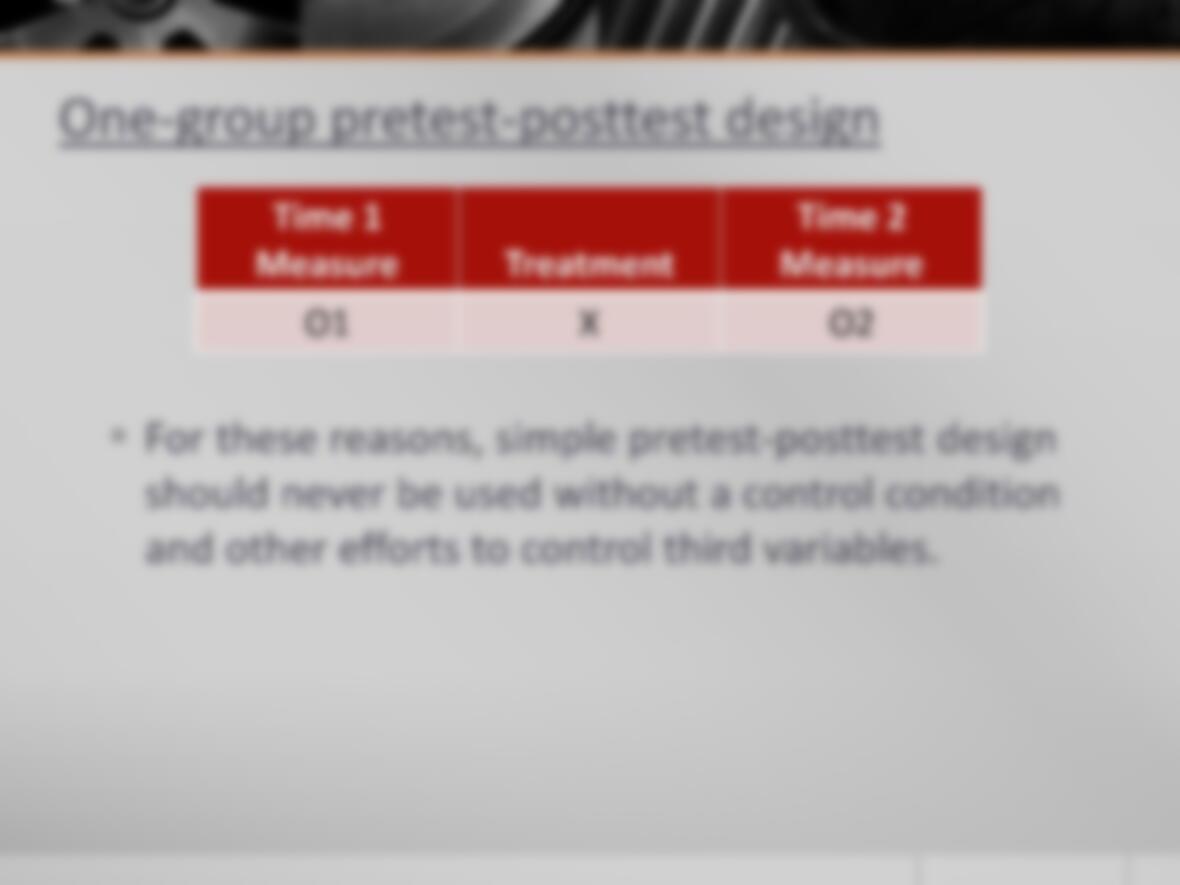
One-group pretest-posttest design
Example: Sample of violent adolescent women
Treatment: anger management class
Measures: aggressive behavior 1 year pre/post
If aggressive behavior is lower at T2 than T1, can we
conclude this decrease is caused by the treatment?
Time 1
Measure
Treatment
Time 2
Measure
O1 X O2

One-group pretest-posttest design
Internal validity problems?
Time 1
Measure
Treatment
Time 2
Measure
O1 X O2