ECE695 Quantum Signal Processing – Final Report
Quantum Photosynthesis:
Dynamics of Excitonic Coherence in Protein
Xueji Wanga)
(Dated: 13 December 2019)
The photosynthesis processes convert solar energy into chemical energy, providing the primary energy source for al-
most all life on Earth. Recent observations of the extremely fast and efficient energy transfer in photosynthesis raise
suspicions of semi-classical models that invoke incoherent hopping between energy levels. In the study by Lee et al.
(Science 316, 5830, 1462-1465), a two-color electronic coherence photon echo experiment (2CECPE) was performed
on the reaction center of a purple bacteria. The direct visualization of excitonic dephasing dynamics between bacte-
riopheophytin and accessory bacteriochlorophyll revealed a long-lasting quantum coherence between the excited states
of neighboring chromophores, allowing a rapid and reversible excitation energy transfer in the photosynthetic system.
The authors suggest that this excitonic coherence is preserved by the protein environments, whose electrostatic response
induces correlated fluctuations in the transition energy of discrete excited states. The results provide new insights into
how highly efficient energy transfer and harvesting are achieved in photosynthetic complexes.
Photosynthesis is a process used by plants and other organ-
isms to convert light energy into chemical energy that can
later be released to fuel the organisms’ activities. In higher
plants and certain bacterial systems, the initial steps of natural
photosynthesis harness light energy with an efficiency of 95%
or more — values that we can only aspire to with artificial
photocells1.
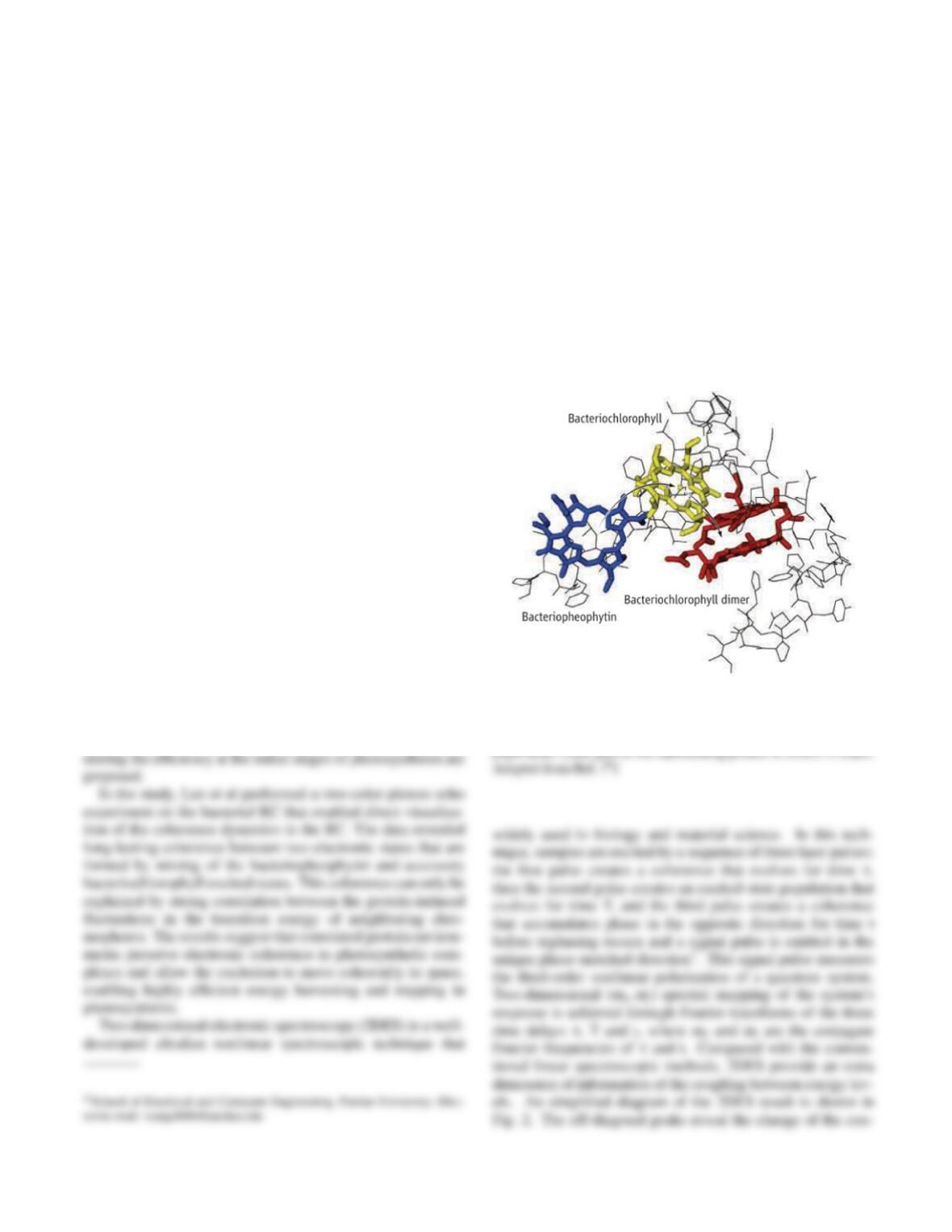
For example, in the study by Lee et al2, the photosynthe-
sis reaction center (RC) from the photosynthetic purple bac-
terium Rhodobacter sphaeroides is used (FIG. 1). The RC in-
cludes a bacteriochlorophyll dimer called the special pair (P)
in the center, an accessory bacteriochlorophyll (H) flanking
P on each side and a bacteriopheophytin next to each bac-
teriochlorophyll (B)3. In this RC, the electron transfer has
near-unity efficiency4, the energy transfer occurs between the
excitonically coupled chromophores, for example, from H to
B in about 100 fs and from B to P in about 150 fs5. This
fast and efficient process cannot be explained by any semi-
classical models that invoke incoherent hopping between en-
ergy levels. Thus, assumptions about quantum coherence pro-
FIG. 1. In the reaction center of purple photosynthetic bacteria,
energy is transferred from a bacteriopheophytin (blue) via an ac-
cessory bacteriochlorophyll (yellow) to the adjacent bacteriochloro-