Discussion Questions
1. What are the pros and cons of continuing production at the Charleroi plant?
2. What downside might there be with offshore outsourcing production of the Pyrex
product line to overseas suppliers?
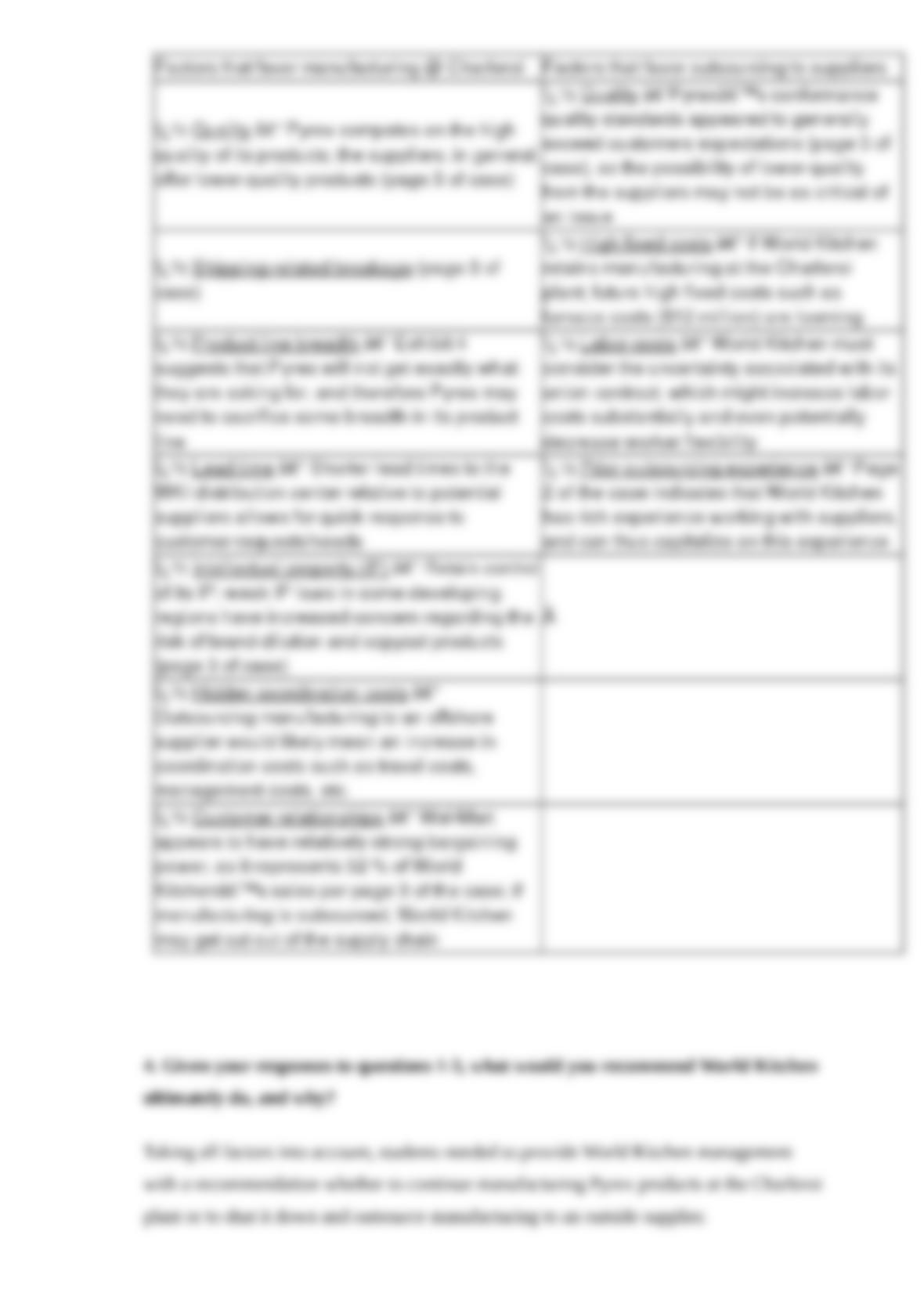
3. If the recommendation is to offshore outsource, what issues have to be addressed with
the Charleroi plant?
The Global Sourcing Department at World Kitchen must decide whether to continue
manufacturing Pyrex products at the Charleroi plant or to shut it down and outsource
manufacturing to an outside supplier. The case highlights management’s concerns with
respect to relative labor costs and capital investments given ongoing union negotiations
and the upcoming need to refurbish the glassmaking furnace.
A number of potential suppliers have substantially lower labor costs, but additional factors
such as quality, product mix, transportation, utilization, intellectual property, and tariffs
must be considered during the strategic decision-making process. The analysis presented
below walks through the key issues one should take into account in making such a
decision.
1. On what dimensions does World Kitchen’s Pyrex product line/brand compete?
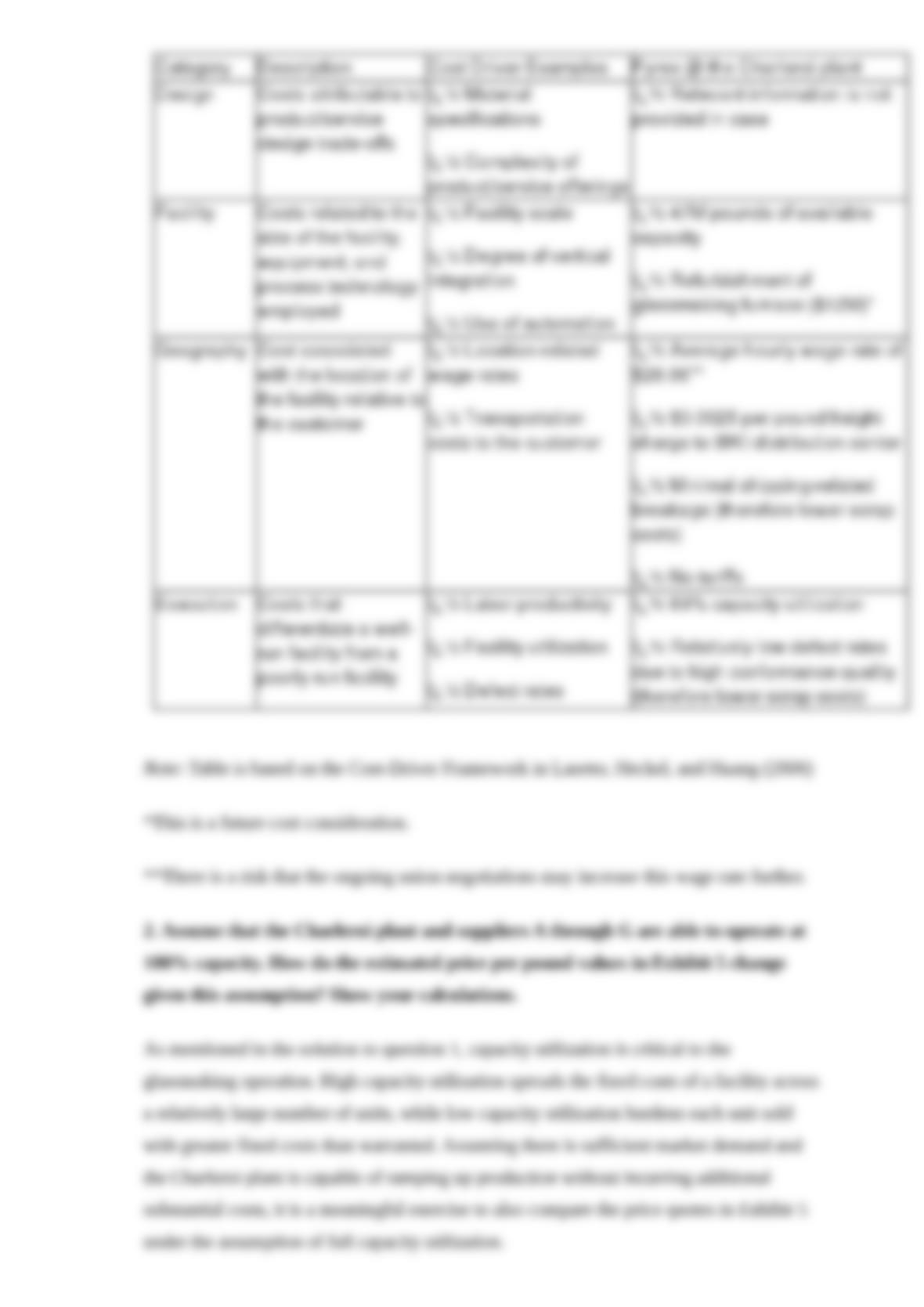
What are the primary cost drivers associated with manufacturing Pyrex products in
the Charleroi plant?
As indicated on page 1 of the case, Pyrex is World Kitchen’s oldest brand and is also one
of the most recognized brand names. It holds a dominant position in the glass cookware
market (75% market share), but competes against a number of strong competitors in the
more broadly defined non-glassware cookware markets. From an operations perspective,
Pyrex competes on many dimensions:
Order qualifiers
Price (and therefore cost) within a reasonable range: per page 4 of the case, profit margins
in this industry are relatively low and shrinking; firms in the industry are experiencing
increasing commoditization of products
Conformance quality*: conformance to specifications/minimal product imperfections (e.g.,
conformance to specifications in terms of color)
* One might alternatively consider conformance quality to be an order winner, but
customers seemed to be willing to accept products of lower quality per page 3 of the case
(see also solution to question 3).
Order winners
Performance quality: Pyrex utilized a fairly complex and rigorous production process to
manufacture products of high performance quality (i.e., performance with respect to the
primary operating characteristics; see page 2 of the case)
Product mix/breadth of product line: Pyrex offered a variety of products in three categories
(a) Prepware; (b) Bakeware; and (c) Serveware. Within these categories, Pyrex provided
its customers with different options of mixing bowls, measuring cups, pie plates, roasting