See discussions, stats, and author profiles for this publication at: https://www.researchgate.net/publication/342674455
Albularyo Folk Healing: Cultural Beliefs on Health Management in Partido
District, Camarines Sur, Philippines
ArticleinJournal of Southeast Asian Studies · June 2020
DOI: 10.22452/jati.vol25no1.11
CITATIONS
0
READS
4,818
1 author:
Some of the authors of this publication are also working on these related projects:
Community Analysis View project
Poverty Studies View project
Calyd Cerio
Partido State University
6 PUBLICATIONS3 CITATIONS
SEE PROFILE
All content following this page was uploaded by Calyd Cerio on 16 July 2020.
The user has requested enhancement of the downloaded file.

JATI-Journal of Southeast Asian Studies, Volume 25(1), June 2020, 210-237
ISSN 1823-4127/e-ISSN 2600-8653
210
ALBULARYO FOLK HEALING: CULTURAL
BELIEFS ON HEALTHCARE MANAGEMENT IN
PARTIDO DISTRICT, CAMARINES SUR,
PHILIPPINES
Calyd T. Cerio
College of Business and Management,
Partido State University, Goa, Camarines Sur, PHILIPPINES
(calyd.cerio@parsu.edu.ph)
Doi: https://doi.org/10.22452/jati.vol25no1.11
Abstract
Cultural beliefs on healthcare management is facing rapid disappearance. Hence,
this study was carried out to describe the dynamics of folk healing in Partido
District, Camarines Sur, Philippines, and document their beliefs on illnesses,
aetiologies, diagnoses, and therapeutics. The study used mixed method following
convergent parallel design. The quantitative and qualitative data were collected
through interviews to 100 folk healers and were analysed through descriptive
statistics and content analysis. The study found that there are 10 types of folk
healing practices that are treating 10 distinct folk illnesses. These diseases are
generally classified as naturalistic and personalistic in terms of aetiology and are
diagnosed and treated through a variety of cultural, spiritual, and ritual
procedures. In addition, the practice of ethnobotany is evident among the
Albularyos. The study suggests that the study area has rich intangible resources
on healthcare management that demands appreciation, documentation, and
inclusion.
Keywords: folk healing, ethnomedicine, aetiology, traditional medicine, health and culture
Introduction
Culture plays an important role in the healthcare system of local communities.
Every society has health belief systems to explain illness and has developed
curative methods for coping demoralising effects of disease on normal life (F. L.
Jocano, 1966; Mc Laughlin & Braun, 1998). Often these preventive health measures
are surrounded by a substantial body of beliefs, knowledge, and practices
designed to make the medicine more effective (Banerjee & Jalota, 1988; Scotch,

Calyd T. Cerio
211
1963). Tan (2008) stressed that culture is inscribed in one’s bodies and mind.
Intrinsically, it is imperative to recognise the relationship between culture and
health as it influences an individuals’ perspective and decision-making process
(Purnell, 2005; Vaughn, Jacquez, & Baker, 2009). The relationship can be ascribed
to as the folk healing systems. Leininger (1991) in his theory of nursing, posited
that all cultures in the world have had a lay health care system described as folk,
indigenous, or generic. Hence, in studying the cultural beliefs of a local
community, healthcare systems usually evolved as one of the main subjects. This
system includes beliefs on folk illnesses, perceived aetiology, diagnosis, and
therapeutics.
Folk medicine is one of the three main categories of traditional medicine
aside from codified medical systems and allied forms of health knowledge (Telles,
Pathak, Singh, & Balkrishna, 2014). The World Health Organization (WHO)
acknowledges the role of traditional medicine and defined it as “the knowledge,
skills and practices based on the theories, beliefs and experiences indigenous to
different cultures, used in the maintenance of health and in the prevention,
diagnosis, improvement or treatment of physical and mental illness” (World
Health Organization [WHO], 2020). Complementary, folk medicine is those
traditional knowledge systems, which have been transmitted orally from past
centuries and use components of the ecosystem that are indigenous to the
community (Payyappallimana, 2010). In most cases, the custodian and dispenser
of folk medicine are the folk healers, themselves.
In Bicol, Philippines, folk healers are generally known as albularyo or
parabulong. Folk healers come in varied types depending on folk illness
specialisation, and modalities in diagnosis and therapeutics. The origin of
Albularyo can be traced back to the pre-colonial era when shamanic leader
babaylan (or Bicol’s bailan) served as the main person in charge of healthcare
(Almario, 2015). Due to the brutal repression of the Spanish colonist, the
introduction of the Western medical system and education during American
occupation, the concept of babaylan disappeared from the consciousness of the
Filipinos. After all, the rise of Filipino animisms evolved in the form of albularyos
who uses the blend of native and foreign healing system, superstitions, and
cultural beliefs.
Generally, the nature of healthcare in the Philippines has turned towards
Western medicine due to economic development, urbanisation (Abe & Ohtani,
2013), and modernisation (Mahmood, Mahmood, & Tabassum, 2011). The rapid
disappearance of traditional culture suggests that unrecorded folk knowledge and
information may be lost forever (Abe & Ohtani, 2013). However, there are few
systematic studies conducted in the Philippines that can be accessed online that

Albularyo Folk Healing: Cultural Beliefs on Healthcare Management in Partido District, Camarines Sur, Philippines
212
records these important intangible national resources. Specifically, there is no
published paper accessible online that documents the folk healing practices of
albularyo in Partido District, Camarines Sur in Bicol Philippines. Therefore, there
is an urgent need to record and analyse Albularyo’s cultural beliefs in folk
diseases, causality, diagnosis, and treatment. Also, the study provides a profile
and dynamics of folk healing in the study area. Hence, this study may provide
appreciation to culture on traditional medicine, which can be used in developing
monographs and instructional materials on local cultures and traditions; and
policy and development inputs for folk healing practices, and the folk healers in
Partido District. This study also adds to the growing scientific literature on
traditional medicine in the country.
Literature Review and Theoretical Framework
There were a number of scholars who studied folk healing practices in the
Philippines. Most of them are historians, sociologists and anthropologists who
have published their papers in past decades but are still valuable as readings to
understand the new phenomena of folk healing in the region. A number of
significant papers have been highlighted for the purpose of this review.
Alternative treatment coexists with prevailing medicinal science. Islam
(2005) discusses the prospect of creating an integrated health network in the
Philippines where biomedical and alternative therapies are merged. However, he
found that there was a little chance between the two groups to work together as
they preferred to stay separate. F. L. Jocano (1966) discusses the distinction
between the two therapeutic viewpoints in the social and cultural dimension and
how these factors structure the nature of the society as it occurs. She suggests that
social and cultural factors influence rural people in their adherence to
conventional rather than scientific practice.
There are many types of Filipino folk healers (Mercado, 1988). One of them
is a psychic surgeon. Allison and Maloney (1981) investigated psychic surgery in
the Philippines in the context of cultural, psychological, medical, and magical
aspects. They then suggested that, when examining the facts, the philosophical
outlook should be broadened. Psychic surgery, according to Krippner and
Taubold (2005), is the method by which a spiritist enters a client’s body with his or
her bare hands, supposedly extracting tumours and other pathological growths or
obstructions. Dein (1992) looked clinically into the treatment of disease by a
Filipino psychic surgeon and discovered that it influenced disease.
In a recent study, Abad et al. (2014) described in his paper seven common
Filipino cultural beliefs about the cause of disease: namamana, lihi, sumpa, gaba,
pasma, namaligno, and kaloob ng Diyos. They understand, though, that there are still
Calyd T. Cerio
213
other aspects that need to be explored and that there are differences from one
ethnic group to another. This strengthens the rationale for this research, as there
are several disparities due to cultural variations in every area of the Philippines.
Three sociological theories are used to analyse the findings of the study.
Applied as sociology of health, these theories include two classical theories –
structural functionalism and conflict perspective, and contemporary – cultural
theory. These ideas attempt to understand the nature of the practice of folk healing
and its connection to a broader social and cultural structure.
Methodology
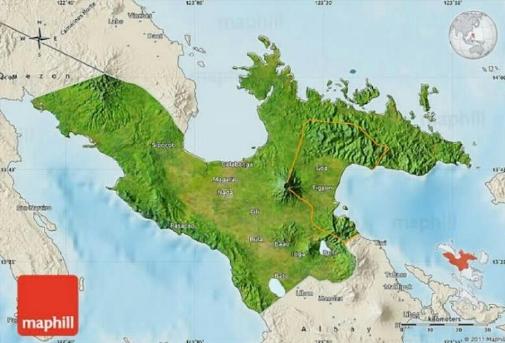
Fieldworks were conducted between August to December 2019. A total of one
hundred (100) traditional health practitioners from the mainland municipalities of
Partido District, Camarines Sur – Tigaon, Sagnay, Goa, San Jose, and Lagonoy,
excluding north sector (see Figure 1) – was interviewed separately at different
occasions. The inclusion criteria for selecting study informants was patterned on
the ethnobotanical study of Del Fiero and Nolasco (2013), these are (i) has been a
folk healer (in any kind) for more than ten years, and (ii) was born and has lived
and practicing in Partido District, Camarines Sur for not less than twenty years.
Figure 1: Map showing the study site (inside the orange ink)
(Source: Maphill. (2011). Free Satellite 3D Map of Camarines Sur, darken. Retrieved
from Maphill: http://www.maphill.com/philippines/region-5/camarines–
sur/3d-maps/satellite-map/darken/free/)
The study utilised a mixed method following convergent parallel design.
This research design collects and analyses independent components of qualitative
and quantitative data at the identical time in a specific phase (Creswell, Plano

Albularyo Folk Healing: Cultural Beliefs on Healthcare Management in Partido District, Camarines Sur, Philippines
214
Clark, Gutmann, & Hanson, 2003). This study used descriptive statistics such as
mean, median, mode, ranking technique, and percentage technique. Furthermore,
a directed narrative content analysis was conducted to gather themes that emerged
in the interview text. In ethnobotanical practice, the study used the Use Value for
each medicinal plant species to cure illnesses.
The Use-Value (UV) index is used to calculate the citation of plants during
interviews, proposed by Phillips and Gentry (1993) and adapted by Albuquerque
et al. (2007). It is calculated as follows:
𝑈𝑉𝑐 = ∑𝑈𝑠/𝑛𝑠
where U is the sum of the total number of use citations by all informants for
a given species, divided by the total number of informants (ns). This method
evaluates the relative importance (RI) of each medicinal species based on its
relative use among informants. This index is useful for the analysis of the use
of a single species and to compare plants among the same sample.
The study used a free listing (an anthropological interview technique for
cultural analysis) to better understand the boundaries of the research content (in
the case of this study, the healthcare practices). The use of free listing is to ensure
that the concepts will be defined by the informants themselves, and are, therefore,
culturally relevant. The folk healers were requested to mention as many folk
illnesses, its causes, diagnosis, and therapeutics. Care was taken to focus on the
exact Bicolano (the local dialect in Camarines Sur) terms used. Moreover, the study
used the book of Madulid (2001) entitled A dictionary of Philippine plant names, Vol.
1 & II, in recognising the identified scientific names of the plants.
Results and Discussion
Socio-Demographic Profile of Folk Healers
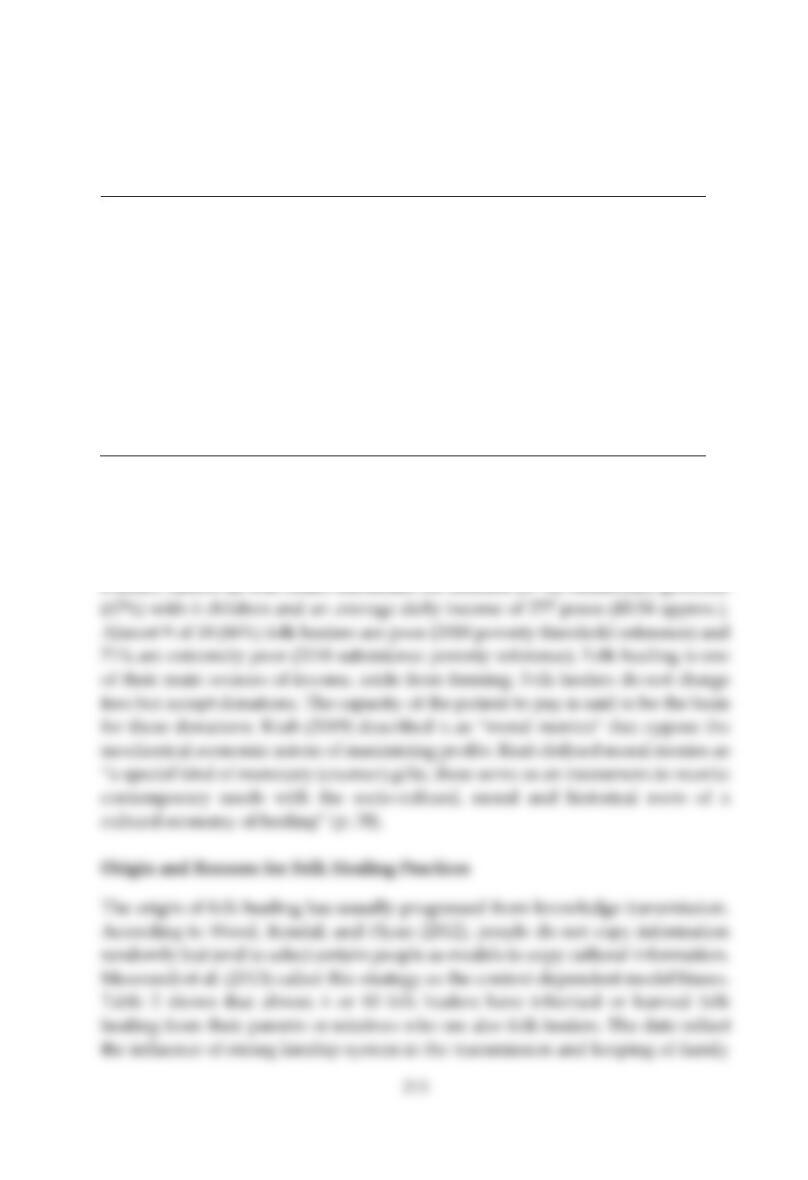
The socio-demographic profile of the folk healers-informants in Partido District is
presented in Table 1. It can be seen that folk healing is a female dominated activity.
This profile can be associated with its historical background, the babaylan, which
was predominantly women (Brewer, 1999; Gabriel et al., 2020; Villariba, 2006) or
men to behave or dress as female (Demetrio, 1973). Babaylan was a pre-colonial
tradition of female mysterious healers whose spiritual connection was the source
of political and social power. Salazar (1999) described babaylan (or balian in Bicol)
as a specialist in the fields of culture, religion, medicine, and all kinds of theoretical
knowledge about the phenomenon of nature.
Calyd T. Cerio
Table 1: Socio-demographic Profile Of Folk Healers in Partido District
Profile
Indicators
%
Profile
Stat. Indicators
Sex
Male
18
Number of
Children
Mode
6
Female
82
Max
14
Civil Status
Single
6
Age
Median
59
Married
87
Min
29
Widowed/Widower
7
Max
88
SD
13.47
Education
No Formal Education
1
Grade 1-5
7
Daily
Income*
Mean
277
Elementary Graduate
67
Min
25
High School Graduate
24
Max
2,800
College Graduate
1
SD
385
*Daily income in pesos ($1 = PhP 50 approx.); n=100
Disturbingly, the median (also the average) age of the folk healers is 59
(74% are aged 50 and above) which implies that they are of old age (mostly are
senior citizens). This data may suggest that folk healing is a dying tradition.