
Fin. 4240
Assignment 2
April 2, 2014
1. Dow Jones Industrial Average
2. Purchasing Power Parity
The law of one price states that the price of a good or service in any country should sell for
the same price worldwide. The nominal interest rate spread between two countries reflects
the difference in inflation rates. Changes in prices occur because of inflation. The
difference of inflation rates between two countries is equal to the percentage
depreciation/appreciation of the exchange rate. The purchasing power parity theory
explains how fluctuating foreign exchange rates, price at which one currency can be
exchanged for another currency, adjust with the changing inflation rate.
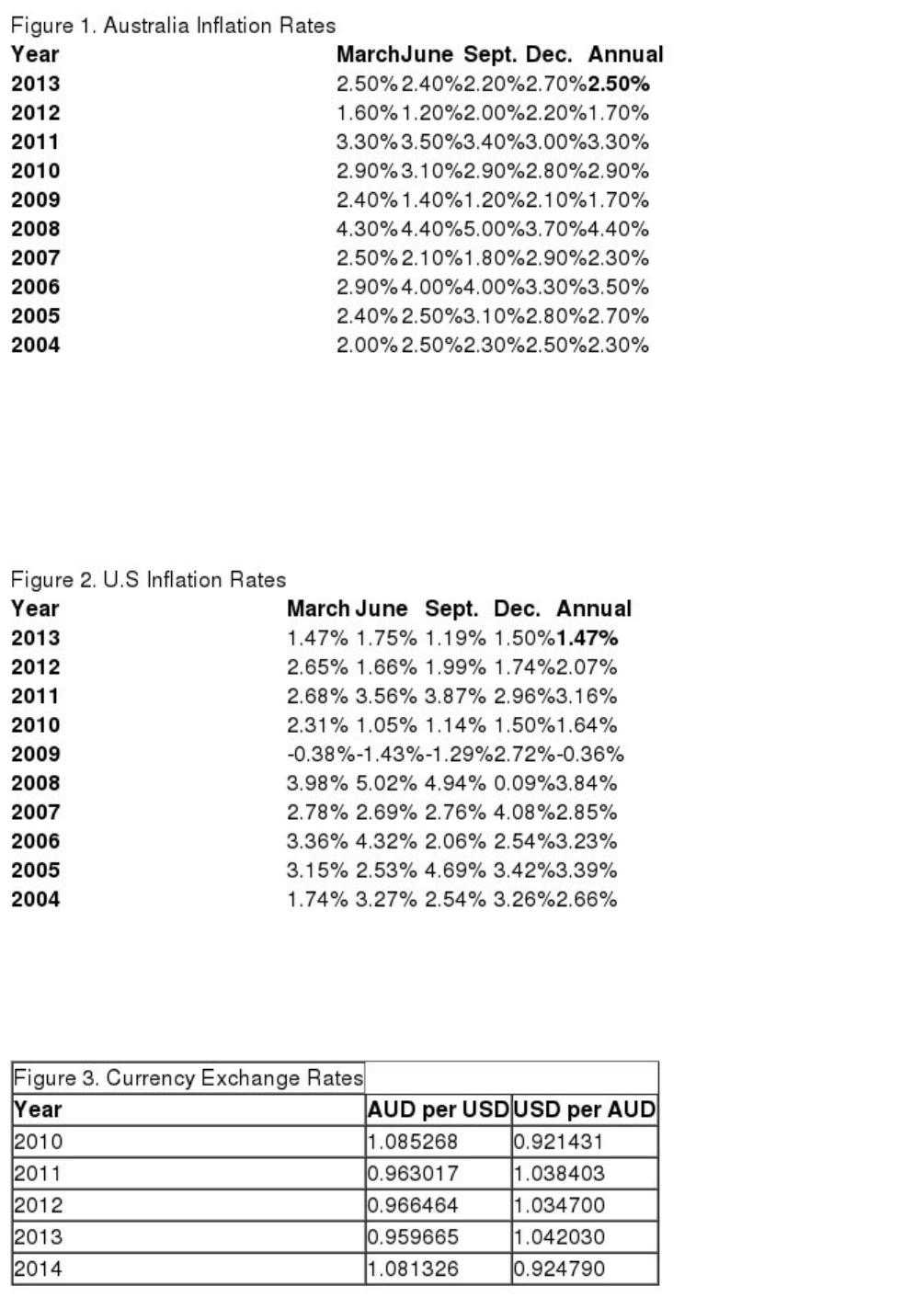
For my example, I used Australia. The inflation rate in 2013 for Australia was 2.50% and
1.47% for the U.S. (Figure 1 and 2). The spot exchange rate between Australia and the
U.S. is 0.92. Using the formula, , where SUS/S equals the
spot exchange rate of U.S. dollars per unit of foreign currency:
1.47% – 2.50% = /0.92 = -1.03% x 0.92 = = -0.00948
New S = 0.92 – 0.00948 = 0.91052
The Australian dollar depreciated because they have higher inflation compared to the U.S.
3. Interest Rate Parity
The interest rate parity theorem states that the domestic interest rate should equal the
foreign interest rate, minus the expected appreciation of the domestic currency. In 2013,