With eir Whole Lives
Ahead of em
Myths and Realities About Why So Many Students Fail to Finish College
A PubliC AgendA RePoRt FoR tHe bill & MelindA gAteS FoundAtion

With their Whole lives AheAd of them
by Jean Johnson and Jon Rochkind with Amber n. ott and Samantha duPont
Prepared with support from the
bill & Melinda gates Foundation
download a copy of “With their Whole lives Ahead of them” at
http://www.publicagenda.org/theirWholelivesAheadofthem
design: tamiko design, llC | Copyediting: Jason Miller and Sona Vogel
this work is licensed under the Creative Commons Attribution-noncommercial-Share Alike 3.0 unported
license. to view a copy of this license, visit http://creativecommons.org/licenses/by-nc-sa/3.0/ or send a letter
to Creative Commons, 171 Second Street, Suite 300, San Francisco, California 94105, uSA.

introduction ………………………………………………………………………………………………..2
myth And reAlity no. 1 ………………………………………………………………………………..5
myth And reAlity no. 2 ………………………………………………………………………………..9
myth And reAlity no. 3 ……………………………………………………………………………… 12
myth And reAlity no. 4 ……………………………………………………………………………… 15
so WhAt Would help? ………………………………………………………………………………… 18
About the study ………………………………………………………………………………………….22
full survey results …………………………………………………………………………………..23
chArActeristics of the sAmple ………………………………………………………………..44
our thAnKs ………………………………………………………………………………………………….47
About the bill & melindA GAtes foundAtion ………………………………………….. 47
About public AGendA …………………………………………………………………………………. 48
With eir Whole Lives Ahead of em | 1
With eir Whole Lives
Ahead of em
Myths and Realities About Why So Many Students Fail to Finish College

According to the u.s. department of education, only 20 percent of young
people who begin their higher education at two-year institutions graduate
within three years.1 there is a similar pattern in four-year institutions, where
about 4 in 10 students receive a degree within six years.2 And these bleak
statistics on national college completion rates are averages. in some
institutions, the numbers are even gloomier.
this is clearly a personal disappointment for the students and their families,
but increasingly, experts and leaders see it as a threat to u.s. international
competitiveness and a phenomenon that perpetuates economic insecurity
and inequality. in 2009, president barack obama set a goal for the united
states to “have the highest proportion of college graduates in the world.”
more specifically, he called for measures that would ensure that an
additional 5 million Americans would complete “degrees and certificates
in the next decade.”3
2 | With eir Whole Lives Ahead of em
introduction

Why do students leAve
school Without finishinG?
e question bedeviling many of those concerned about
higher education and the economy is why so many
college students drop out. Some 2.8 million students
enroll in some form of higher education each fall, in
two- and four-year programs and in public, private,
online, and for-profit institutions.4 ese young people
are motivated enough to start college, and somehow they
manage to find sufficient resources to enroll, but getting
a college ID card, buying the books and showing up for
class doesn’t mean they are poised to complete a degree.
What exactly goes wrong?
Several thought-provoking studies have looked at the
question in recent years and advanced many possible
explanations: rising tuition costs, poor academic prepara-
tion and study skills, minimal student support and
advisory services in higher education, too many young
people going to college even though they really do not
want to, and too many professors and advisers complain-
ing because, as they see it, completion is the student’s
responsibility.5 Leaders debate different ways to tackle
the problem. Some want to provide more financial
support and better services for students. Others focus
on revamping higher education policies and programs
in ways that would encourage more young people to
complete a degree or certificate.
“With eir Whole Lives Ahead of em” asks young
Americans why so many college students drop out. is
study is designed to test the assumptions many of us
make about college students today and why so many of
them fail to graduate. It also helps to identify solutions
that young people themselves say would help most. With
underwriting from the Bill & Melinda Gates Founda-
tion, Public Agenda surveyed more than 600 young
adults, ages 22 to 30, who had at least some higher
education coursework. We asked those who started
college but did not complete a degree why they left,
and we compared their views, experiences and responses
with those of students who had successfully completed
a two- or four-year college program. More detailed
information about how we conducted the study can be
found at http://www.publicagenda.org/theirwholelives
aheadofthem/methodology.
1 u.s. department of education, national center for education statistics, ipeds 2006–2007, Graduation rate file.
2 u.s. department of education, national center for education statistics, 1996/01, beginning postsecondary students longitudinal study.
3 http://www.whitehouse.gov/the_press_office/excerpts-of-the-presidents-remarks-in-Warren-michigan-and-fact-sheet-on-the-American-Graduation-
initiative/.
4 “digest of education statistics,” institute of education sciences, 2008.
5 see, for example: bowen, chingos and mcpherson, Crossing the Finish Line: Completing College at America’s Public Universities, princeton
university press, 2009. Also: hess and schneider, “diplomas and dropouts: Which colleges Actually Graduate their students (and Which don’t),”
American enterprise institute, June 3, 2009.
With eir Whole Lives Ahead of em | 3

todAy’s colleGe
students: not necessArily
WhAt you expect
As background to the survey findings, it may be helpful
to begin with a clearer picture of “college students” today.
Many of us envision young people living in college
dorms, going to school full-time, attending ball games
and fraternity parties, maybe working a few hours a week
or in the summer to bring in a little spare cash. In high
school, perhaps, they dreamed about going to a particular
school, filled out application after application and waited
eagerly for the acceptance letter to arrive. e facts,
though, show quite a different picture:
• Amongstudentsinfour-yearschools,45percent
work more than 20 hours a week.6
• Amongthoseattendingcommunitycolleges,
6 in 10 work more than 20 hours a week, and
more than a quarter work more than 35 hours
a week.7
• Just25percentofstudentsattendthesort
of residential college we often envision.8
• Twenty-threepercentofcollegestudentshave
dependent children.9
hoW should hiGher
educAtion respond?
Given these realities, it’s not surprising that when Public
Agenda surveyed young people about what led them to
leave college early—and what would help them to return
and finish—we got some surprising answers. “With eir
Whole Lives Ahead of em” offers firsthand testimony
from young people about the barriers they face trying
to earn a degree or credential. It is testimony that, we
believe, poses a moral challenge to higher education and
the country as a whole. If we truly aim to help this new
group of nontraditional students fulfill their aspirations,
college and university officials, state and federal policy-
makers, employers, foundations and other advocates
trying to ramp up college completion need to take a
fresh, clear-eyed look at their current assumptions and
practices. e findings here reveal gaps in the higher
education system that serve to undercut the efforts of
students who need to work and go to school at the same
time. ey raise serious questions about long-standing
policies that seem profoundly ill suited to students who
simply cannot afford to go to school full-time for several
years. ey powerfully suggest the need for innovative
responses that would help more young Americans
continue their education, but in better-organized and
more cost-effective programs. e results of this research
pose a challenge.
here is the story as young people
themselves tell it.
6 u.s. department of education, 2007 –2008 national postsecondary student Aid study; in viany orozco and nancy K. cauthen, “Work less, study
more & succeed: how financial supports can improve postsecondary success,” demos, 2009.
7 ibid.
8 u.s. department of education, national center for education statistics, 2008, national postsecondary student Aid study, authors own
retrieval of information.
9 ibid.
4 | With eir Whole Lives Ahead of em

e number one reason students give for leaving school
is the fact that they had to work and go to school at the
same time and, despite their best efforts, the stress of
trying to do both eventually took its toll. More than half
of those who left higher ed before completing a degree or
a certificate say that the “need to work and make money”
while attending classes is the major reason they left.
Balancing work and school was an even bigger barrier
than finding money for tuition. ose who dropped out
are almost twice as likely to cite problems juggling work
and school as their main problem as they are to blame
tuition bills (54 percent to 31 percent).
e problem often begins in the first year. Of those
who fail to graduate, more than 6 in 10 report that the
statement “I had to work as well, and it was too stressful
trying to do both” described their first year of school;
more than a third say it describes their first year “a lot.”
In contrast, nearly half of those who graduated
(48 percent) say this statement doesn’t describe their
first year in school at all.10
Few former students say they left college because they
were bored or found that college “just isn’t for them.”
Only about 1 in 10 students who have left college say
a major reason they quit was that they didn’t like sitting
in class or thought the classes were too difficult.
WorK is the top reAson younG
Adults Give for not returninG
to colleGe once they leAve.
More than a third (36 percent) of those who left school
say that even if they had a grant that fully paid for tuition
and books, it would be hard to go back. And twice as
many of them say the need “to work full-time”
MYTH NO. 1: most students go to college full-time. if they leave without a degree, it’s because
they’re bored with their classes and don’t want to work hard.
REALITY NO. 1: most students leave college because they are working to support
themselves and going to school at the same time. At some point, the stress of work and
study just becomes too difficult.
10 A recent pew hispanic poll found a similar trend among hispanic students—74 percent of hispanic students aged 16–25 said they do not go to
school because “i need to help support my family.” see http://pewhispanic.org/files/reports/115.pdf.
myth And reAlity no. 1
With eir Whole Lives Ahead of em | 5

myth And reAlity no. 1
(56 percent) and “family commitments” (53 percent)
are major reasons they can’t go back, compared with
26 percent who say they would “not be able to afford
college.” In the focus groups, young people often de–
scribed their predicaments. A young woman in Seattle
said, “Yeah, I think [working and going to school] was
hard. You want to work so that you can help pay off [your
tuition and loans] so you don’t have this accumulating
debt. I think, for me, it always got in the way. I didn’t
have enough time in the day to get everything done.”
A young woman from the Phoenix area who had
dropped out but recently returned to classes told us,
“It’s very hard because I go to school three nights a week.
I work from 8 to 5. I don’t get home until 9:30, 10 at
night… I also think my dedication to my classes could
be better if I didn’t work as much.” A young man in Erie,
Pennsylvania, who hoped to return to school described
his fears that he might never get a diploma: “e reason
why I’m set back is because I got a wife, kids. My wife’s
doing her thing. Once she’s done with that then she can
stay at home and take the side job, whatever that she’s
doing. en I can do my thing at school, and then once
I’m done we’ll have the jobs.”
Many of the young people we interviewed believed that
they could not afford not to work for the time it would
take to complete a degree. ey had to have a paying job
to make ends meet. Far from being slackers, as some
people imagine, they were often assuming responsibilities
and financial burdens that traditional full-time college
students do not have to shoulder. It is a test of maturity
and perseverance that more affluent students are usually
not required to face.
Such responses to our survey are a bracing reminder
that the world of higher education has changed markedly
over the years. For many students today, the experience
of “going to college” is a far cry from that of the stereo-
typical“JoeCollege”sooftenseeninthemoviesandon
television. For these students, the balancing act is not
between going to class and attending football games and
frat parties; it’s more likely between going to class and
punching a clock in order to pay the rent. eirs is a
dilemma that relatively few government or higher
education programs readily address.
6 | With eir Whole Lives Ahead of em
those who did not complete had trouble
balancing work and school in their first year
of higher education.
0 20 40 60 80 100
I found it hard to live away from home
I had a hard time writing college papers
I was not used to having so much freedom
I was overwhelmed by the amount of studying I had to do
I found it hard to pay attention in class
I spent too much time socializing and not enough
time studying
I had to work as well, and it was too stressful
trying to do both
The cost of textbooks and other fees besides
tuition affected me financially
18%8% 10%
22%
4%
18%
36%12% 24%
38%11% 27%
29%13% 16%
50%17% 33%
46%16% 30%
50%12% 38%
43%18% 25%
38%9% 29%
47%23% 24%
50%14% 36%
63%35% 28%
52%26% 26%
60%36% 24%
58%23% 35%
Thinking about your first year in school, please tell
me if the following describes you:
Graduated
Did not graduate
A little
A lot
A little
A lot
myth And reAlity no. 1
0 20 40 60 80 100
Some of the classes were too difficult
I didn’t like sitting in class
All things considered, it just didn’t seem to be worth
the money I was paying
I thought many of the classes were boring
I didn’t have enough time for my family
I had to take too many classes that I did not
think were useful
I needed a break from school
I just couldn’t afford the tuition and fees
I needed to go to work and make money
Minor reason
Major reason
Percent who say the following is a reason why
they did not complete their program:
71%
52%
54%
43%
41%
45%
35%
38%
34%
54%
31%
21%
16%
16%
14%
14%
10%
11%
17%
21%
33%
27%
25%
31%
21%
24%
27%
having to work is the top reason young
adults give for why they left school.
base: 22–30-year-olds who did not complete their
postsecondary education. base: 22–30-year-olds with some postsecondary education.
With eir Whole Lives Ahead of em | 7
note: Question wording in charts may be slightly edited for space. Full question wording
is available in the Full Survey Results at the end of this report. Percentages may not equal
100 percent owing to rounding or the omission of some answer categories.

myth And reAlity no. 1
…and say work and family
responsibilities are what makes it
difficult to go back.
0 20 40 60 80 100
I don’t think any college would accept me
No school near me seems to have a program that
I am really interested in
No school near me has classes that fit my schedule
I still would not be able to afford college
I have family commitments
I really need to work full-time, and I don’t think I could
work and go to school at the same time
75%
72%
55%
48%
32%
22%
56%
53%
26%
17%
7%
14%
19%
19%
29%
31%
15%
18%
Percent who say the following is a reason why it
would still be hard for them to go back to school:
Minor reason
Major reason
most students who have dropped
out of school have thought about
going back…
65%
9%
2%
24%
How much thought have you given to going
back to school—a lot of thought, some thought
or no thought at all?
Some thought
A lot of thought
Don’t know
No thought at all
base: 22–30-year-olds who did not complete their
postsecondary education.
base: 22–30-year-olds who left school and said
that even if tuition and books were paid for, it would be
hard to return.
8 | With eir Whole Lives Ahead of em

MYTH NO. 2: most college students are supported by their parents and take advantage
of a multitude of available loans, scholarships, and savings plans.
REALITY NO. 2: young people who fail to finish college are often going it alone financially.
they’re essentially putting themselves through school.
REASON NO. 2: I Have to Pay My Own Way
According to one recent analysis, college costs have
risen more than 400 percent in the last 25 years, while
the median family income has increased less than 150
percent.11 And even though the pressure of having to
balance the demands of a job and school is the major
reason young people say they drop out of college, it
would be misleading to dismiss the role of rising college
costs and stagnant family incomes. National statistics
show that young people who leave college without a
degree are more likely than their peers to come from less
privileged backgrounds and to live in more precarious
economic circumstances.12 is study revealed that these
students often bear the full responsibility of paying for
school: Nearly 6 in 10 students in our study who left
higher education without graduating say that they had
to pay for college costs themselves, rather than being able
to count on help from their families. In contrast, more
than 6 in 10 of those who completed their degrees say
they had help from parents or other relatives to cover
the costs of school.
11 the national center for public policy and education, “measuring up 2008” report; in viany orozco and nancy K. cauthen, “Work less, study more,
& succeed: how financial supports can improve postsecondary success,” demos, 2009.
12 “employment and earnings report,” bureau of labor statistics, August 2009.
myth And reAlity no. 2
With eir Whole Lives Ahead of em | 9

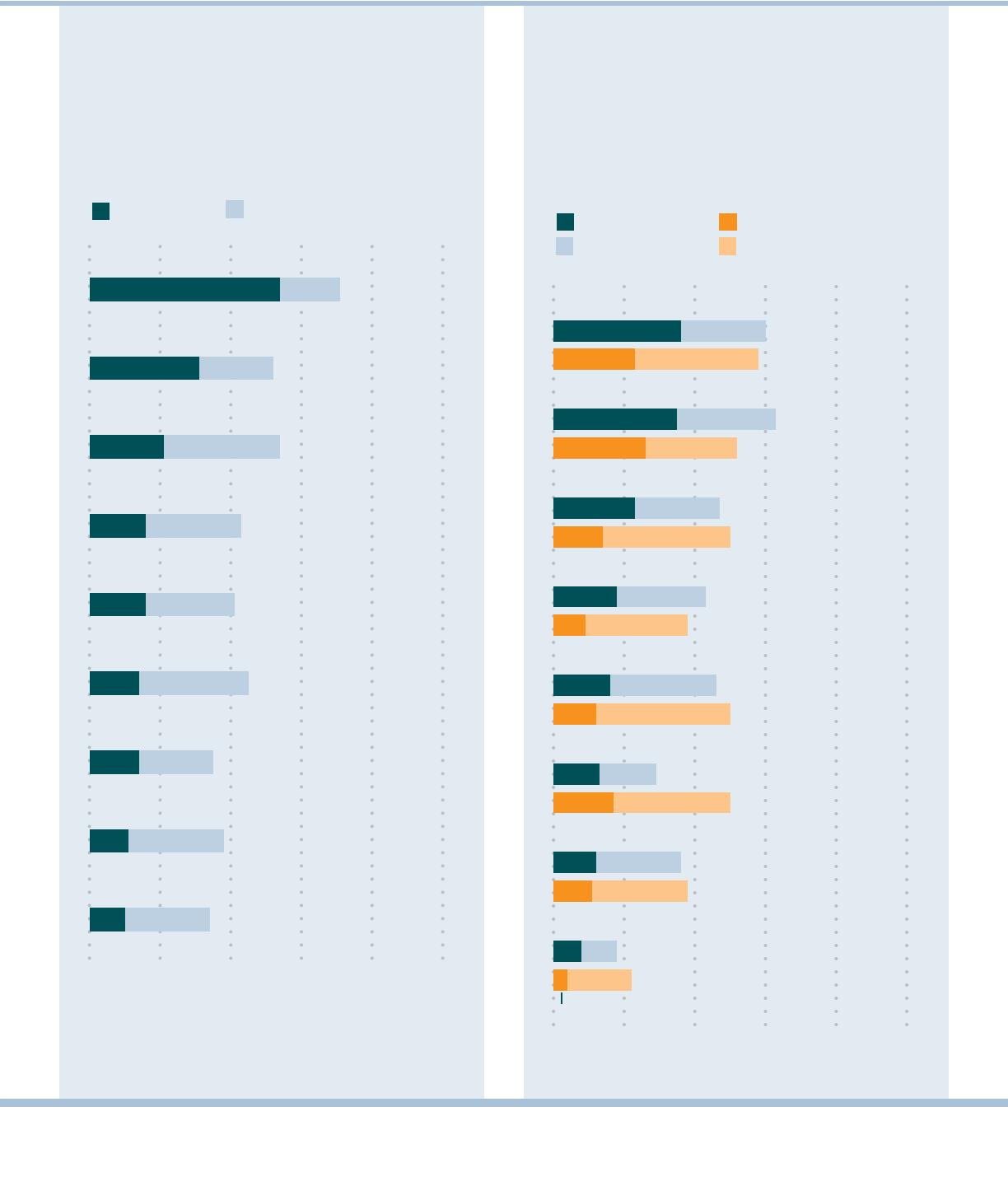
…and those without parental support
differ in many ways from students
who have support.
They selected their school because it had a class schedule
that worked with their own schedule (major reason)
They did not have a scholarship or financial aid
to help pay for college
They chose their college based on its proximity
to where they live or work (major reason)
62%
49%
62%
45%
Percent of students who say:
Students whose parents
or other relatives helped
pay for college
Students whose parents
or other relatives did
not help pay for college
those who left school are more likely
to have paid for school themselves…
A scholarship or financial aid
Parents or other relatives
58%
69%
37%
Percent who did not have the following to help pay
for post secondary education:
Graduated
Did not graduate
myth And reAlity no. 2