1
Notes on Perfect Competition
1. Definition of Perfect Competition
The perfect competition is an idealistic market structure which has four characteristics:
A. There are large number of buyers. Each buyer buys small quantity of goods compared to the
size of the market.
B. There are large number of sellers. Each seller produces small quantity of goods compared to
the size of the market.
C. Both the buyer and the seller has perfect information about the market.
D. There is unrestricted entry and exit of firms in the Long Run but not in the Short Run.
2. Characterization of Perfect Competition
A. Market Control
Since there are large number of buyers and sellers, neither the buyer nor the seller can
control the market price. Both the buyer and the seller take the market price as given and
then make their buying and selling decision.
B. Type of Goods Produced in the Market
Since the sellers cannot control the market price and since there are intense competitions
among the sellers, the goods produced by the sellers are Identical or Homogenous.
C. Demand Curve for the Market and Market Equilibrium
The demand curve for the market looks like our standard downward sloping curve and the
market equilibrium price and quantity is determined at the intersection between demand
and supply.
D. Demand Curve for a Single Firm
At the given market equilibrium price (which our firm takes as given), our firm faces demand
from a large number buyers who will pay only one market equilibrium price:
i. Compared to the market supply, the amount that a single firm can produce is very
small.
ii. If one firm charges a price more than the market price, everyone will buy from
someone else because goods are homogenous.
iii. If one firm charges a price lower than the market price, every other firm will also
charge that lower price (All firms have perfect information). As a result, market price
will go down. This will reduce profit for everyone. Therefore, no one will charge a
price lower than the market price.
DD = MR
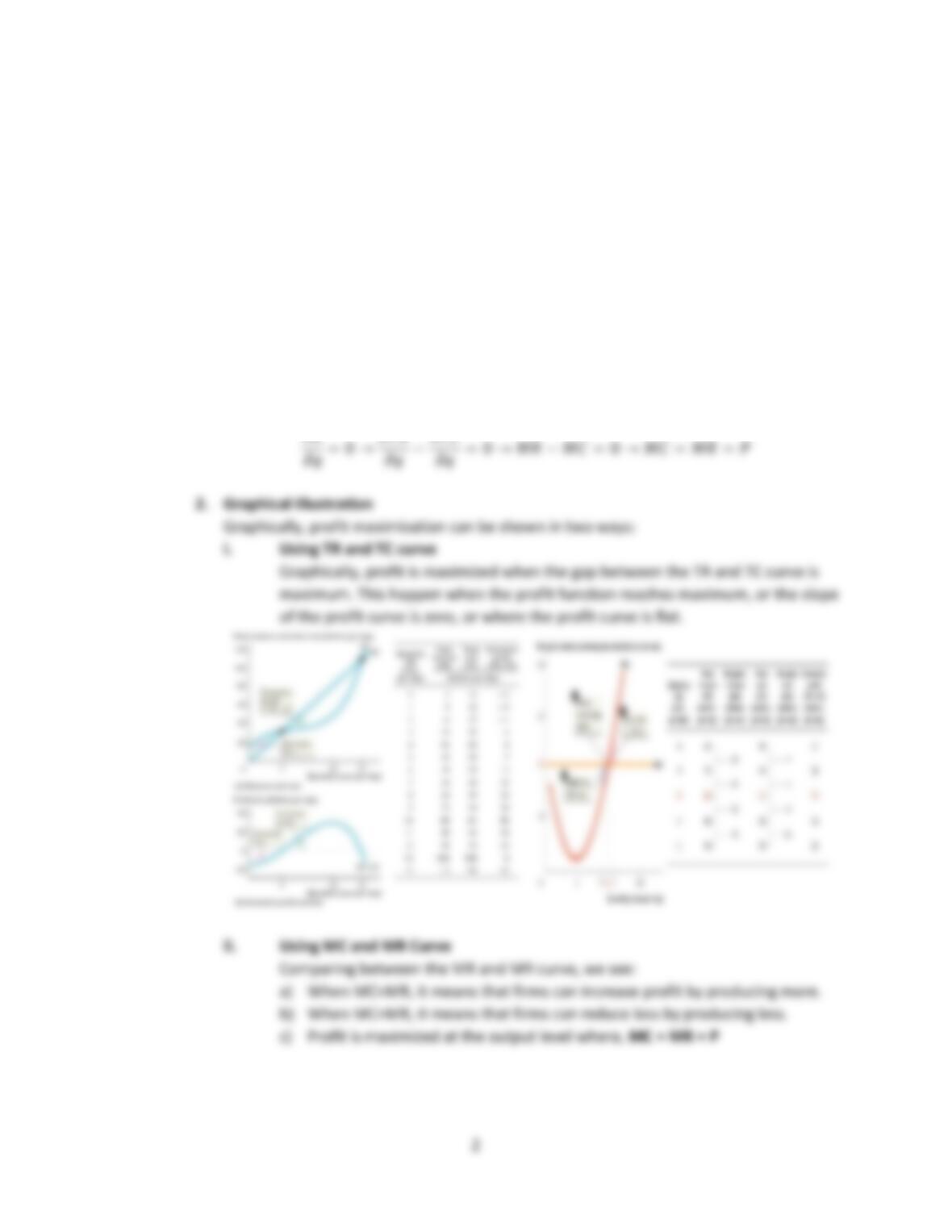
iv. At the market equilibrium price, the demand faced by an individual firm at the
market equilibrium price is very large and non-existent in any other price. Hence,
the demand curve faced by a single firm at the market equilibrium price is
horizontal.
v. At the market equilibrium price, a firm can sell as much as it can and the extra or
marginal revenue it earns is equal to the market price. Hence for an individual firm,
the demand curve it faces is also its marginal revenue curve.
E. Profit Maximization Under Perfect Competition
1. Mathematical Formulation
Profit is defined as the gap between total revenue (TR) and Total cost (TC).
Mathematically, it is written as:
𝜋 = 𝑇𝑅 −𝑇𝐶
Profit is maximized when profit is maximum or no further change in output can bring
any further increase in profit. Mathematically, profit maximization can be written as: