DISC: 203 –Probability & Statistics
Lectures 5 & 6
Probability
1

Outline
•Background concepts
•Experiment
•Sample point
•Sample space
•Event
•Rules of probability
•Addition rule
•Conditional probability
•Multiplication rule
•Bayes theorem
•Random sampling
2

PROBABILITY
•What is probability?
•Likelihood, the chance of something happening.
•A number between 0 (impossible) and 1 (certain)
•Probability is the reverse of Statistics.
•Statistical problem → conclusion about the population are drawn from the
available sample characteristics
•Probability problem → questions regarding sample are tackled assuming the
population/system properties are known
•It is important understand the uncertainty associated with taking a
sample.
3

DEFINITIONS
•Experiment: a process which leads to a single outcome (sample
point) that cannot be predicted with certainty.
•Sample point: the most basic outcome of an experiment.
•Collection of all sample points in an experiment is called sample
space.
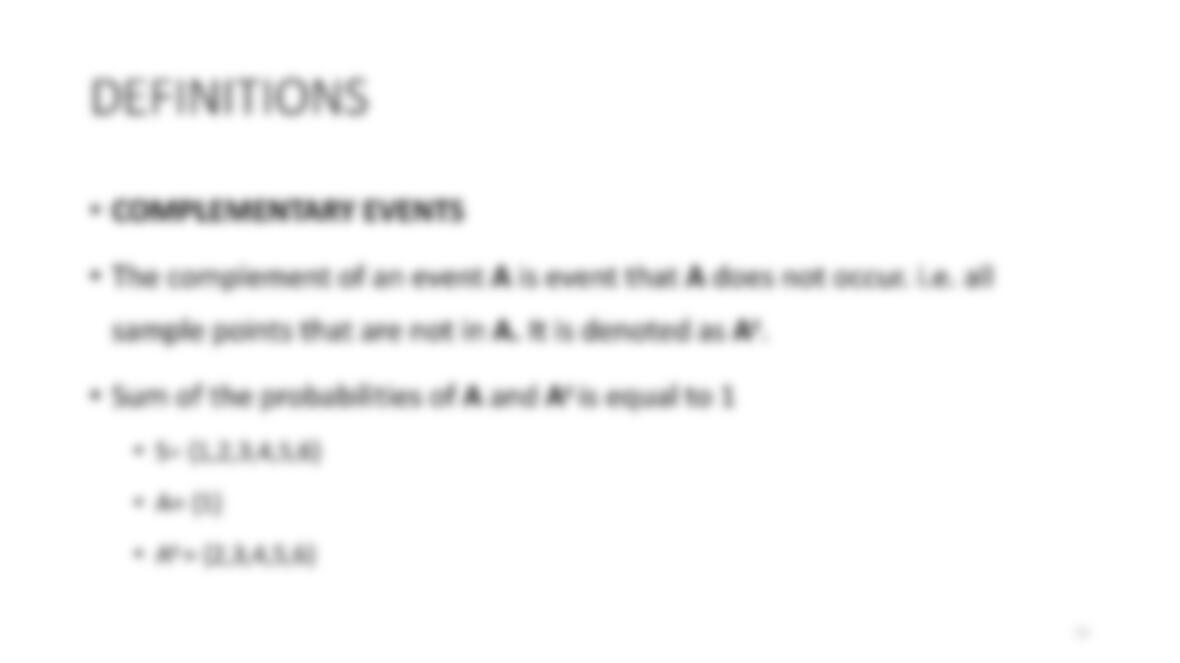
•We roll a die once and observe the value that is faced up.
•S = {1,2,3,4,5,6}
•Law of Large Numbers : When an experiment is replicated for a large
number of times, the relative frequency of an outcome approaches
the theoretical probability of the outcome.
4

DEFINITIONS
•Probability rules for sample points
•All sample point probabilities must be between 0 and 1
0 ≤ 𝑝𝑖≤ 1
•The sum of all sample point probabilities within a sample space must be equal
to 1
𝑝𝑖= 1
5

DEFINITIONS
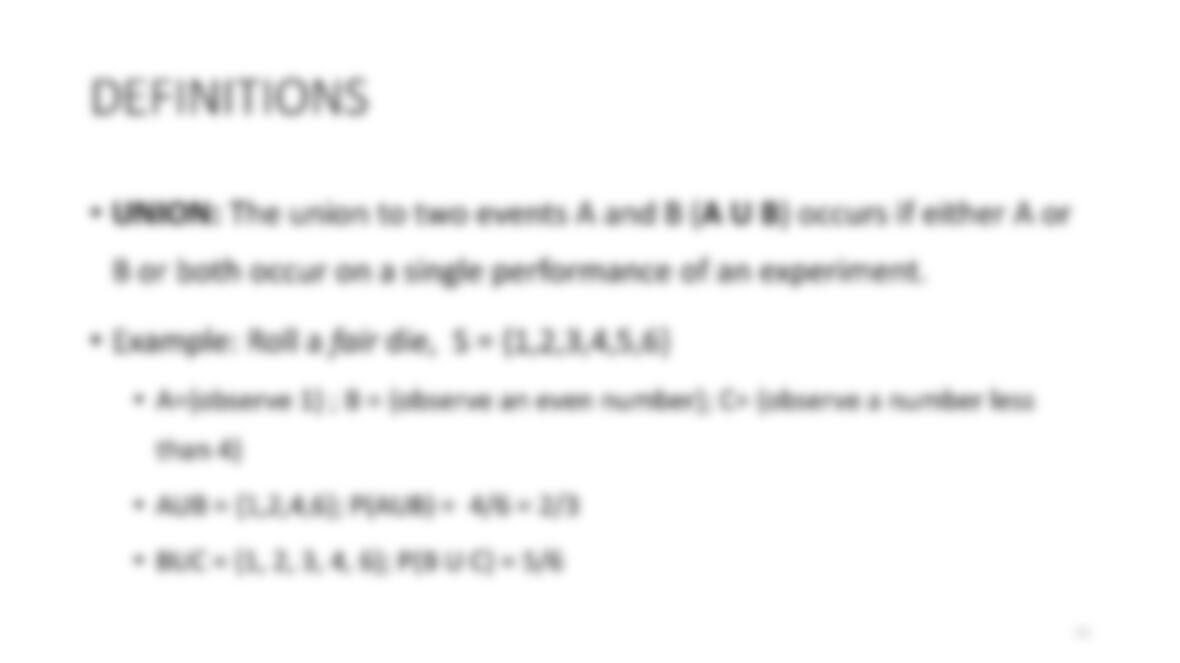
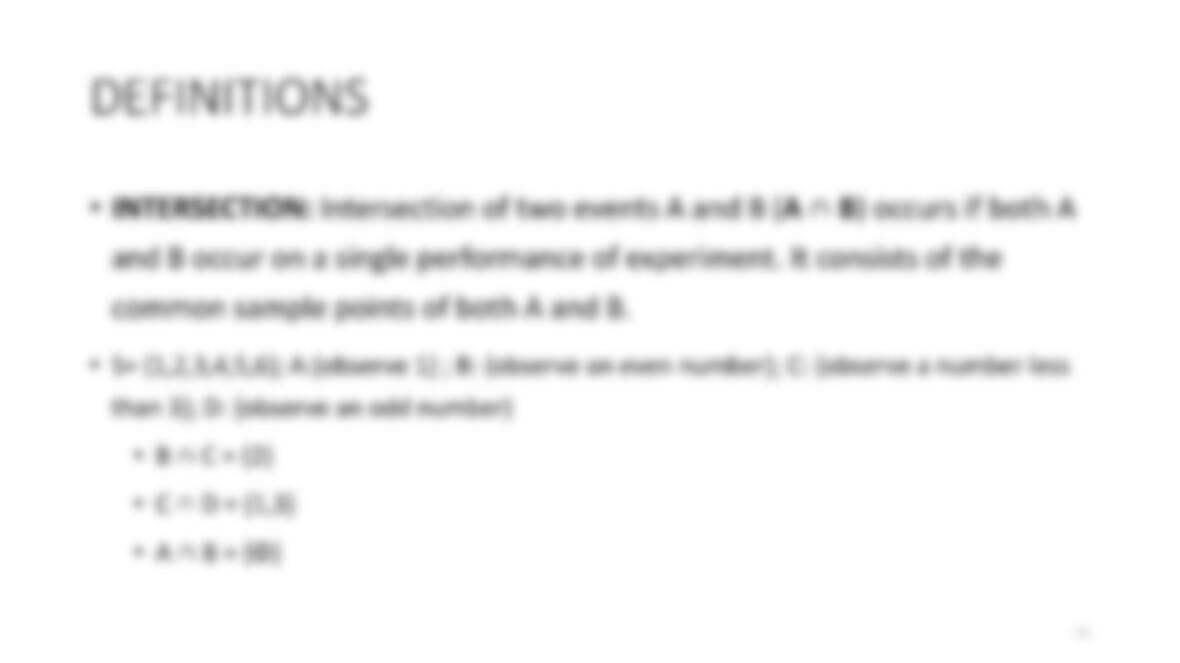
•Event: is a specific collection of sample points.
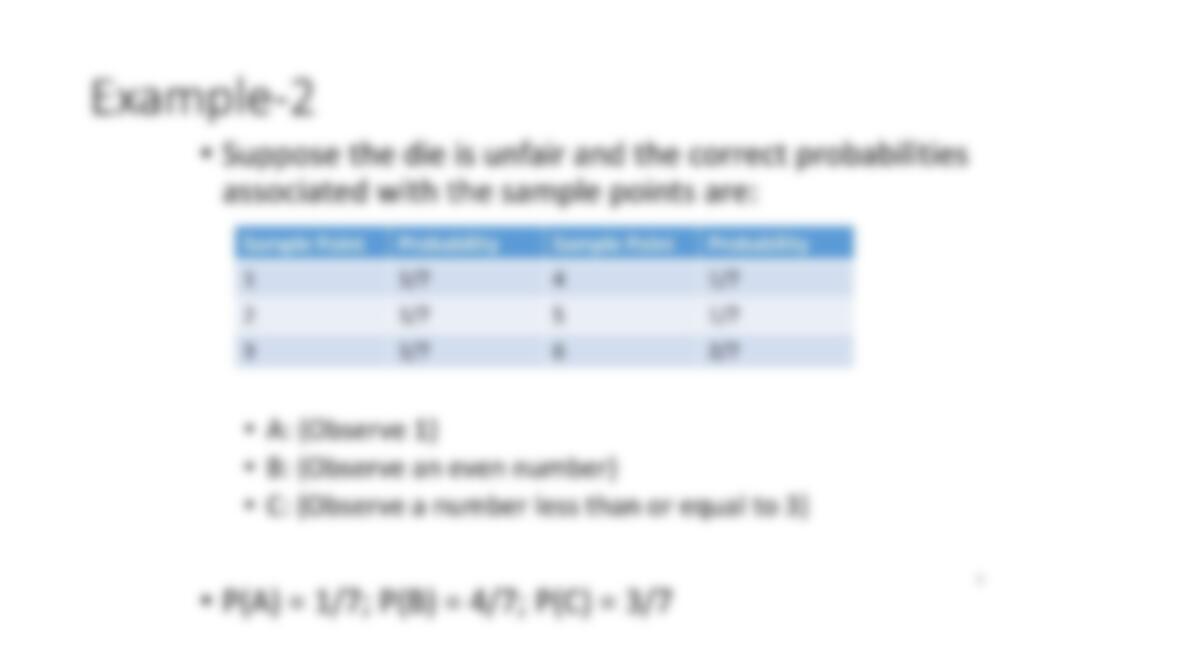
•Example: Define three events for one roll of a fair die:
•A: {Observe 1}
•B: {Observe an even number}
•C: {Observe a number less than or equal to 3 }
•P(A) = 1/6; P(B) = 1/2; P(C) = 1/2
•If all sample points are equally likely,
P = # of sample points in event /total # of sample points
6
Steps for calculating probabilities of events
1. Define the experiment –Roll of a die
2. List the sample points –S = {1,2,3,4,5,6}
3. Assign probabilities to the sample points –1(1/6), 2(1/6), 3(1/6), 4(1/6),
5(1/6), 6(1/6)