Introduction to Primary Research:
Observations, Surveys, and
Interviews
by Dana Lynn Driscoll
This essay is a chapter in Writing Spaces: Readings on Writing, Volume 2, a
peer-reviewed open textbook series for the writing classroom.
Download the full volume and individual chapters from:
•Writing Spaces: http://writingspaces.org/essays
•Parlor Press: http://parlorpress.com/writingspaces
•WAC Clearinghouse: http://wac.colostate.edu/books/
Print versions of the volume are available for purchase directly from Parlor
Press and through other booksellers.
This essay is available under a Creative Commons License subject to the Writing Spaces’
Terms of Use. More information, such as the specific license being used, is available at the
bottom of the first page of the chapter.
© 2011 by the respective author(s). For reprint rights and other permissions, contact the
original author(s).
Library of Congress Cataloging-in-Publication Data
Writing spaces : readings on writing. Volume 1 / edited by Charles Lowe and Pavel
Zemliansky.
p. cm.
Includes bibliographical references and index.
ISBN 978-1-60235-184-4 (pbk. : alk. paper) — ISBN 978-1-60235-185-1 (adobe ebook)
1. College readers. 2. English language–Rhetoric. I. Lowe, Charles, 1965- II. Zemliansky,
Pavel.
PE1417.W735 2010
808’.0427–dc22
2010019487

153
Introduction to Primary Research:
Observations, Surveys, and
Interviews
Dana Lynn Driscoll
Primary Research: Definitions and Overview
How research is defined varies widely from field to field, and as you
progress through your college career, your coursework will teach you
much more about what it means to be a researcher within your field.*
For example, engineers, who focus on applying scientific knowledge
to develop designs, processes, and objects, conduct research using
simulations, mathematical models, and a variety of tests to see how
well their designs work. Sociologists conduct research using surveys,
interviews, observations, and statistical analysis to better understand
people, societies, and cultures. Graphic designers conduct research
through locating images for reference for their artwork and engaging
in background research on clients and companies to best serve their
needs. Historians conduct research by examining archival materials—
newspapers, journals, letters, and other surviving texts—and through
conducting oral history interviews. Research is not limited to what has
already been written or found at the library, also known as secondary
* This work is licensed under the Creative Commons Attribution-
Noncommercial-ShareAlike 3.0 United States License and is subject to the
Writing Spaces’ Terms of Use. To view a copy of this license, visit http://
creativecommons.org/licenses/by-nc-sa/3.0/us/ or send a letter to Creative
Commons, 171 Second Street, Suite 300, San Francisco, California, 94105,
USA. To view the Writing Spaces’ Terms of Use, visit http://writingspaces.
org/terms-of-use.
Dana Lynn Driscoll154
research. Rather, individuals conducting research are producing the ar–
ticles and reports found in a library database or in a book. Primary
research, the focus of this essay, is research that is collected firsthand
rather than found in a book, database, or journal.
Primary research is often based on principles of the scientific meth-
od, a theory of investigation first developed by John Stuart Mill in
the nineteenth century in his book Philosophy of the Scientific Method.
Although the application of the scientific method varies from field to
field, the general principles of the scientific method allow researchers
to learn more about the world and observable phenomena. Using the
scientific method, researchers develop research questions or hypoth-
eses and collect data on events, objects, or people that is measurable,
observable, and replicable. The ultimate goal in conducting primary
research is to learn about something new that can be confirmed by
others and to eliminate our own biases in the process.
Essay Overview and Student Examples
The essay begins by providing an overview of ethical considerations
when conducting primary research, and then covers the stages that
you will go through in your primary research: planning, collecting,
analyzing, and writing. After the four stages comes an introduction
to three common ways of conducting primary research in first year
writing classes:
•Observations. Observing and measuring the world around
you, including observations of people and other measurable
events.
•Interviews. Asking participants questions in a one-on–one or
small group setting.
•Surveys. Asking participants about their opinions and behav-
iors through a short questionnaire.
In addition, we will be examining two student projects that used sub–
stantial portions of primary research:
Derek Laan, a nutrition major at Purdue University, wanted to
learn more about student eating habits on campus. His primary re–
search included observations of the campus food courts, student be–
havior while in the food courts, and a survey of students’ daily food
intake. His secondary research included looking at national student
Introduction to Primary Research 155
eating trends on college campuses, information from the United States
Food and Drug Administration, and books on healthy eating.
Jared Schwab, an agricultural and biological engineering major at
Purdue, was interested in learning more about how writing and com-
munication took place in his field. His primary research included
interviewing a professional engineer and a student who was a senior
majoring in engineering. His secondary research included examining
journals, books, professional organizations, and writing guides within
the field of engineering.
Ethics of Primary Research
Both projects listed above included primary research on human partic-
ipants; therefore, Derek and Jared both had to consider research ethics
throughout their primary research process. As Earl Babbie writes in
The Practice of Social Research, throughout the early and middle parts
of the twentieth century researchers took advantage of participants
and treated them unethically. During World War II, Nazi doctors
performed heinous experiments on prisoners without their consent,
while in the U.S., a number of medical and psychological experiments
on caused patients undue mental and physical trauma and, in some
cases, death. Because of these and other similar events, many nations
have established ethical laws and guidelines for researchers who work
with human participants. In the United States, the guidelines for the
ethical treatment of human research participants are described in The
Belmont Report, released in 1979. Today, universities have Institutional
Review Boards (or IRBs) that oversee research. Students conducting
research as part of a class may not need permission from the univer–
sity’s IRB, although they still need to ensure that they follow ethical
guidelines in research. The following provides a brief overview of ethi-
cal considerations:
•Voluntary participation. The Belmont Report suggests that, in
most cases, you need to get permission from people before
you involve them in any primary research you are conduct–
ing. If you are doing a survey or interview, your participants
must first agree to fill out your survey or to be interviewed.
Consent for observations can be more complicated, and is dis-
cussed later in the essay.
Dana Lynn Driscoll156
•Confidentiality and anonymity. Your participants may reveal
embarrassing or potentially damaging information such as
racist comments or unconventional behavior. In these cases,
you should keep your participants’ identities anonymous
when writing your results. An easy way to do this is to create
a “pseudonym” (or false name) for them so that their identity
is protected.
•Researcher bias. There is little point in collecting data and
learning about something if you already think you know the
answer! Bias might be present in the way you ask questions,
the way you take notes, or the conclusions you draw from the
data you collect.
The above are only three of many considerations when involving
human participants in your primary research. For a complete under–
standing of ethical considerations please refer to The Belmont Report.
Now that we have considered the ethical implications of research,
we will examine how to formulate research questions and plan your
primary research project.
Planning Your Primary Research Project
The primary research process is quite similar to the writing process,
and you can draw upon your knowledge of the writing process to un-
derstand the steps involved in a primary research project. Just like in
the writing process, a successful primary research project begins with
careful planning and background research. This section first describes
how to create a research timeline to help plan your research. It then
walks you through the planning stages by examining when primary
research is useful or appropriate for your first year composition course,
narrowing down a topic, and developing research questions.
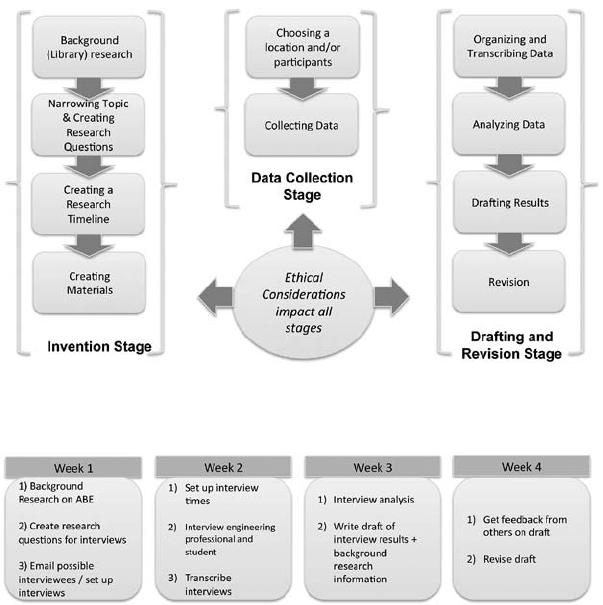
e Research Timeline
When you begin to conduct any kind of primary research, creating a
timeline will help keep you on task. Because students conducting pri-
mary research usually focus on the collection of data itself, they often
overlook the equally important areas of planning (invention), analyz-
ing data, and writing. To help manage your time, you should create a
research timeline, such as the sample timeline presented here.
Introduction to Primary Research 157
When Primary Research Is Useful or Appropriate
In Evaluating Scientific Research: Separating Fact from Fiction, Fred
Leavitt explains that primary research is useful for questions that can
be answered through asking others and direct observation. For first
year writing courses, primary research is particularly useful when you
want to learn about a problem that does not have a wealth of published
information. This may be because the problem is a recent event or it
is something not commonly studied. For example, if you are writing
a paper on a new political issue, such as changes in tax laws or health–
care, you might not be able to find a wealth of peer-reviewed research
because the issue is only several weeks old. You may find it necessary
to collect some of your own data on the issue to supplement what
you found at the library. Primary research is also useful when you
Fig. 1: The Research Process
Fig. 2: A sample timeline for Jared’s research project.
Dana Lynn Driscoll158
are studying a local problem or learning how a larger issue plays out
at the local level. Although you might be able to find information on
national statistics for healthy eating, whether or not those statistics are
representative of your college campus is something that you can learn
through primary research.
However, not all research questions and topics are appropriate for
primary research. As Fred Leavitt writes, questions of an ethical, phil-
osophical, or metaphysical nature are not appropriate because these
questions are not testable or observable. For example, the question
“Does an afterlife exist?” is not a question that can be answered with
primary research. However, the question “How many people in my
community believe in an afterlife?” is something that primary research
can answer.
Narrowing Your Topic
Just like the writing process, you should start your primary research
process with secondary (library) research to learn more about what is
already known and what gaps you need to fill with your own data. As