I. INTRODUCTION:
Marketing can be seen as the process by which individuals or groups achieve what
they need and want through the creation, dedication, and free exchange of values of
products and services with each other. By definition for managers, marketing is like
“art of selling”, but surprisingly, the most important element of marketing is not
actually selling the product. As Kotler, P. and Armstrong, G. define marketing as the
process by which companies engage customers, build strong customer relationships,
and create customer value in order to capture value from customers in return. A
customer who works with a unit with good care will definitely bring a better
experience than where it is not. Customers will be answered the needs and wants,
avoiding wasting time on marginal problems.
II. MARKETING PROCESS:
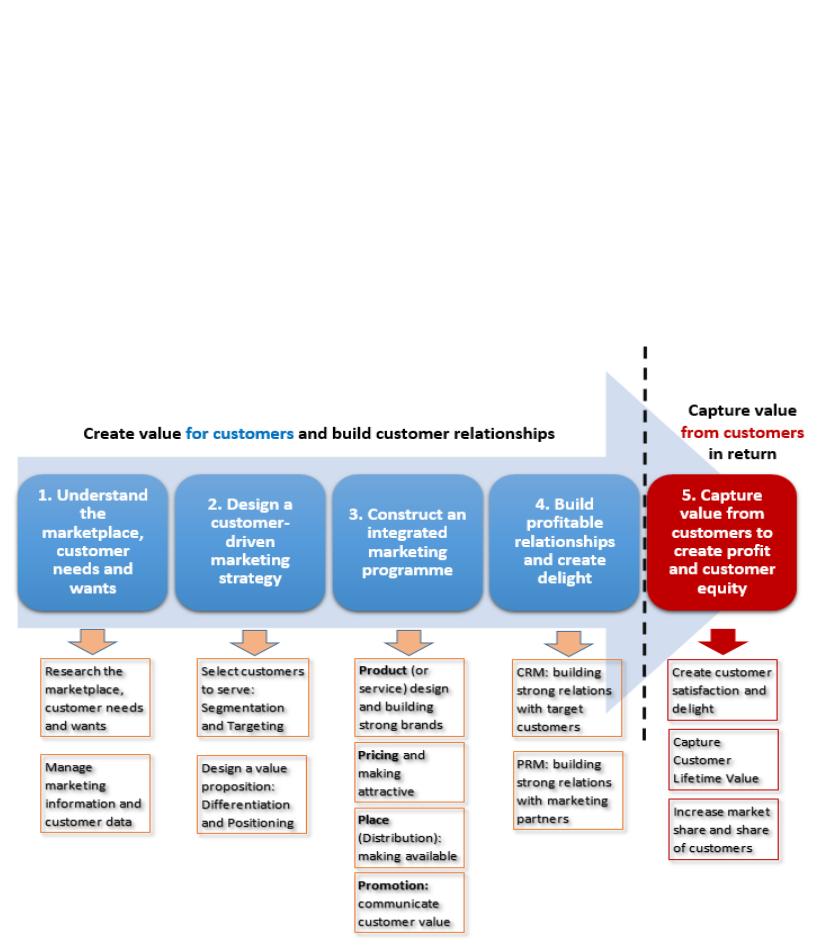
The strategic marketing process puts all the pieces together so that everything you do
contributes to the success of your business. Rather than executing haphazard activities
and ideas, developing a solid plan that weaves goals and tactics into a seamless
experience is essential. You can follow these steps to create products and services that
will delight your customers and beat out your competitors. There are five-step model
of the marketing process. In the first four steps, companies work to understand
consumers, create customer value,, and build strong customer relationships. In the
final step, companies reap the rewards of creating superior customer value. By
creating value for consumers, they in turn capture value form consumers in the form
of sales, profits, and the long-term customer equity.

1. Building customer relationships:
The fourth step in the first part of the Marketing Process which aims to create value
for customers is to build profitable customer relationships with target customers. The
factor leading to success in this goes beyond satisfying customers. Instead, the
orientation must be creating customer delight, meaning that the company’s offers
exceed customers’ expectations. Then, customers will repeat the purchase action and
stay loyal and profitable for the company. Therefore, this step may be the most
important one in the first part of the Marketing Process. The process which leads to
the creation and maintenance of customer relationships is CRM, Customer
Relationship Management. However, the firm cannot do all of this alone. Creating
customer value and maintaining strong customer relationships also requires strong
relationships and collaboration. building customer relationship is the important thing
in service marketing and relationship marketing.
a. Relationship marketing:
Relationship marketing is about forming long-term relationships with customers.
Rather than trying to encourage a one-time sale, relationship marketing tries to foster
customer loyalty by providing exemplary products and services. This is different than
most normal advertising practices that focus on a single transaction; watch ad A and
buy product B. Relationship marketing, by contrast, is usually not linked to a single
product or offer. It involves a company refining the way they do business in order to
maximize the value of that relationship for the customer. Relationship marketing
mainly involves the improvement of internal operations. Many customers leave a
company not because they didn’t like the product, but because they were frustrated
with the customer service. If a business streamlines its internal operations to satisfy all
service needs of their customers, customers will be happier even in the face of product
problems. There are three categories of relationship marketing:
i. Database marketing:
Database marketing is a form of direct marketing using databases of customers or
potential customers to generate personalized communications in order to promote a
product or service for marketing purposes. Database marketing emphasizes the use of
statistical techniques by using customers’ data to develop models of customer
behavior, which are then used to select customers for communications.
ii. Interaction marketing:
Face-to-face interaction between customers and representatives of the supplier. It is a
cyclical process of initiating and responding through two-way between organization
and customers. Interactive marketing is the ability to address the customer, remember
what the customer says and address the customer again in a way that illustrates that
we remember what the customer has told us.
iii. Network marking:
Network marketing also known as Multi-level marketing (MLM) is a business model
that relies on a network of customers, distributors, suppliers, the media, consultants,
trade associations, government agencies, competitors etc.
Importance of relationship marketing
Acquiring new customers can be challenging and costly. Relationship marketing helps
retain customers over the long term, which results in customer loyalty rather than
customers purchase once or infrequently.
Relationship marketing is important for its ability to stay in close contact with
customers. By understanding how customers use a brand’s products and services and
observing additional unmet needs, brands can create new features and offerings to
meet those needs, further strengthening the relationship.
Benefits of relationship marketing
• Higher customer lifetime value (CLV). Relationship marketing creates loyal
customers, which leads to repeat purchases and a higher CLV. In addition, loyal
customers are likely to become brand advocates or ambassadors, recommending
products and services to friends, family and business associates.
• Reduction in marketing and advertising spend. Spending on marketing and
advertising to acquire new customers can be expensive. Relationship marketing
causes customers to do the marketing for a brand, in what’s called buzz marketing.
Customers tell others about a brand’s products and services, which can drive sales.
Brands with exceptional relationship marketing programs spend little to no money
on marketing or advertising.
• Stronger organizational alignment around the customer. Organizations that
emphasize relationship marketing have a stronger organizational alignment