Tutorial 1
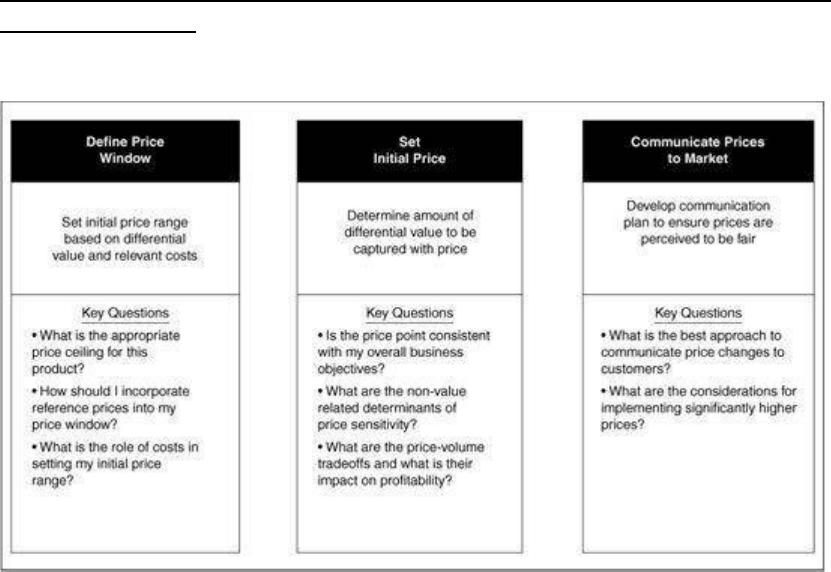
1. Discuss the impact/implications of the five key elements of strategic pricing.
Value creation
Total savings or satisfaction that the customer receives
Economic value: Offer true differentiation value to customers, over and above what
your competitors offer.
Offering design: “Value packages” for customers — combination of products and
services that refine value creation to match closely what each customer receives.
Segmentation: Segment and compare based on value drivers and economic value
estimation to find most profitable opportunities given your capabilities
Implications
Create a good value that you can sell profitably, not great products and services
that maximise creative potential.
Value creation requires deep understanding of customer needs and how it creates
value from them and which customer segments are high value segments
When price is factored into the decision, many customers are willing to give up in
exchange for lower prices.
Price structure
Tactics for pricing across segments
Metrics: The basis for tracking the value customers receive and how they pay for it
Fences: Policies, rules, programs and structures that customers must follow to
qualify for price discounts or rewards.
Controls
Implications
Make pricing align with value delivered and costs to serve, not products sold.
More complicated price structure is to reflect di&erences in the potential
contribution that can be captured from di&erent customer segments by capturing
the best possible price from each segment, making the sale at the lowest positive
cost or both.
Price and value communication
Strategies to influence willingness to pay
Communication
Criteria for discounting
Implications
Justify prices in terms of customer economics
Understanding the value your products create for customers and translating that
understanding into a value-based price structure can still result in poor sales
unless customers recognise the value they are obtaining
Pricing policy
Setting prices based on economic value, pricing strategy, and pricing structure.
Negotiation tactics
Criteria for discounting
Implications
Manage pricing proactively to influence expectations, not in relation to them.
Success of a pricing strategy depends upon customers being willing to pay the
price you exchange
Rationale for value based pricing is that a customer’s relative willingness to pay for
one product versus another should track closely with di&erences in the relative
value of those products
Price level
Setting the right price level for sustainable profit
Implication
Set price levels to maximise long-term profitability, not margin or market share.

2. “Price cu ng is a useful marketing tool for gaining sales.” Explain this statement.
Lecture 1 Page 3 Slide 10
Certainly, this approach to pricing has been the key to success for warehouse
supermarkets and Asian textile manufacturers.
Price cu2ng through trial o&ers and couponing is a very successful way to induce
people to try a new product
Yet many airlines have become less profitable as they used price cu2ng to expand
Coke and Pepsi have converted markets of loyal customers into price conscious
brand switchers due to frequent price promotions to grab market share
Price cu2ng as a marketing tool is a double-edged sword. If competitors can
match your prices quickly and there is li4le ability to stimulate market demand,
price cu2ng may simply cut profitability.
3. Identify the problem with cost-driven pricing.
Sep 2013 Question 4 (b)
September 2013 Question 4 (b)
September 2012 Question 2 (a)
Impossible to determine a product’s unit cost before determining its price as unit
costs change with volume
A price increase to “cover” higher fixed costs reduces sales further and causes unit
cost to rise even higher (price increases actually reduce profits)
Cost-plus pricing leads to overpricing in weak markets and underpricing in strong
markets

4. Identify the problems with customer-driven pricing.
Lecture 1 Page 5 Slide 20
September 2013 Question 1 (c)
Sophisticated buyers are rarely honest about how much they are actually willing
to pay for a product. Professional purchasing agents conceal the true value of a
product to their organisations.
Customers’ willingness to pay. The job of marketers is not simply to process orders
at whatever price customers are currently willing to pay but rather to raise
customers’ willingness to pay a price that be4er reflects the product’ true value.
In conclusion, understand the value of the product to satisfied customers and
communicate that value to others.
5. Explain the two most important problems when prices re+ect the amount buyers
seem willing to pay.
Ignorance of the value of the product
May depress profits
6. Explain the goals of companies pricing objectives.
Lecture 1 Page 7 Slide 26
Survival: Companies may set survival as their main objective if they are troubled
by too much capacity, heavy competition, or changing consumer wants. To set a
plant going, a company may set a low price, hoping to increase demand.
Current profit maximisation: Companies may use current profit maximisation as
their objective. They estimate what demand and costs will be at di&erent prices
and choose the price that will produce the maximum current profit, cash %ow, or
return of investment.
Market-share leadership: Companies might use market-share leadership as their
objective. They believe that the company with the largest market share will enjoy
the lowest costs and highest long-run profit. Prices are usually set as low as
possible.
Product-quality leadership: This normally calls for charging a high price to cover
higher performance quality and the high cost of Research and Development.

Tutorial 2
1. Evaluate the possible ways a marketer can achieve pricing advantage.
Lecture 2 Page 1 & 2 Slides 4 & 5
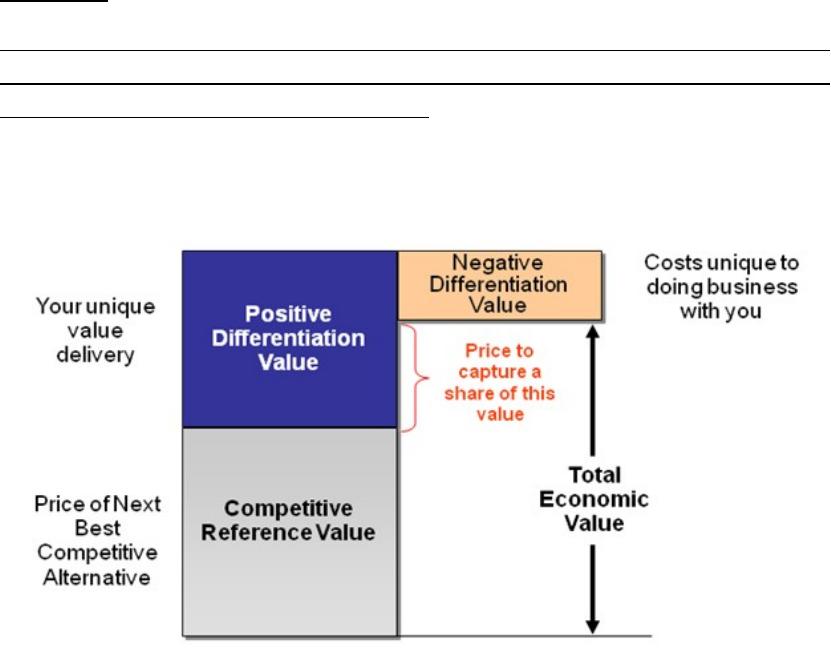
Value refers to the total savings or satisfaction that the customer receives from the
product
Value creation focuses on three key strategic areas:
Economic value: This is the source of pricing advantage. If you o&er true
di&erentiation value to your customers, over and above what your competitors
o&er, you have the latitude and %exibility to craC creative pricing strategies that
build upon and leverage your ability to set prices that truly reflect the value you
create.
offering design: This refers to the “value packages” you design for customers —
combinations of product and services, that refine value creation to match more
closely what each customer receives. Some customers prefer to receive an
augmented value package with lots of service and support, while others prefer to
receive the basic value package for a lower price.
Segmentation: This refers to value-based segmentation — based on di&erences in
economic value among buyers in the marketplace. A key way to distinguish among
di&erent segments based on economic value is to identify di&erences in value
drivers.
2. Discuss the principles of value-based market segmentation with appropriate
examples.
Lecture 2 Page 5 Slides 19 & 20
Di&erences
Most segmentation criteria correlate poorly with di&erent buyer’s motivations to
pay higher or lower prices
Needs-based segmentations give priority only to those di&erences that are
important to the customer
Value-based segmentations also uncover why customers find certain product
benefits appealing

Steps for value-based segmentation
1. Determine basic segmentation criteria
2. Identify discriminating value drivers
3. Determine your operational constraints & advantages
4. Create primary & secondary segments
5. Create detailed segment descriptions
6. Develop segment metrics & fences
3. Discuss the various possible pricing strategies with appropriate examples.
Pricing at a premium
Businesses set costs higher than their competitors
Most e&ective in the early days of a product’s life cycle, and ideal for small
businesses that sell unique goods.
Because customers need to perceive products as being worth the higher price tag,
a business must work hard to create a value perception.
Pricing for market penetration
Aim to attract buyers by o&ering lower prices on goods and services
Many new companies use this technique to draw attention away from their
competition, penetration pricing does tend to result in an initial loss of income for
the business.
Over time, however, the increase in awareness can drive profits and help small
businesses to stand out from the crowd.
In the long run, aCer suIciently penetrating a market, companies oCen wind up
最 終 raising their prices to be4er reflect the state of their position within the
market.
多用於新推出成熟的 mature phrase 產品,例:新飲料
Economy pricing
Aims to attract the most price-conscious of consumers
Businesses minimise the costs associated with marketing and production in order
to keep product prices down
As a result, customers can purchase the products they need without frills 虛飾.
The technique can be dangerous for small businesses. Because small businesses
lack the sales volume of larger companies, they may struggle to generate a
suIcient profit when prices are too low.
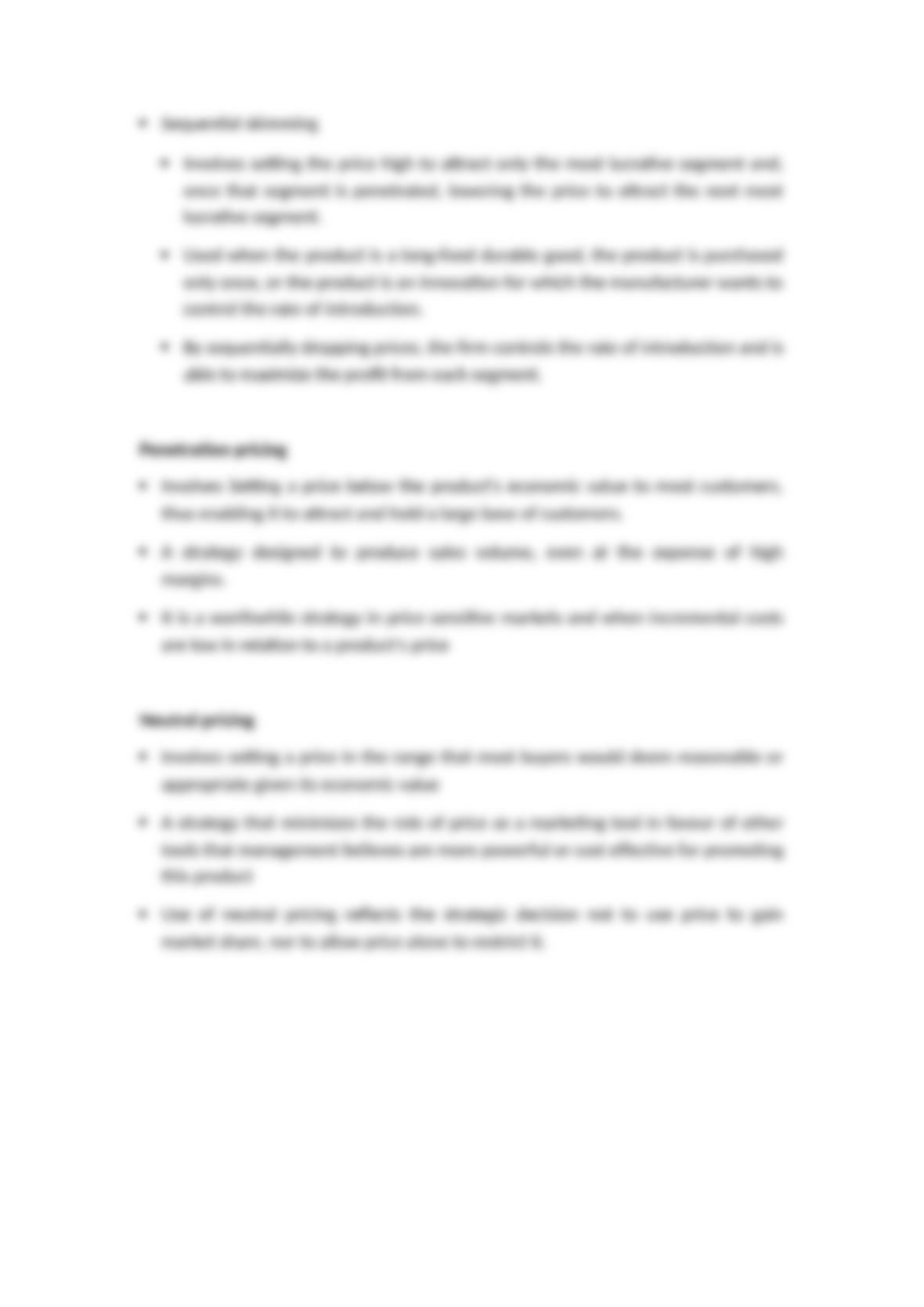
Price skimming
Help businesses maximise sales on new products and services