Article from accountingformanagement.com
Pricing Products and Services:
Learning Objectives of the Articles:
1. Compute the profit maximizing price of a product and service using the price
elasticity of demand and variable cost.
2. Compute the selling price of a product using the absorption costing approach.
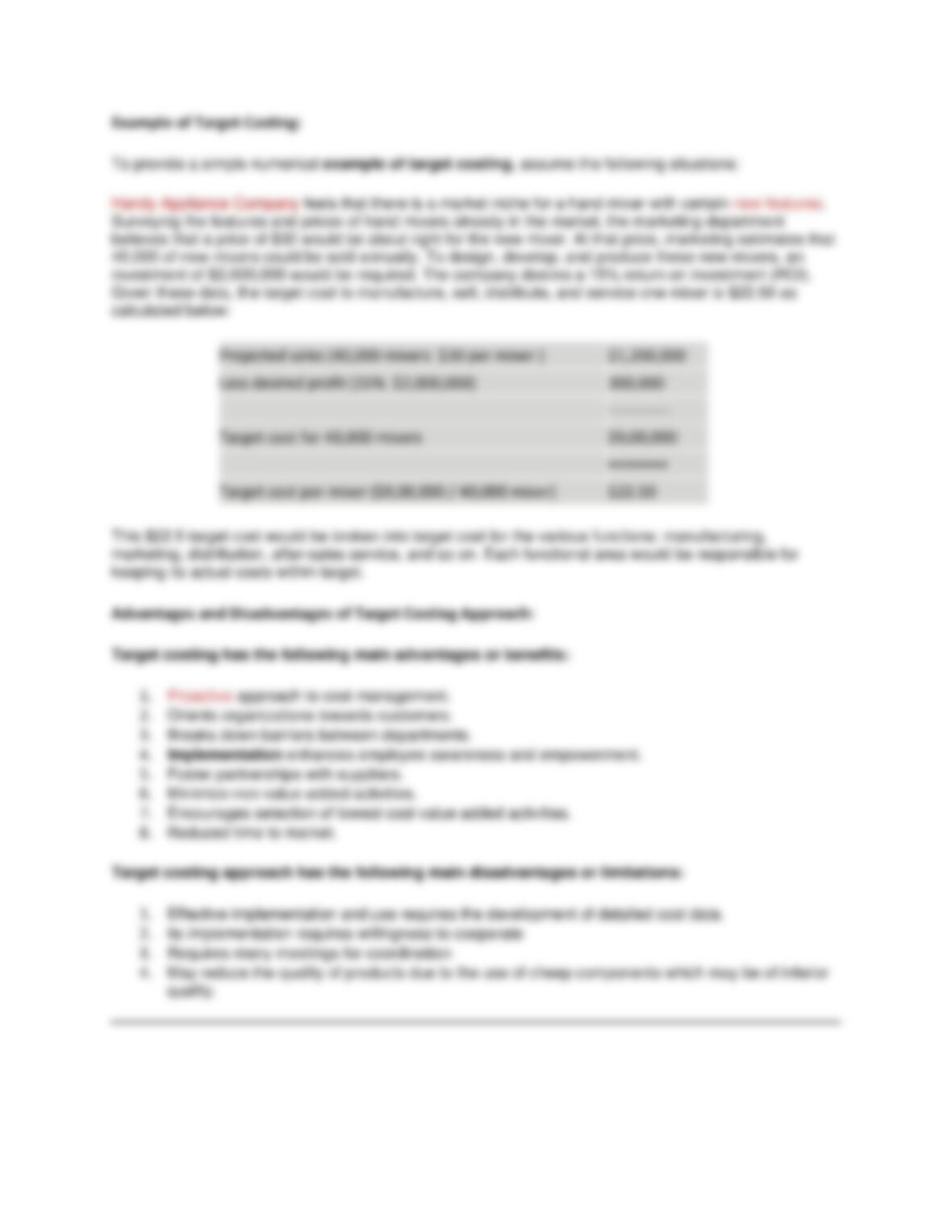
3. Calculate the target cost for a new product or service.
4. Calculate and use billing rates used in time and material pricing
Pricing is not a problem for some businesses. They make products or provide a service that
is in competition with others, identical products or services for which a market price already
exists. Customers will not pay more that this price, and there is no reason to charge less.
Under these circumstances, the company simply charges the prevailing market price.
Markets for basic raw materials such as farm products and minerals follow this pattern.
Here we are concerned with the more common situation in which a company is faced with
the problem of setting its own prices. Clearly, the pricing decision can be critical. If the price
is too high, customers will avoid purchasing the company’s products. If the price is set too
low, the company’s costs may not be covered.
the usual approach in pricing is to mark up cost. A product’s markup is the difference
between its selling price and its cost. The markup is usually expressed as a percentage of
cost. This approach is called cost plus pricing because the predetermined markup
percentage is applied to the cost base to determine a target selling price.
[Selling price = Cost + (Markup × Cost)]
For example, if a company uses a markup of 50%, to the costs of its products to determine
the selling price. If a product costs $10, then it would charge $15 for the products.
Two key issues must be addressed when the cost plus approach to pricing is used. First,
What cost should be used? Second, how should the markup be determined? Several
alternatives approaches are considered here, starting with the generally favored by
economists.

Price Elasticity of Demand—Economists’ Approach to Pricing:
If a company raises the price of a product, unit sales ordinarily falls. Because of this, pricing
is a delicate balancing act in which the benefits of higher revenues per unit are traded off
against the lower volume that results from charging higher prices. The sensitivity of unit
sales to changes in prices is called the price elasticity of demand.
Absorption Costing Approach to Cost Plus Pricing:
The absorption costing approach to cost plus pricing differs from the economists’ approach
(price elasticity of demand) both in what costs are marked up and in how markup is
determined. Under the absorption costing approach to cost plus pricing, the cost base is the
absorption costing unit product cost rather than variable costing.
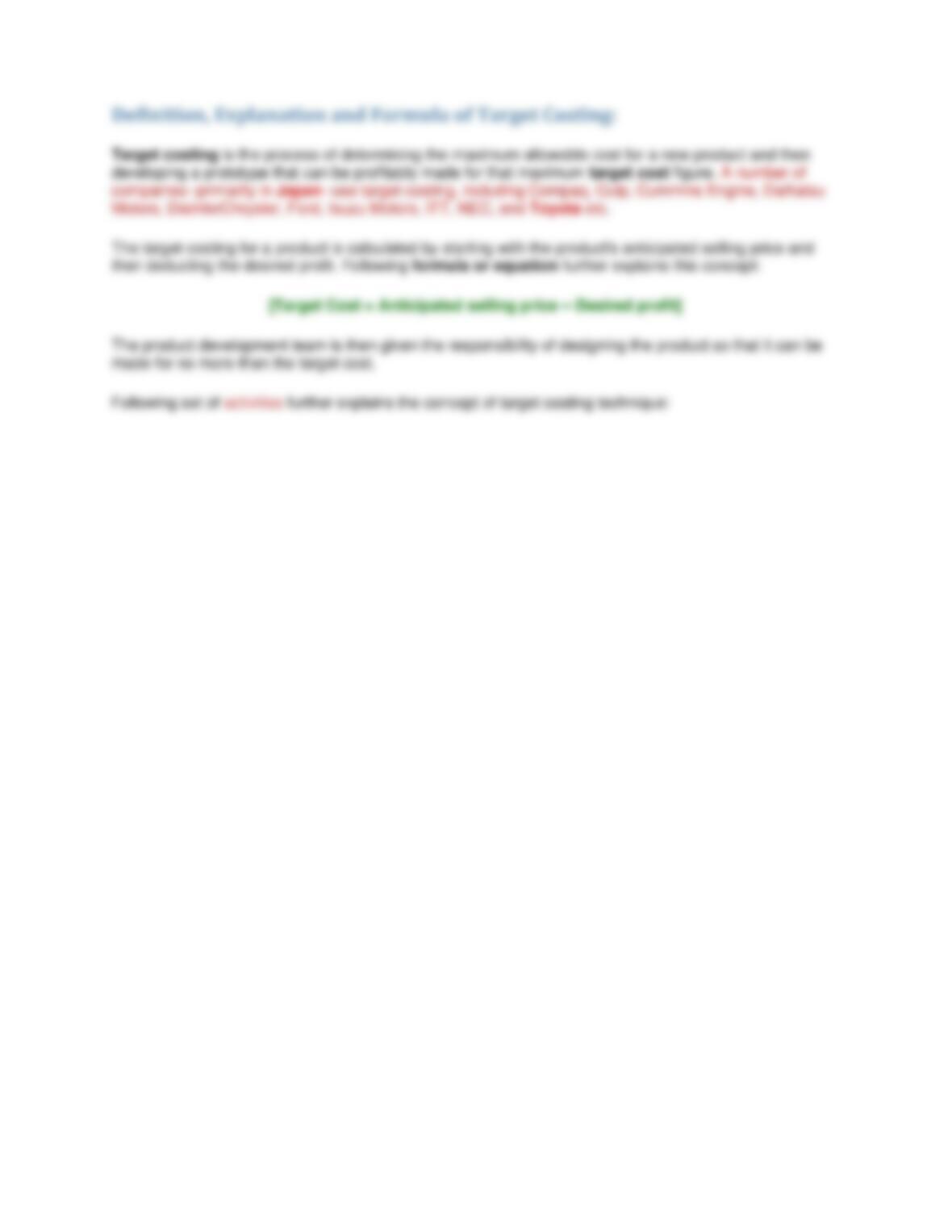
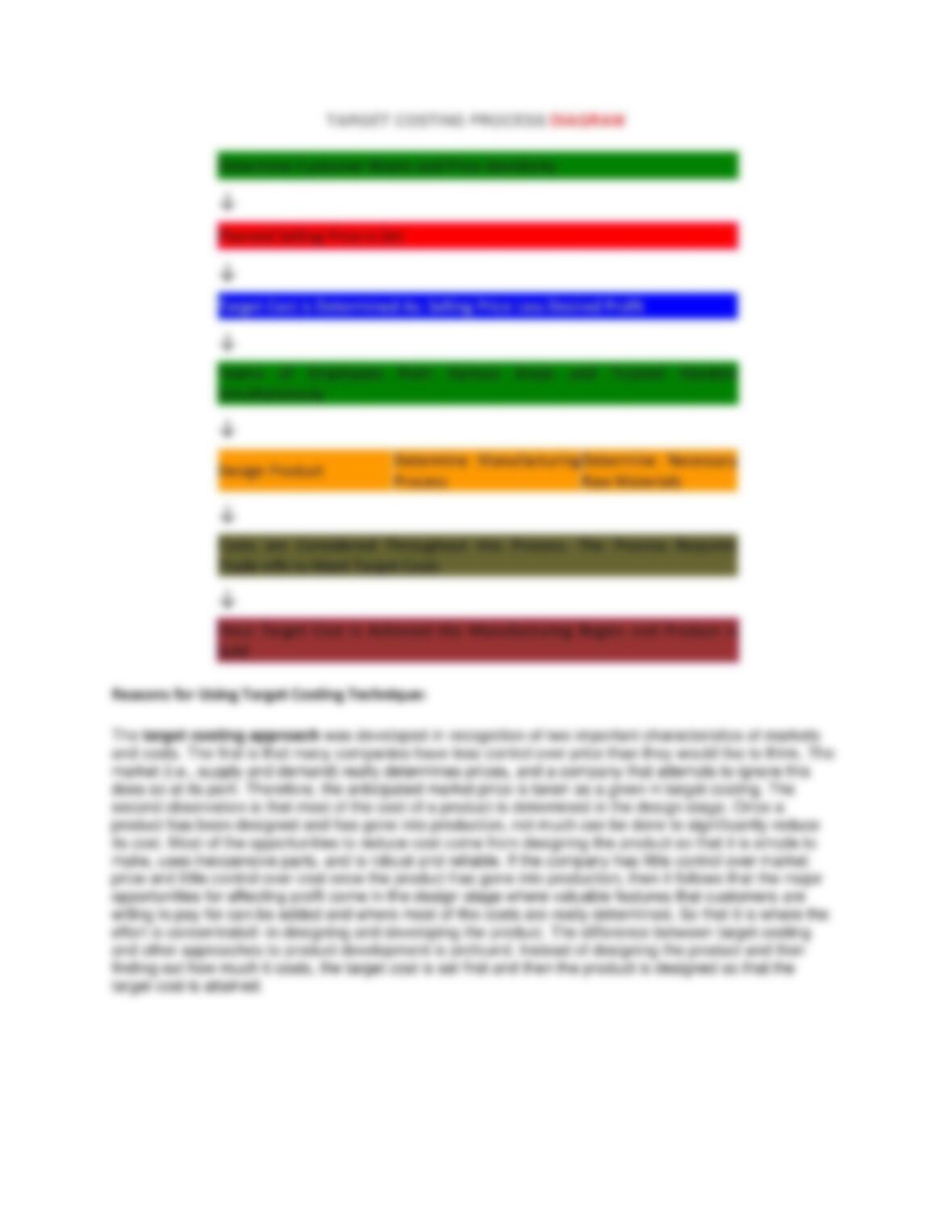
Target Costing:
Target costing is the process of determining the maximum allowable cost for a new product
and then developing a prototype that can be profitably made for that maximum target cost
figure.
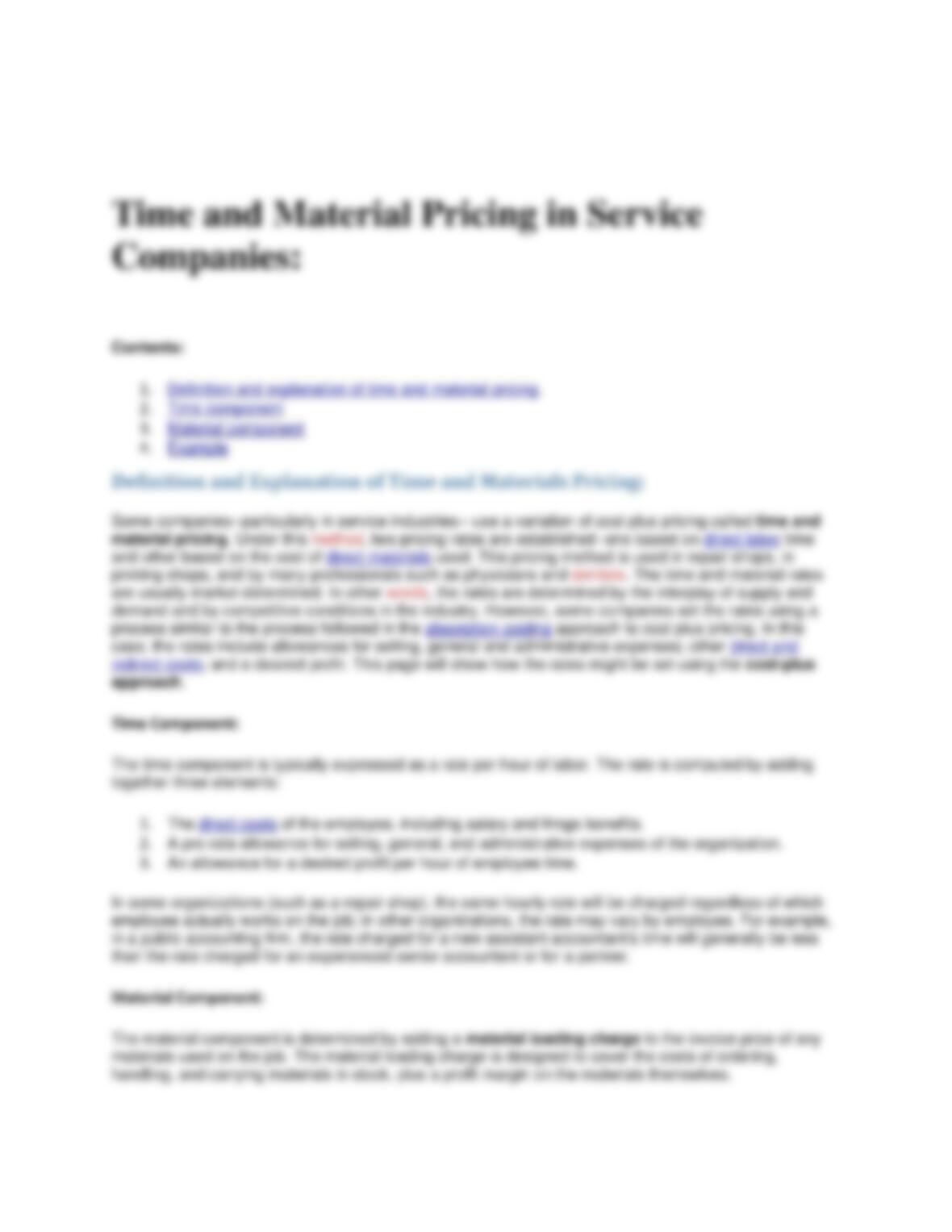
Time and Material Pricing in Service Companies:
Some companies—particularly in service industries— use a variation of cost plus pricing
called time and material pricing. Under this method, two pricing rates are established—
one based on direct labor time and other based on the cost of direct materials used.

Price Elasticity of Demand—Economists’
Approach to Pricing:
If a company raises the price of a product, unit sales ordinarily falls. Because of this, pricing is a delicate
balancing act in which the benefits of higher revenues per unit are traded-off against the lower volume
that results from charging higher prices. The sensitivity of unit sales to changes in prices is called the
price elasticity of demand.
1. Definition and explanation of price elasticity of demand
2. Formula of Price elasticity of demand
3. Profit maximizing price
Elasticity of Demand—Definition and Explanation:
A product’s price elasticity should be a key element in setting its price. The price elasticity of demand
measures the degree to which the unit sales of a product or service are affected by a change in price.
Demand for a product is said to be inelastic if a change in price has little effect on the number of units
sold. The demand for designer perfumes sold by trained personnel at cosmetic counters in department
stores is relatively inelastic. Lowering prices on these luxury goods has little effect on sales volume;
factors other than price are more important in generating sales. On the other hand, demand for a product
is said to be elastic if a change in price has a substantial effect on the volume of units sold. An example
of a product whose demand is elastic is gasoline. If a gas station raises its prices for gasoline, there will
usually be a substantial drop in volume as customers seek lower prices elsewhere.
Price elasticity is very important in determining prices. Managers should set higher markups over cost
where customers are relatively insensitive to price (i.e., demand is inelastic) and lower markups where
customers are relatively sensitive to price (i.e., demand is elastic). This principle is followed in
departmental stores. Merchandise sold in the bargain basement has a much lower markup than
merchandise sold elsewhere in the store because customers who shop in the bargain basement are
much more sensitive to price i.e., demand is elastic.
Formula and Example of Price Elasticity of Demand:
Price elasticity of demand for a product or service can be estimated using the following formula:
[Price Elasticity of Demand = In(1+ % Change in quantity sold) / In(1 + % Change in price)]
• The term In( ) is the natural log function. You can compute natural log of any number using the LN or lnx key on your calculator.
For example, ln(0.85) = –0.1625
• This formula assumes that the price elasticity of demand is constant. This occurs when the relationship between the selling price,
P, and the unit sales, q, can be expressed in the following form: ln(q) = a + elasticity of demand ln(p). Even if this is not precisely
true, the formula provides a useful way to estimate a product’s real price elasticity.

For example, suppose that the managers of Nature’s Garden Inc. believe that every 10% increase in the
selling price of their apple-almond shampoo will result in a 15% decrease in the number of bottles of
shampoo sold. The Calculation of the price elasticity of demand for this product would be as follows:
Price elasticity of Demand = In(1 + ( – (0.15)) / In(1 + (1.10))
In(0.85) / In(1.10)
= – 1.71
• The estimated change in unit sales should take into account competitor’s responses to a price change.
For comparison purposes, the managers of Nature’s Garden Inc. believe that another product, strawberry
glycerin soap, will experience 20% drop in unit sales if its price is increased by 10%. (Purchasers of this
product are more sensitive to price than the purchasers of the apple-almond shampoo). The calculation
of the price elasticity of demand for the strawberry glycerin soap is:
Price elasticity of Demand = In(1 + ( – (0.20)) / In(1 + (1.10))
In(0.80) / In(1.10)
= – 2.34
Both of these products, like other normal products, have a price elasticity that is less than – 1. Not also
that the price elasticity of demand for the strawberry glycerin soap is larger (in absolute value) that the
price elasticity of demand for the apple-almond shampoo. The more sensitive customers are to price, the
larger (in absolute value) in the price elasticity of demand. In other words, a larger (in absolute value)
price elasticity of demand indicates a product whose demand is more elastic. The price elasticity of
demand will be used to calculate selling price that maximizes the profits of the company.
Profit Maximizing Price:
Under certain conditions, it can be shown that the profit-maximizing price can be determined by
marking up variable cost using the following formula:
*[Profit-maximizing markup on variable cost = (Price elasticity of demand / 1 + Price elasticity of
demand) – 1]
*The formula assumes that:
• The price elasticity of demand is constant.
• Total cost = Total fixed cost + Variable cost per unit × q
• The price of the product has no effect on the sales or costs of any other product. The formula can be derived using calculus.
Using the above markup is equivalent to setting the selling price using this formula:
[Profit-maximizing price = (Price elasticity of demand / 1 + Price elasticity of demand) Variable
cost per unit]
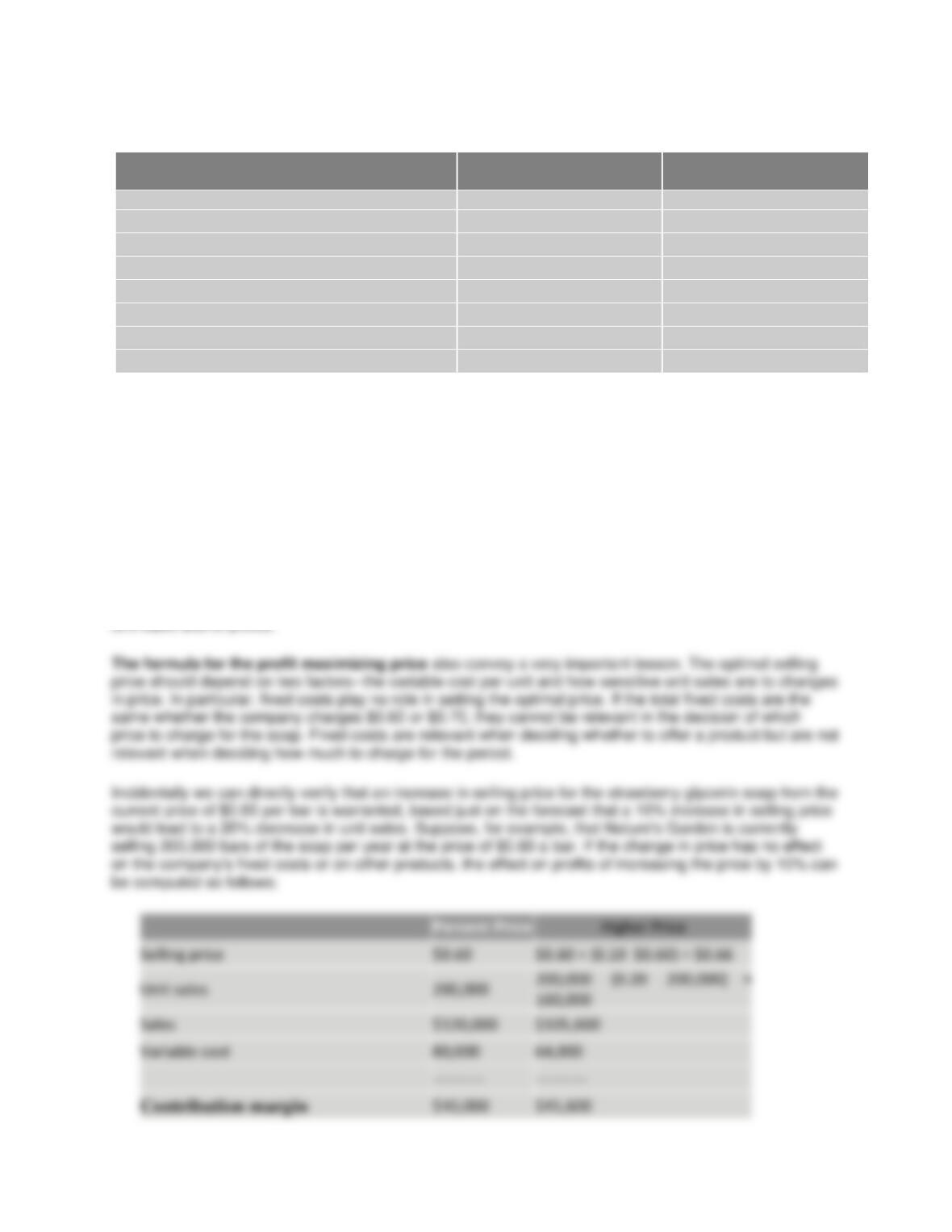
The profit maximizing prices for two Nature’s Garden products are computed below using these formulas:
Apple-Almond Shampoo
Strawberry Glycerin Soap
Price elasticity of demand
– 1.71
– 2.34
Profit maximizing markup on variable cost (a)
(– 1.71 / – 1.71 + 1) – 1
(– 2.34 / – 2.34 + 1) – 1
2.41 – 1 = 1.41 or 141%
1.75 – 1 = 0.75 or 75%
Variable cost per unit—given (b)
$2.00
$0.40
Markup, (a) × (b)
2.82
0.30
————
———–
Profit maximizing price
$4.82
$0.70
=======
=======
Note that the 75% markup for the strawberry glycerin soap is lower that 140% markup for the apple
almond shampoo. The reason for this is that the purchasers of strawberry glycerin soap are more
sensitive to price than the purchasers of apple-almond shampoo. This could be because strawberry
glycerin soap is a relatively common product with close substitutes available in nearly every grocery store.
Caution is advised when using these formulas to establish a selling price. The assumptions underlying
the formulas are probably not completely valid, and the estimate of the percentage change in unit sales
that would result from a given percentage change in price is likely to be inexact. Nevertheless, the
formulas can provide valuable clues regarding whether prices should be increased or decreased.
Suppose, for example, that the strawberry glycerin soap is currently being sold for $0.60 per bar. The
formula indicates that the profit maximizing price is $0.70 per bar. Rather than increasing the price by
$0.10, it would be prudent to increase the price by a more modest amount to observe what happens to