Protecting Workers
Health Series
No 5
Preventing Musculoskeletal Disorders
in the Workplace
Prof. Dr. rer. nat. Alwin Luttmann
PD Dr.-Ing. Matthias Jäger
Prof. Dr. med. Barbara Griefahn
Institute for Occupational Physiology
at the University of Dortmund
Institut für Arbeitsphysiologie
an der Universität Dortmund
Ardeystrasse 67
D-44139 Dortmund
Germany
and
Dr. med. sc. Gustav Caffier
Dr. med. Falk Liebers
Dipl.-Ing. Ulf Steinberg
Federal Institute for Occupational
Safety and Health/
Bundesanstalt für Arbeitsschutz
und Arbeitsmedizin
Nöldnerstrassie 40-42
D-10317 Berlin
Germany

Cover page layout
Tuula Solasaari-Pekki
Finnish Institute of Occupational Health
Design and layout
M/s Safire Graphix, New Delhi, India
Other booklets from the Protecting Workers Health Series:
No.1 : Preventing health risks from the use of pesticides in agriculture
No.2 : Understanding and performing economic assessments at the company
level
No. 3 : Work organization and stress at work
No.4 : Raising awareness of Psychological Harassment at Work

WHO Library Cataloguing-in-Publication Data
Preventing musculoskeletal disorders in the workplace/Alwin Luttmann … [et al.]
Protecting workers health series ; no. 5.
1. Musculoskeletal diseases – prevention and control 2. Workplace
3. Risk factors 4. Guidelines I. Luttmann, Alwin. II. Series
ISBN 92 4 159053 X (LC/NLM classification: WA 440)
© World Health Organization 2003
All rights reserved. Publications of the World Health Organization can be obtained from
Marketing and Dissemination, World Health Organization, 20 Avenue Appia, 1211
Geneva 27, Switzerland (tel: +41 22 791 2476; fax: +41 22 791 4857; email:
bookorders@who.int). Requests for permission to reproduce or translate WHO publica-
tions whether for sale or for noncommercial distribution should be addressed to
Publications, at the above address (fax: +41 22 791 4806; email: permissions@who.int).
The designations employed and the presentation of the material in this publication do
not imply the expression of any opinion whatsoever on the part of the World Health
Organization concerning the legal status of any country, territory, city or area or of its
authorities, or concerning the delimitation of its frontiers or boundaries.
The World Health Organization does not warrant that the information contained in this
publication is complete and correct and shall not be liable for any damages incurred as
a result of its use.
Printed in India
All illustrations are copyright protected, therefore when using any of them the copy-
right owner has to be named: Lang/Metze Atelier f:50, Berlin

Preface
Disorders of the musculoskeletal system represent a main cause for
absence from occupational work. Musculoskeletal disorders lead to
considerable costs for the public health system. Specific disorders of the
musculoskeletal system may relate to different body regions and
occupational work. For example, disorders in the lower back are often
correlated to lifting and carrying of loads or to the application of vibration.
Upper-limb disorders (at fingers, hands, wrists, arms, elbows, shoulders,
neck) may result from repetitive or long-lasting static force exertion or
may be intensified by such activities. The severity of these disorders
may vary between occasional aches or pain to exactly diagnosed specific
diseases. Occurrence of pain may be interpreted as the result of a
reversible acute overloading or may be a pre-symptom for the beginning
of a serious disease.
The purpose of this document on the prevention of musculoskeletal
disorders is to inform about risk factors and to influence the actions of
employers and the behaviour of workers in such a way that risks of
physical loadings, dangerous to health or unnecessary fatiguing, are
avoided or diminished. The document has been prepared in such a way
that it can be used by employers, supervisors, and occupational health
trainers when designing work and work environment or for preparing
information materials and training programs. In consequence, application
of the guide should be helpful to reduce harm to individuals, to influence
the efficiency of work positively, and to reduce costs on the public health
system.
It is intended that this booklet be used by employers, supervisors and
occupational health trainers to help them recognise risks that may lead
to musculoskeletal disorders, as well as to design work itself and the
work environment in a way which is safe for the employee.
Acknowledgement is expressed to the following reviewers: Thomas R.
Waters, Ph. D., National Institute for Occupational Safety and Health,
Cincinnati; Dr. Hisashi Ogawa, World Health Organization, Regional
Adviser for Occupational Health, Regional Office for the Western Pacific,
Manila; and Evelyn Kortum-Margot, Occupational Health Programme,
World Health Organization, Geneva, Switzerland.
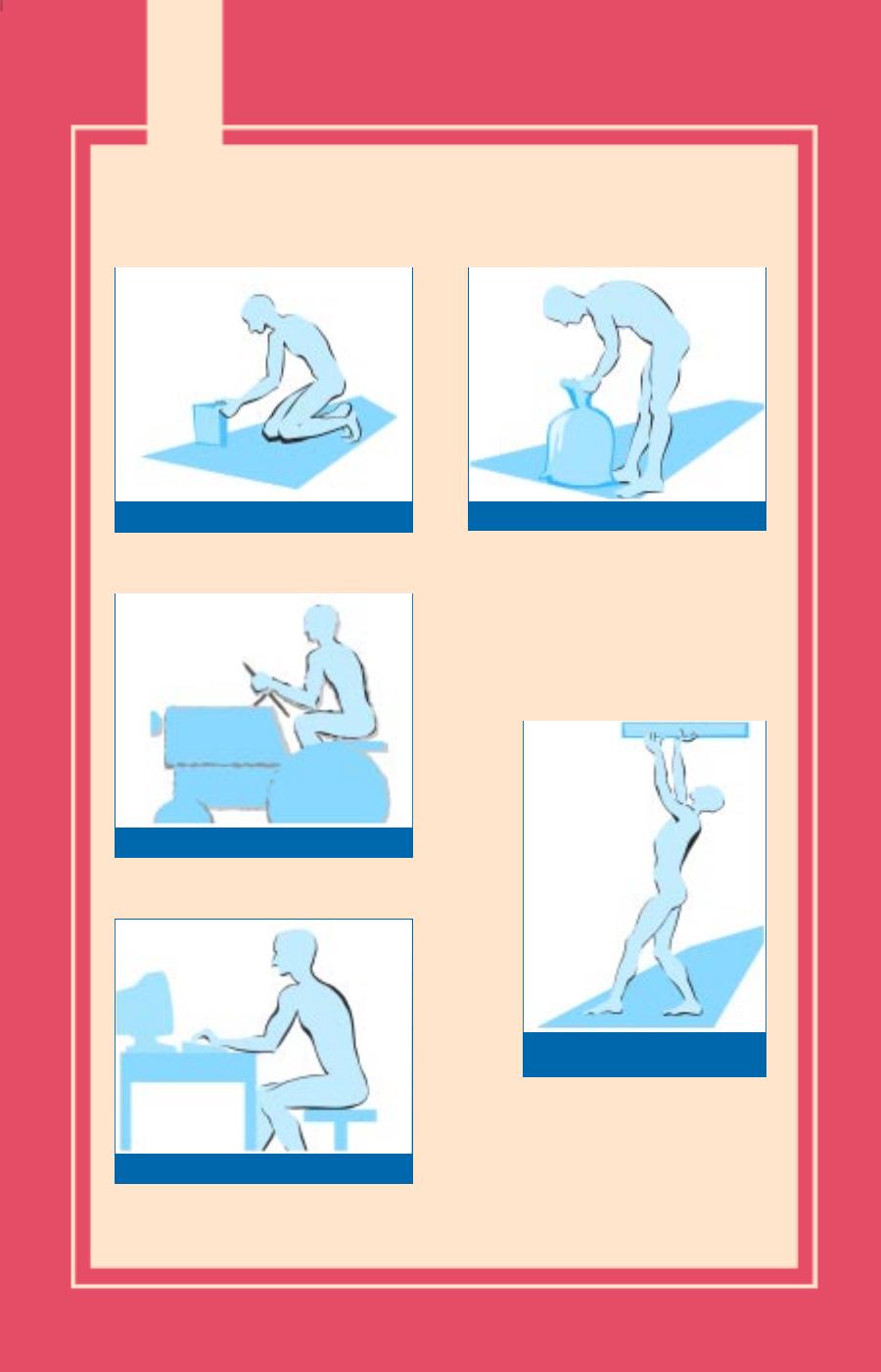
Examples of physical loadings at work which may be dan-
gerous to health:
Kneeling for long duration Manipulation of heavy loads
Sitting for long duration
Whole-body vibration
Static work and awkward
posture

Contents
Part 1: Objectives
1.1 Work-related musculoskeletal disorders – a definition 1
1.2 Characteristic health problems 2
1.3 Basic risk factors for the development of 3
musculoskeletal disorders
1.4 Factors to be considered in prevention 12
Part 2: Guidance
2 Guidance on main risk factors 15
2.1 Risk factor: Manipulation of heavy loads 15
2.2 Risk factor: Work with high force exertion 18
2.3 Risk factor: Working in unfavourable body postures 19
2.4 Risk factor: Monotonous repetitive tasks 22
2.5 Risk factor: Long-lasting loadings 23
2.6 Risk factor: Physical environmental conditions 25
Appendix: Basic rules for preventive actions in practice 27
Summary 29
Conclusion 30
Further reading and references 31
1
Objectives
1.1 Work-related musculoskeletal disorders – a definition
The term musculoskeletal disorders denotes health problems of
the locomotor apparatus, i.e. of muscles, tendons, the skeleton,
cartilage, ligaments and nerves. Musculoskeletal disorders include
all forms of ill-health ranging from light, transitory disorders to
irreversible, disabling injuries. This booklet focuses on
Part
1