STAT7055
LECTURE 2
Probability
February 17, 2016
STAT7055 – Lecture 2 February 17, 2016 1 / 64

Introduction Definitions
Random Experiment
IArandom experiment is a process that results in
one of several possible outcomes, none of which can
be predicted with certainty.
IFor example:
IRolling a conventional die. Possible outcomes are 1,2,3,
4,5or 6.
IFlipping a coin. Possible outcomes are heads or tails.
IOutcomes are denoted by Oi.
STAT7055 – Lecture 2 February 17, 2016 2 / 64

Introduction Definitions
Sample Space
IThe sample space of a random experiment is a list
of all the possible outcomes and is denoted by
S={O1, O2, O3, . . .}.
IFor example, when flipping a coin, S={H, T }.
IThe outcomes in a sample space must be both
mutually exclusive and exhaustive.
IMutually exclusive: No two outcomes can both occur
at the same time on any single trial of the experiment.
IExhaustive: The sample space must include all possible
outcomes that can occur.
STAT7055 – Lecture 2 February 17, 2016 3 / 64

Introduction Definitions
Probabilities of Outcomes
IThe probability of an outcome occurring on a single
trial is written as P(Oi).
IProbabilities associated with the outcomes in a
sample space must satisfy two important
requirements:
1. 0≤P(Oi)≤1for all i.
2. X
all i
P(Oi) = 1
STAT7055 – Lecture 2 February 17, 2016 4 / 64

Introduction Three Approaches for Assigning Probabilities
Classical Approach
IThe classical approach is based on the assumption
that the outcomes of an experiment are equally
likely to happen.
ISuppose we roll a fair six-sided die.
IWhat is the probability of rolling a 5?
IThe sample space is S={1,2,3,4,5,6}.
IAssuming all six outcomes are equally likely, the
probability of rolling a 5is P(5) = 1
6.
INote that in more complicated experiments, we often
need to use mathematical rules to count the total
number of outcomes.
STAT7055 – Lecture 2 February 17, 2016 5 / 64

Introduction Three Approaches for Assigning Probabilities
Relative Frequency Approach
IThe relative frequency approach defines
probability as the long-run relative frequency with
which an outcomes occurs.
ISuppose we roll a loaded six-sided die.
IWhat is the probability of rolling a 5?
IWe can’t assume equally likely outcomes.
IBut suppose we know that in the past 1000 rolls, a 5
came up 190 times.
IBased on this past history, we assign the probability of
rolling a 5to be the long-run relative frequency, i.e.,
190
1000 = 0.19.
STAT7055 – Lecture 2 February 17, 2016 6 / 64

Introduction Three Approaches for Assigning Probabilities
Subjective Approach
IThe subjective approach is based on personal
judgment, accumulation of knowledge, and
experience.
ISuppose we roll a loaded six-sided die.
IWhat is the probability of rolling a 5?
IWe can’t assume equally likely outcomes.
ISuppose I have no historical data on the die.
ISo, based on what I read about loaded dice on Wikipedia
and also based on how this particular die feels in my
hand (weight distribution, size, etc.), I decide that the
probability of rolling a 5is 0.2.
STAT7055 – Lecture 2 February 17, 2016 7 / 64

Introduction Events
Events
IAsimple event is an individual outcome from the
sample space.
IAn event is a collection of one or more simple
events (or outcomes).
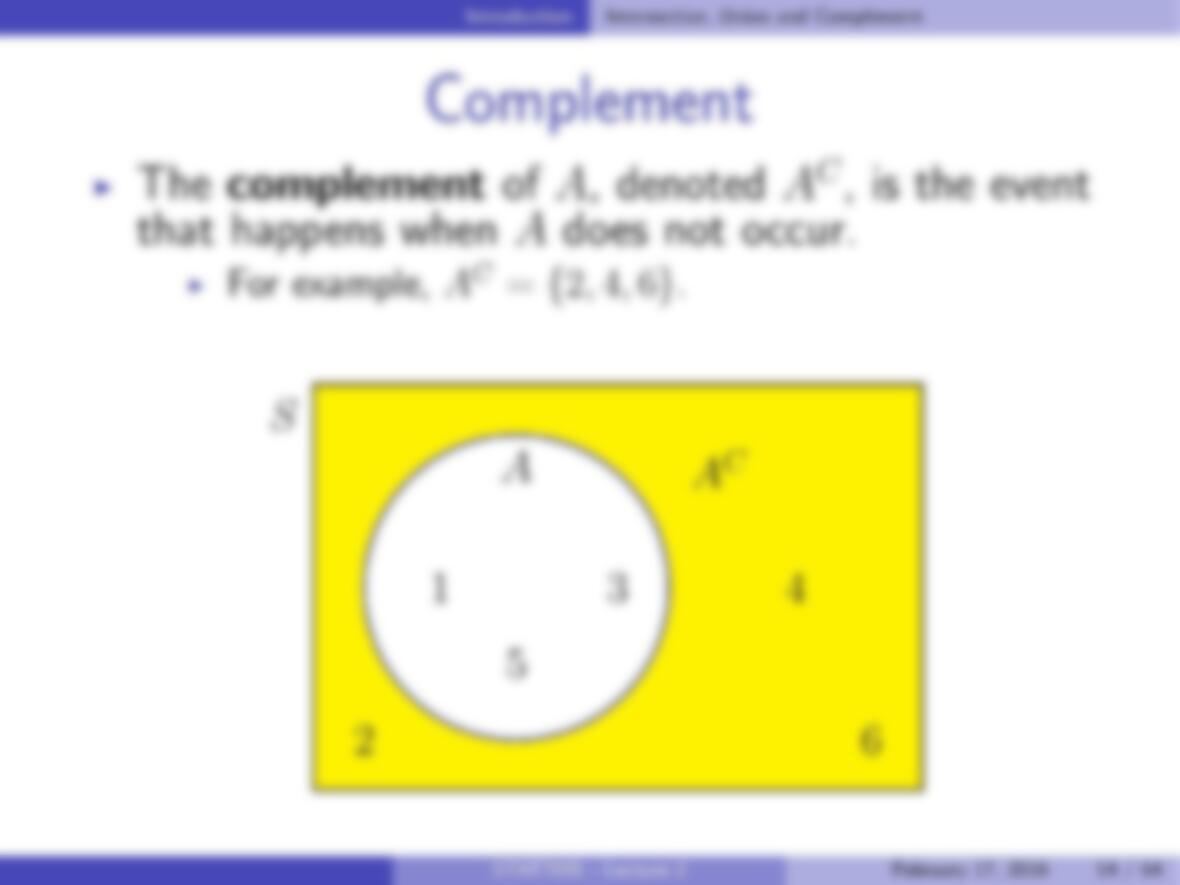
IFor example, when rolling a die, let Adenote the event
that an odd number comes up. Then A={1,3,5}.
STAT7055 – Lecture 2 February 17, 2016 8 / 64

Introduction Events
Probability of an Event
IThe probability of an event is equal to the sum of
the probabilities of the simple events that make up
the event:
IP(A) = P(1) + P(3) + P(5) = 1
6+1
6+1
6=1
2
IIf we assume all simple events have equal
probability, we can also determine the probability of
an event by counting the number of simple events
that make up the event:
IP(A) = number of simple events in A
number of simple events in S=3
6=1
2
STAT7055 – Lecture 2 February 17, 2016 9 / 64

Introduction Intersection, Union and Complement
Combining Events
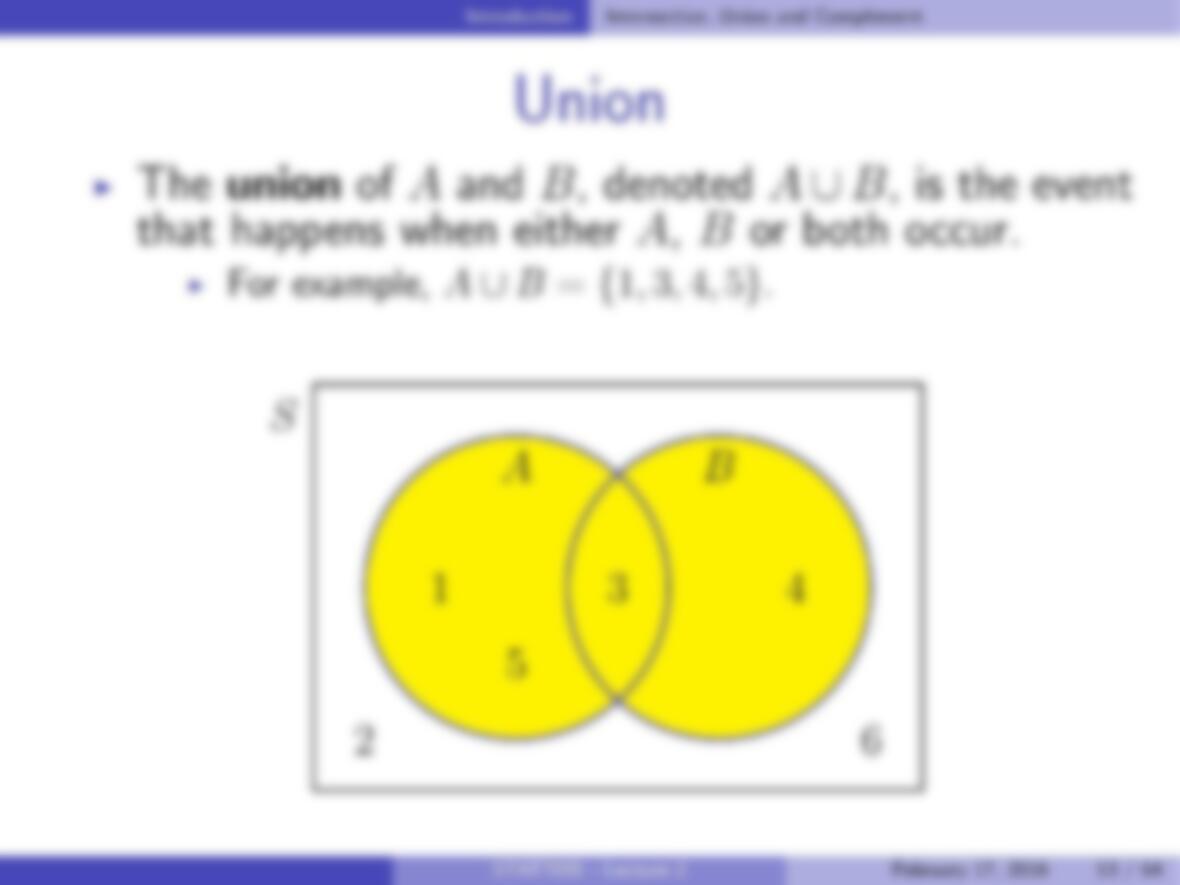
IThere are some important ways in which events can
be combined that we will encounter repeatedly
throughout this course.
ISuppose we have two events, Aand B.
IFor example, suppose we roll a conventional die and let
A={1,3,5}denote the event of rolling an odd number
and let B={3,4}denote the event of rolling either a 3
or a 4.
STAT7055 – Lecture 2 February 17, 2016 10 / 64

Introduction Intersection, Union and Complement
Venn Diagrams
IWe can use Venn diagrams to visually describe the
events.
S
A B
1
5
3 4
2 6
STAT7055 – Lecture 2 February 17, 2016 11 / 64
Introduction Intersection, Union and Complement
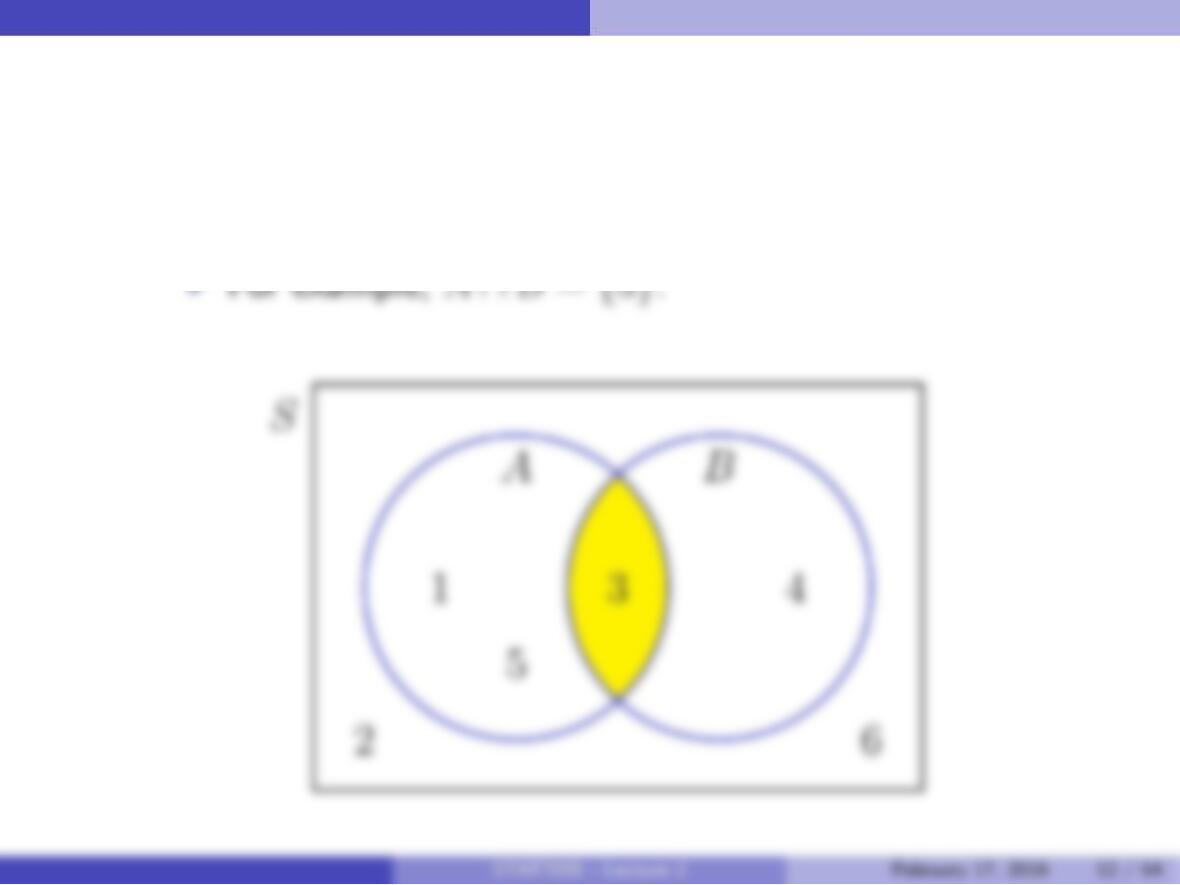
Intersection
IThe intersection of Aand B, denoted A∩B, is
the event that happens when both Aand Boccur.

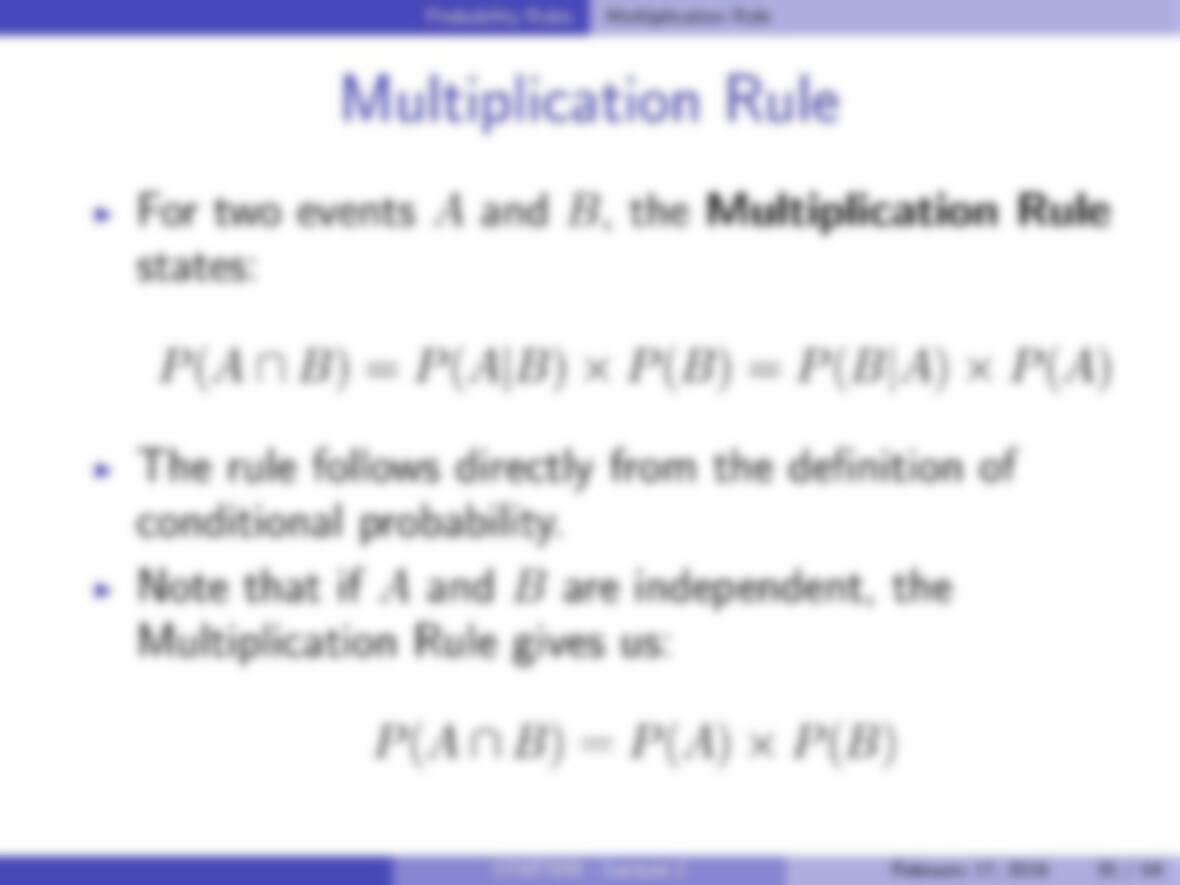
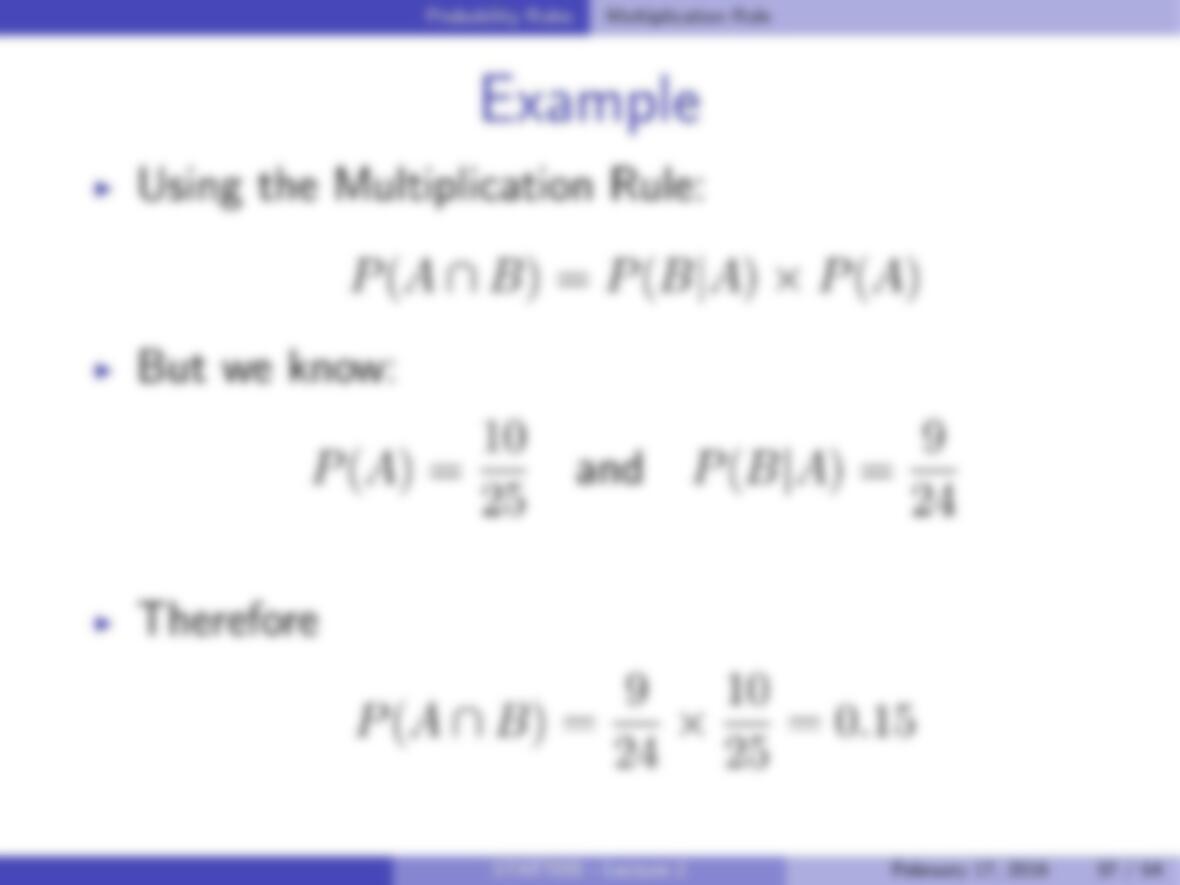
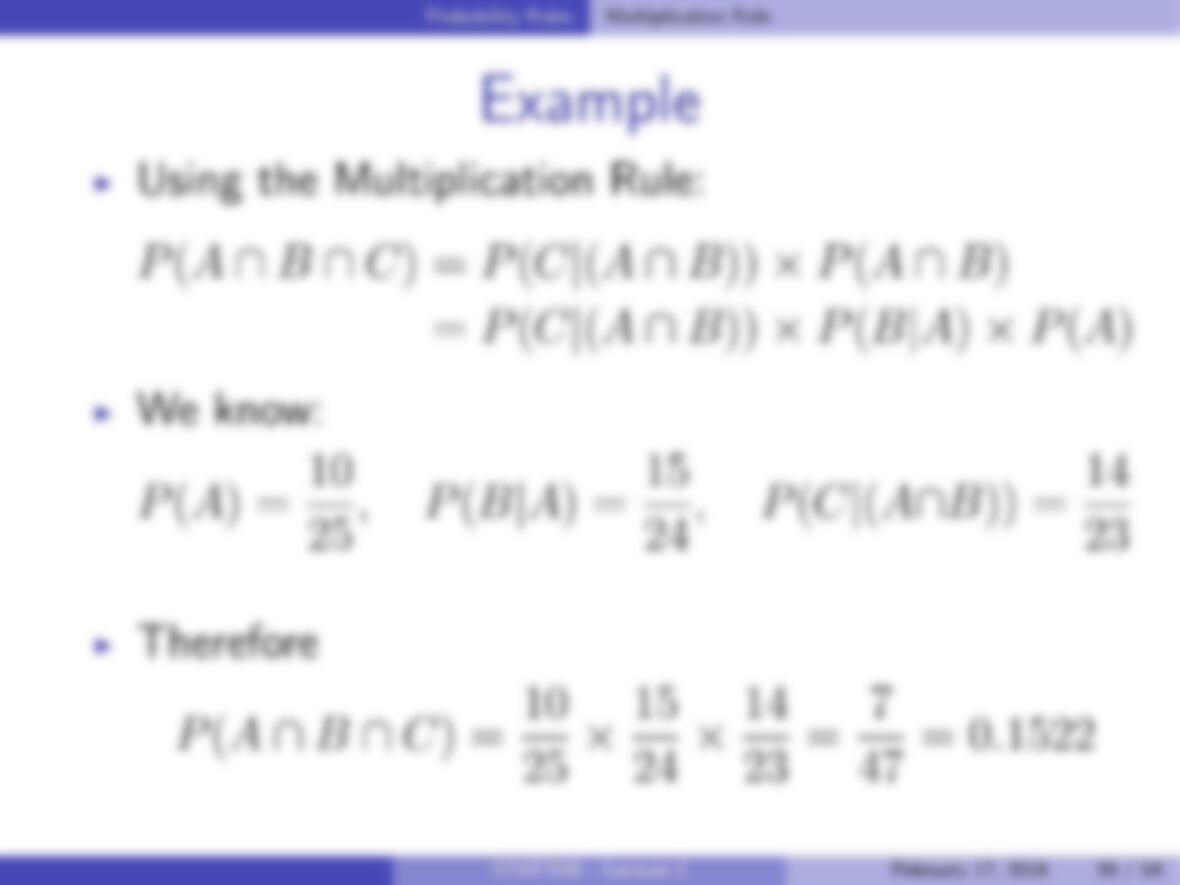
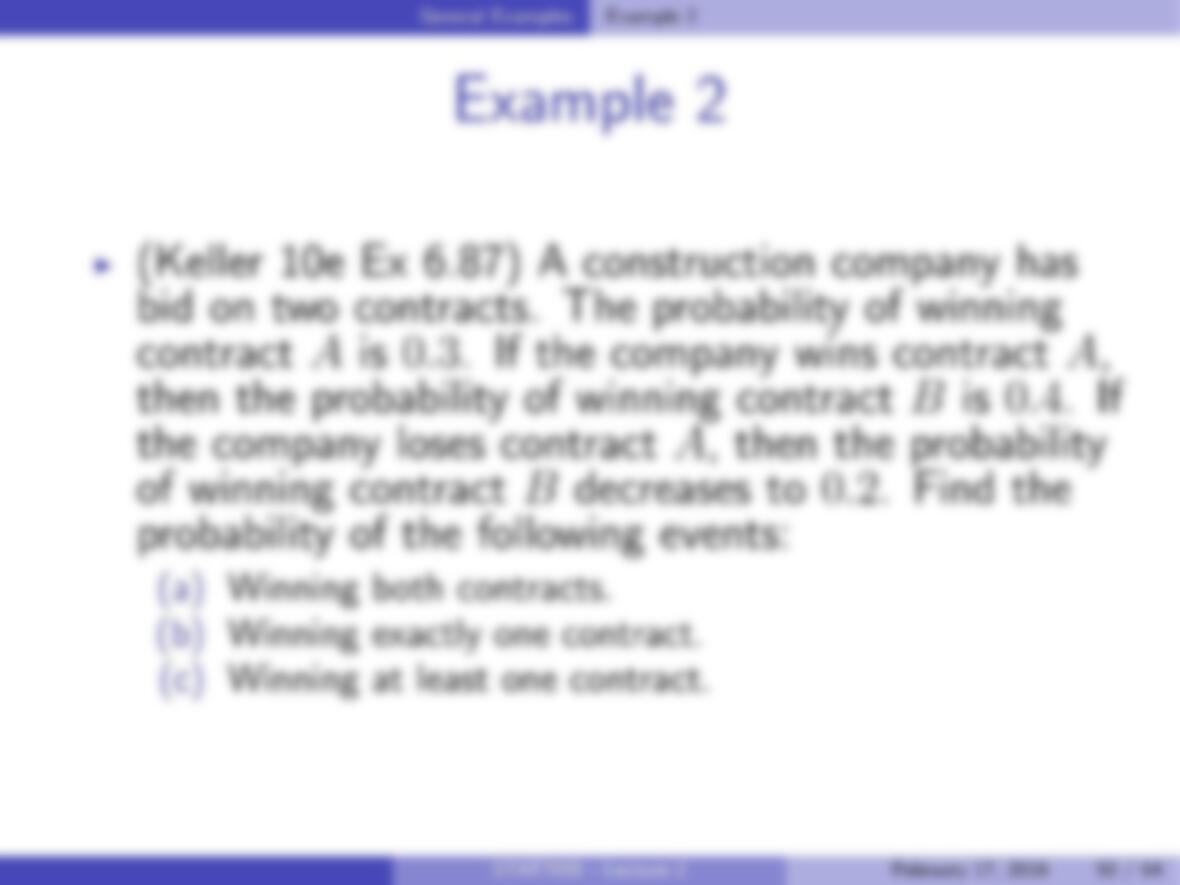
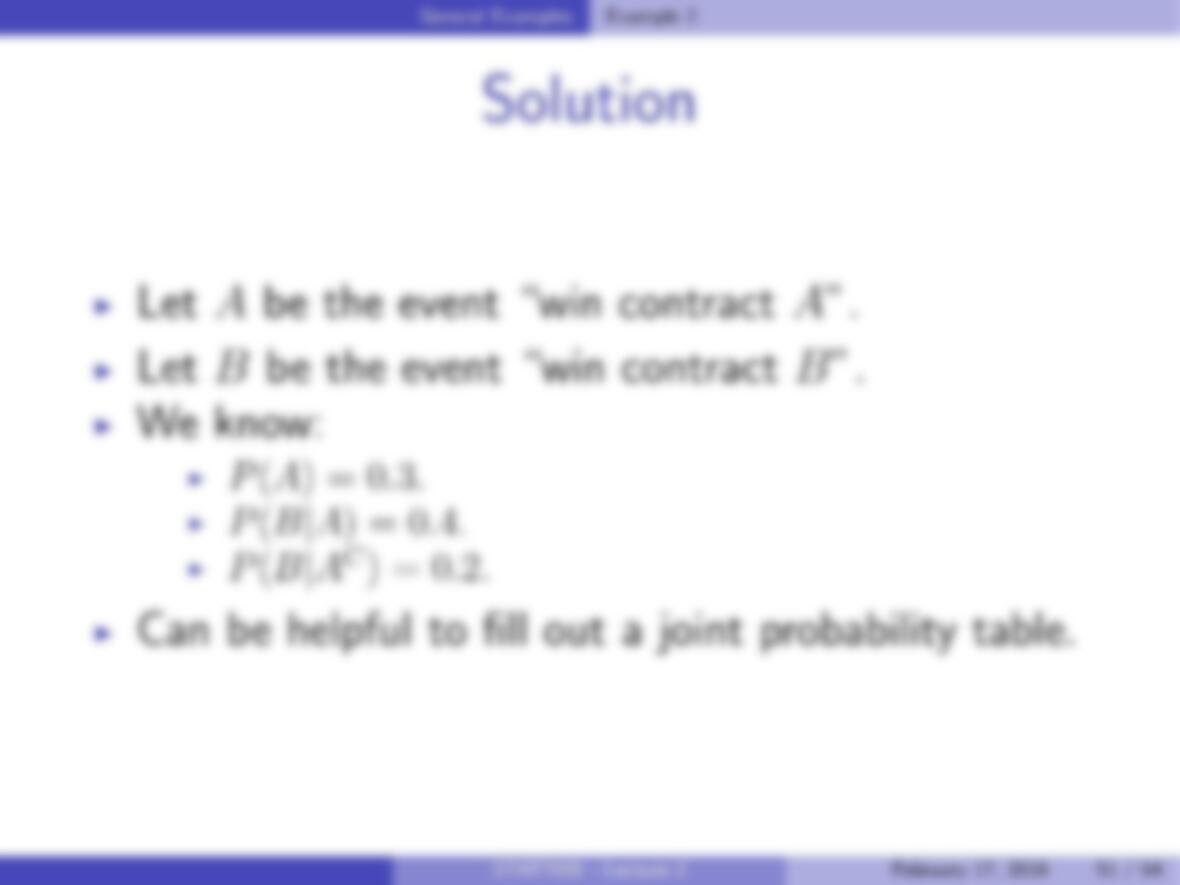
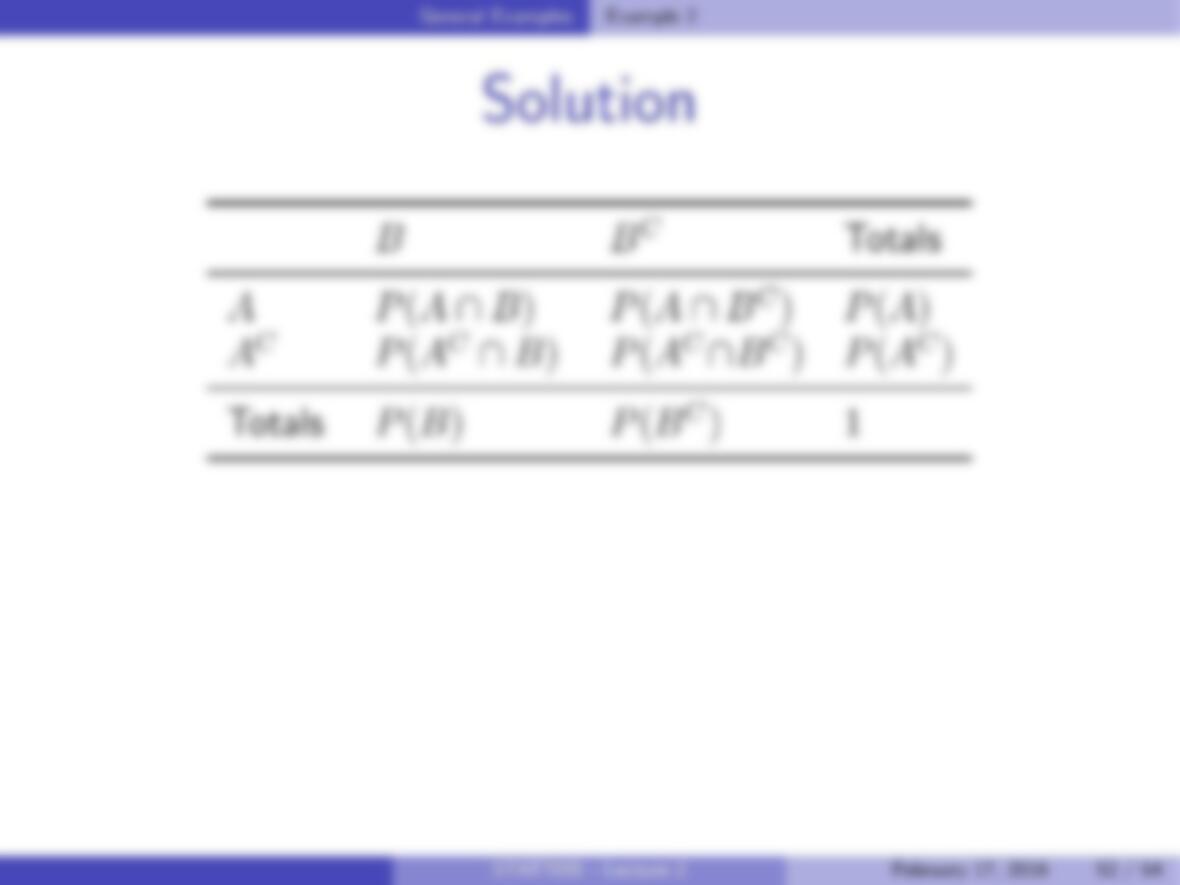
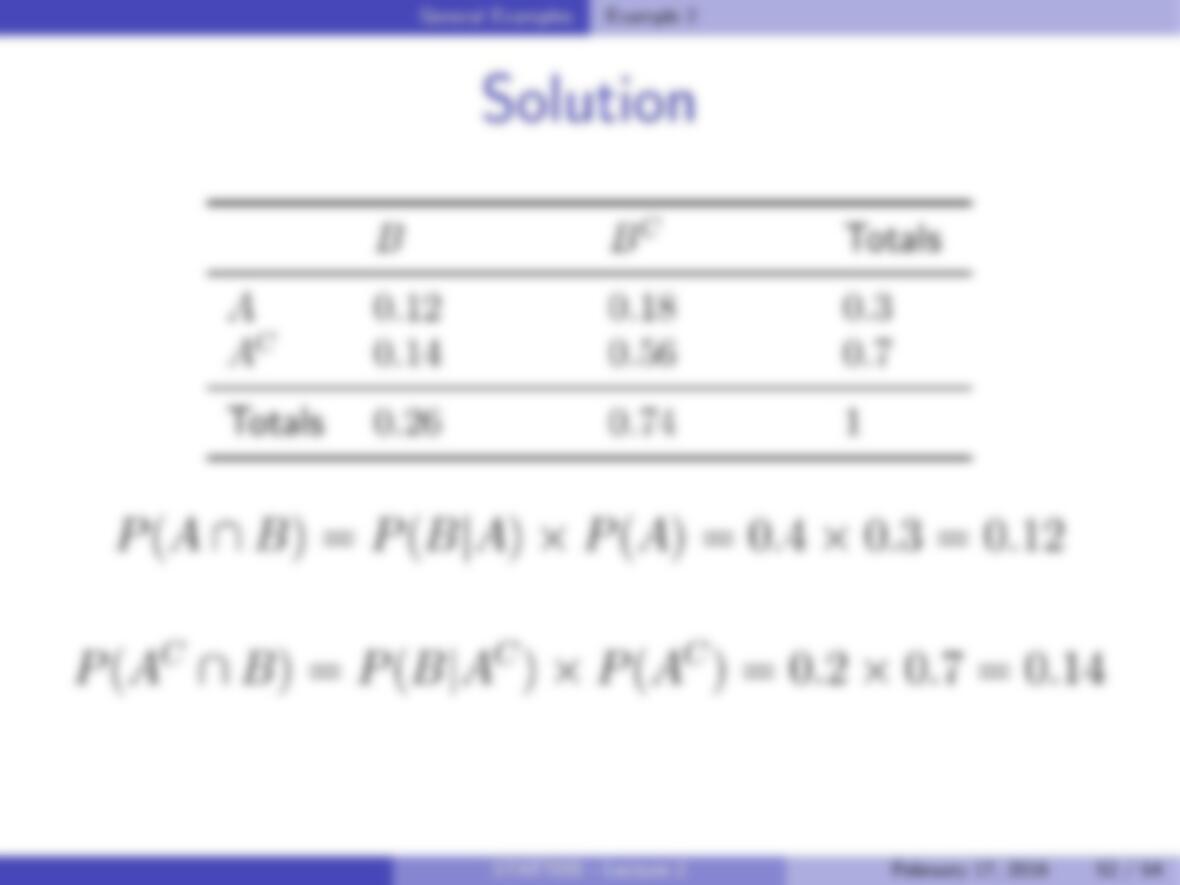
P(A∩B) = P(B|A)×P(A)=0.4×0.3=0.12
P(AC∩B) = P(B|AC)×P(AC)=0.2×0.7=0.14