Business Statistics, ISOM2500
Practice Quiz II
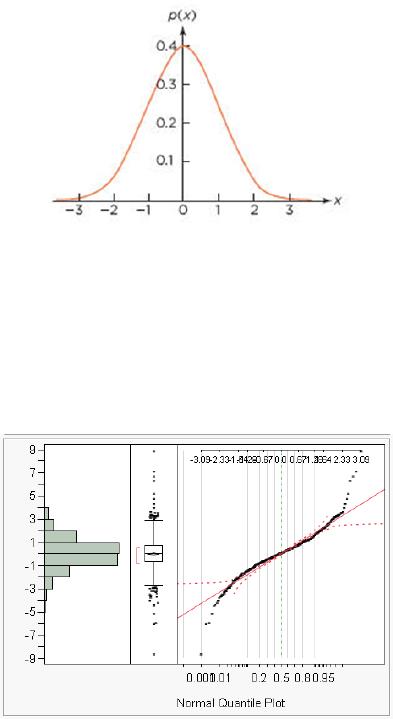
1. Suppose that Zis a random variable whose distribution is given by the curve below. Which of the
following statements is true?
(a) P(Z= 0) is about 0.4.
(b) P(Z= 0) is bigger than P(Z= 1).
(c) P(−1.02 < Z < −0.02) is bigger than P(1.02 ≤Z≤2.02)
(d) None of the above.
2-3. The following plots summarize a data set.
2. Which of the following statements about the distribution is false?
(a) It is roughly symmetric.
(b) It is unimodal.
(c) It can be appropriately described by a normal model.
(d) It has lots of outliers.
3. Which of the following statements about the skewness/kurtosis of the data is true?
(a) The skewness is around 0, while the kurtosis will be quite large.
(b) Both the skewness and the kurtosis are around 0.
(c) The kurtosis is around 0, and the skewness will be quite large.
(d) Both the skewness and the kurtosis will be quite large.
4-5. Suppose that you own an auto parts warehouse and you have recently started selling a certain type
of tire. According to the manufacturer, the tire lifetimes (measured in kilometers (km)) are normally
distributed with a mean of 60,000 (km) and a standard deviation of 3,000 (km).
4. Which of the following is true about the probability that a randomly selected tire of this type will
have a lifetime more than 67,000 (km)?
(a) <0.15% (b) between 0.15% and 2.5% (c) between 2.5% and 5% (d) bigger than 5%
1
5. You would like to offer a guarantee for free replacement of any tire that does not last a specified
minimum number of miles. Which of the following should be the guaranteed lifetime if you desire
that about 1% of this type of tires will fail to last the guaranteed number of miles?
(a) 53,000 (b) 67,000 (c) 52,000 (d) 68,000
6. An investment is expected to grow during the year by 11% with SD 23%. Assume a normal model
for the return. Find the 2% value at risk (VaR, ($)) for an investment of $100,000.
(a) −36,235 (b) −42,505 (c) 42,505 (d) 36,235
7. Suppose that the 5% VaR of an investment is $393,500. Which of the following statements is true?
(a) The loss will not exceed $393,500.
(b) Even in the worst 5% scenarios, the loss will not exceed $393,500.
(c) There’s 5% chance that the return will be more than $393,500.
(d) In the worst 5% scenarios the loss may be much higher than $393,500.
8. A hurricane bond pays the holder $1 million if the loss caused by a hurricane in a certain state is $50
million or more. Suppose that the chance for a hurricane is 10% per year. And the loss caused by
a hurricane follows a normal distribution with mean $60 million and SD $30 million. If a financial
firm sells these bonds for $80,000, what is the chance that the firm loses money? (Accurate to two
decimal places)
(a) 0.62 (b) 0.06 (c) 0.10 (d) 0.13
9. A technician at a plant which produces wire cables selects a simple random sample of 100 cables
each week from among the thousands of cables that are ready for shipping. The cables are subjected
to a load of 1000 pounds. Any cable that breaks under this load is considered to be defective. The
quality control manager has decided that if the proportion of defective cables in the sample exceeds
0.10, then all cables currently ready for shipping will be tested before they are shipped. Which of