Department of Finance and Accounting
Rennes School of Business
FI506E
Quantitative Finance
Fall 2020
Session 3-4: Portfolio Theory and Practice Exercises and
Answers
Questions
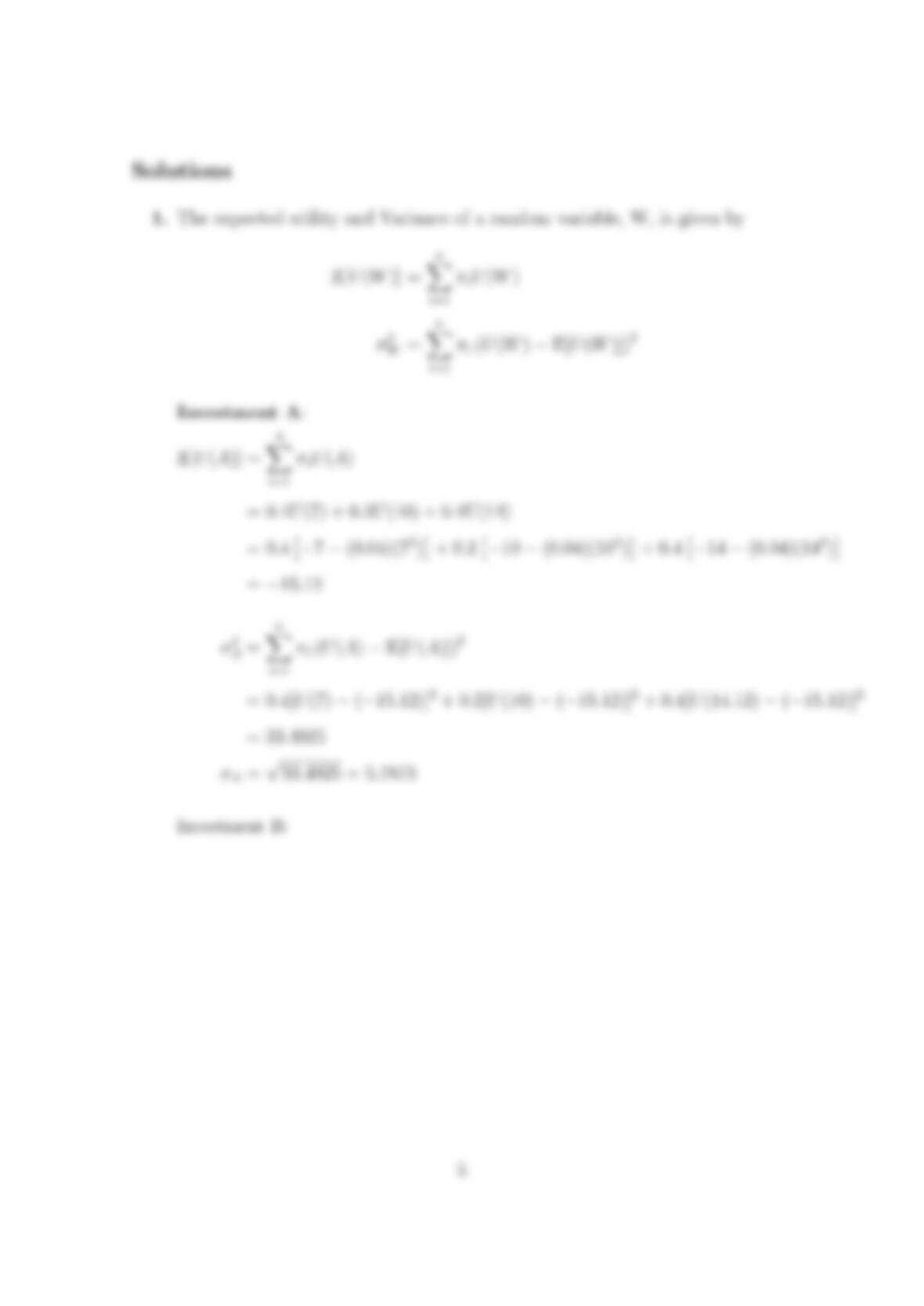
1. Consider the following two investments. Which is preferred if the utility func-
tion is U(W) = −W−0.04W2?
Investment A Investment B
eOutcome Probability eOutcome Probability
7 0.4 5 0.5
10 0.2 12 0.25
14 0.4 20 0.25
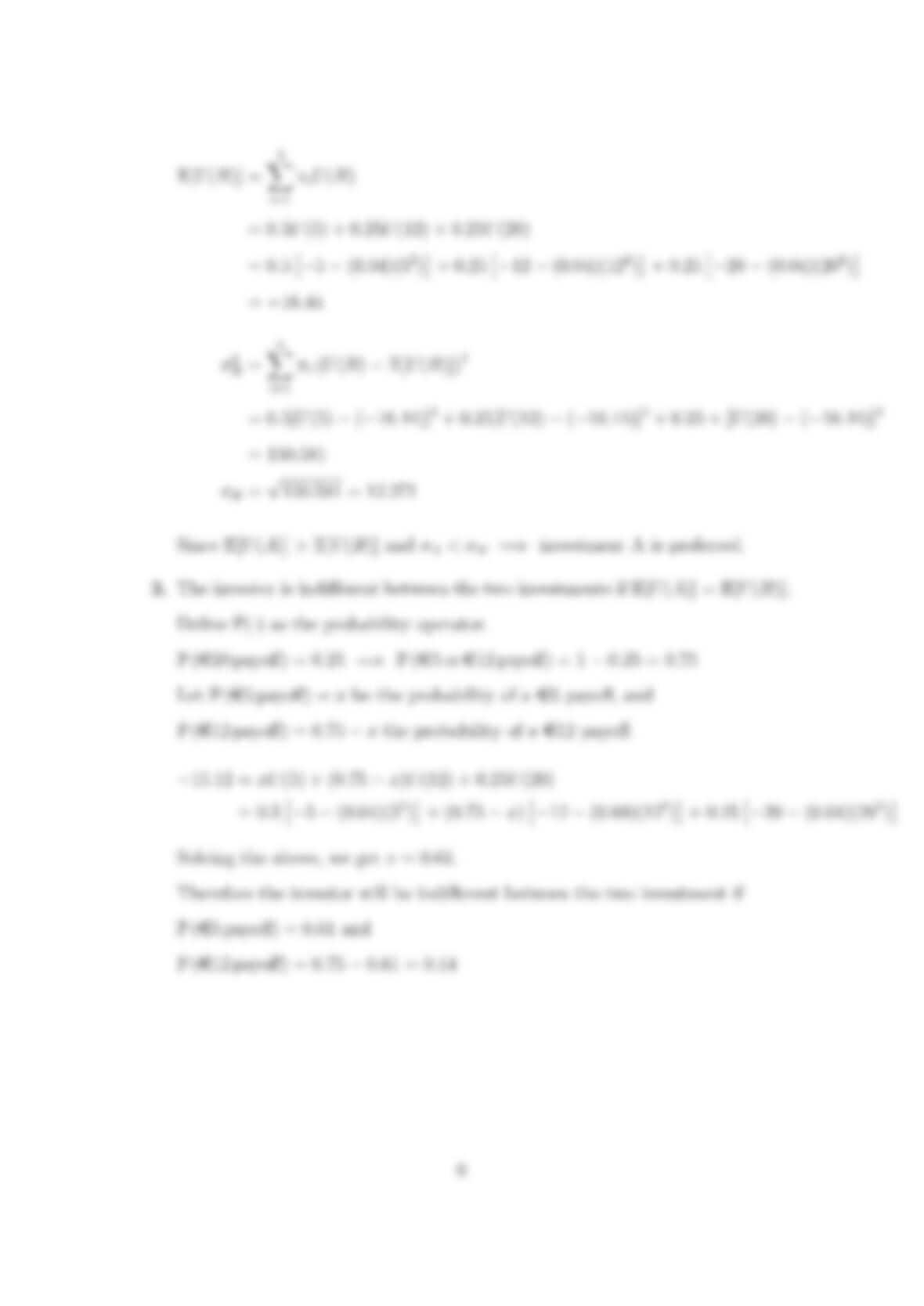
2. Consider again the table in Question 1. The probability of a e5 payoff is 0.5
and a e12 payoff is 0.25. How much would these probabilities have to change
so that the investor is indifferent between investments A and B?
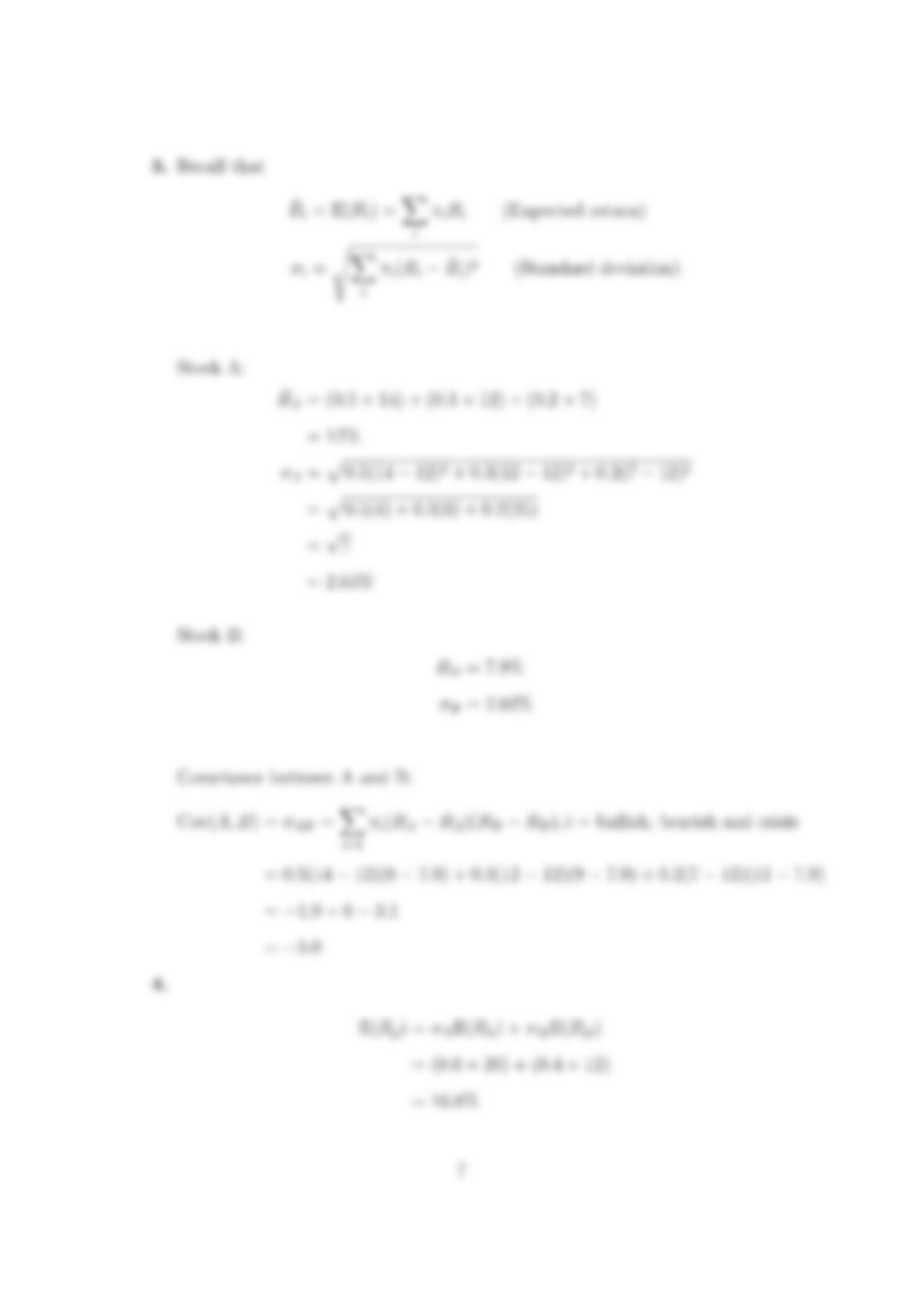
3. Compute the mean and the standard deviation of share A and B, and their
covariance
State Bullish Bearish Crisis
Probability 0.5 0.3 0.2
Share A (%) 14 12 7
Share B (%) 6 9 11
4. Compute the expected return and volatility of a portfolio of two funds based
on the following information. The correlation between the fund returns 0.10.
1

E[R] (%) σ[R] (%) Allocation (%)
Stock fund (S) 20 30 60
Bond fund (B) 12 15 40
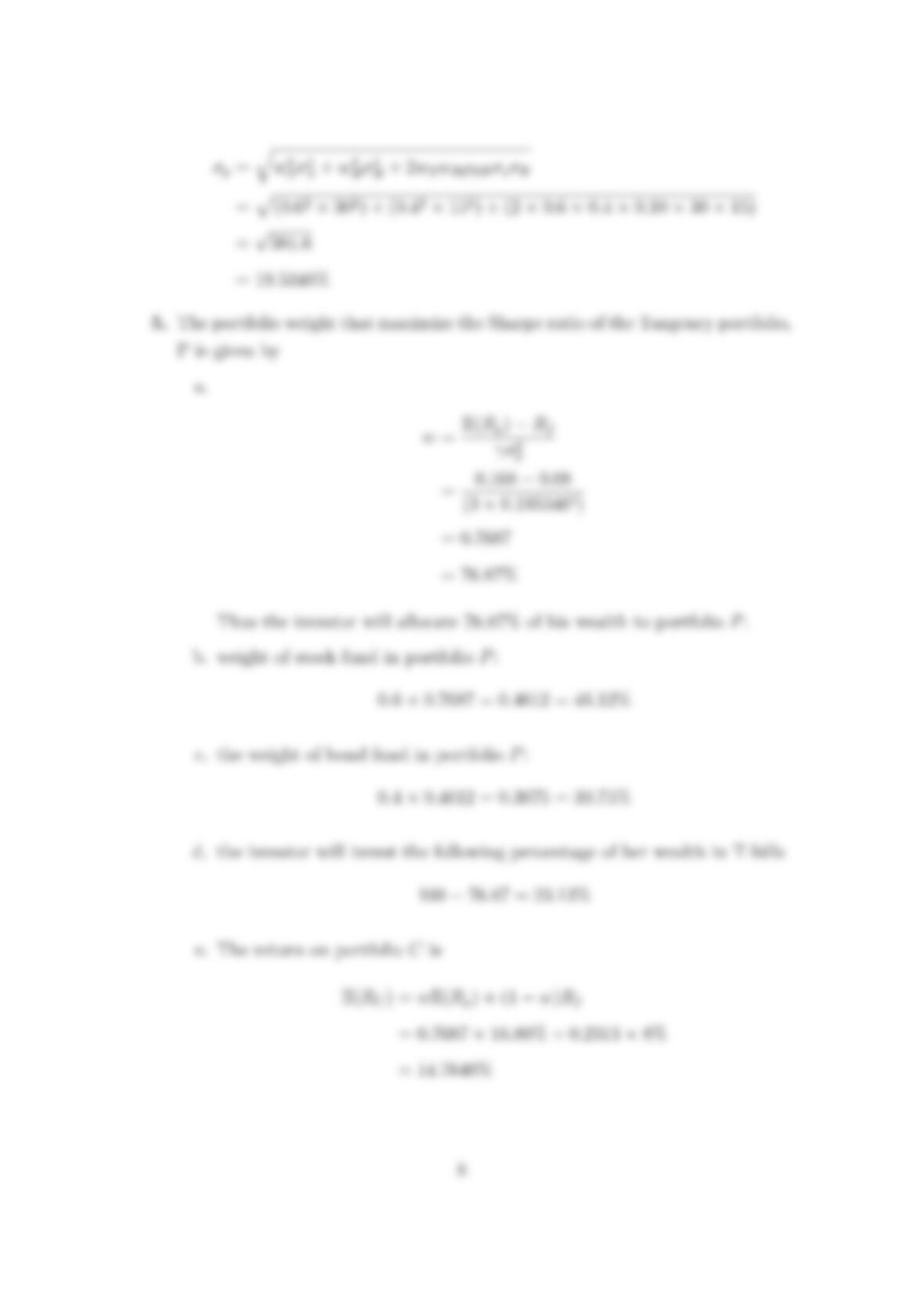
5. Assume portfolio Pis the optimal risky portfolio made up of a Stock fund
and a Bond fund. Portfolio Fis T-bills, proxy for the risky free asset. The
two portfolios (Pand F) are then combined to form an optimum portfolio
C. The correlation between the fund returns is 0.10. Assume a risk aversion
parameter of 3.
Portfolio E[R] (%) σ(R) (%) Allocation (%)
PStock fund (S) 20 30 60
Bond fund (B) 12 15 40
FT-bills 8 0
From the information given in the table above, compute the
a. optimal allocation to portfolio P
a. allocation of the stock fund in portfolio C
c. allocation of the bond fund in portfolio C
d. allocation of T-bills in portfolio C
e. expected return of portfolio C
f. risk of portfolio C
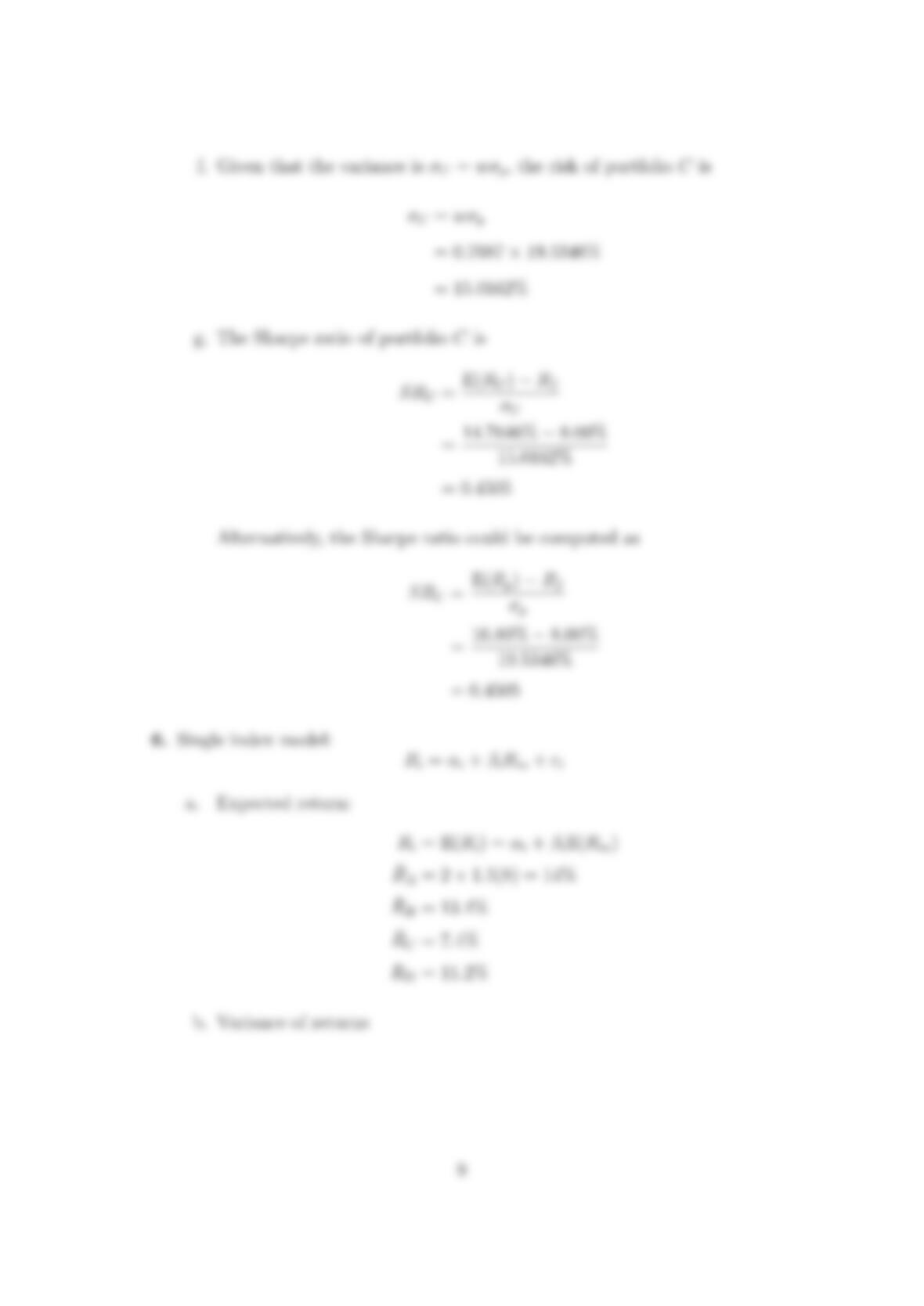
g. Sharpe ratio of portfolio C
6. Consider the table below:
Security
Parameter A B C D
αi2.0% 3.0% 1.0% 4.0%
βi1.5 1.3 0.8 0.9
σei3.0 1.0 2.0 4.0
If E[Rm] = 8% and σm= 5%, calculate the following:
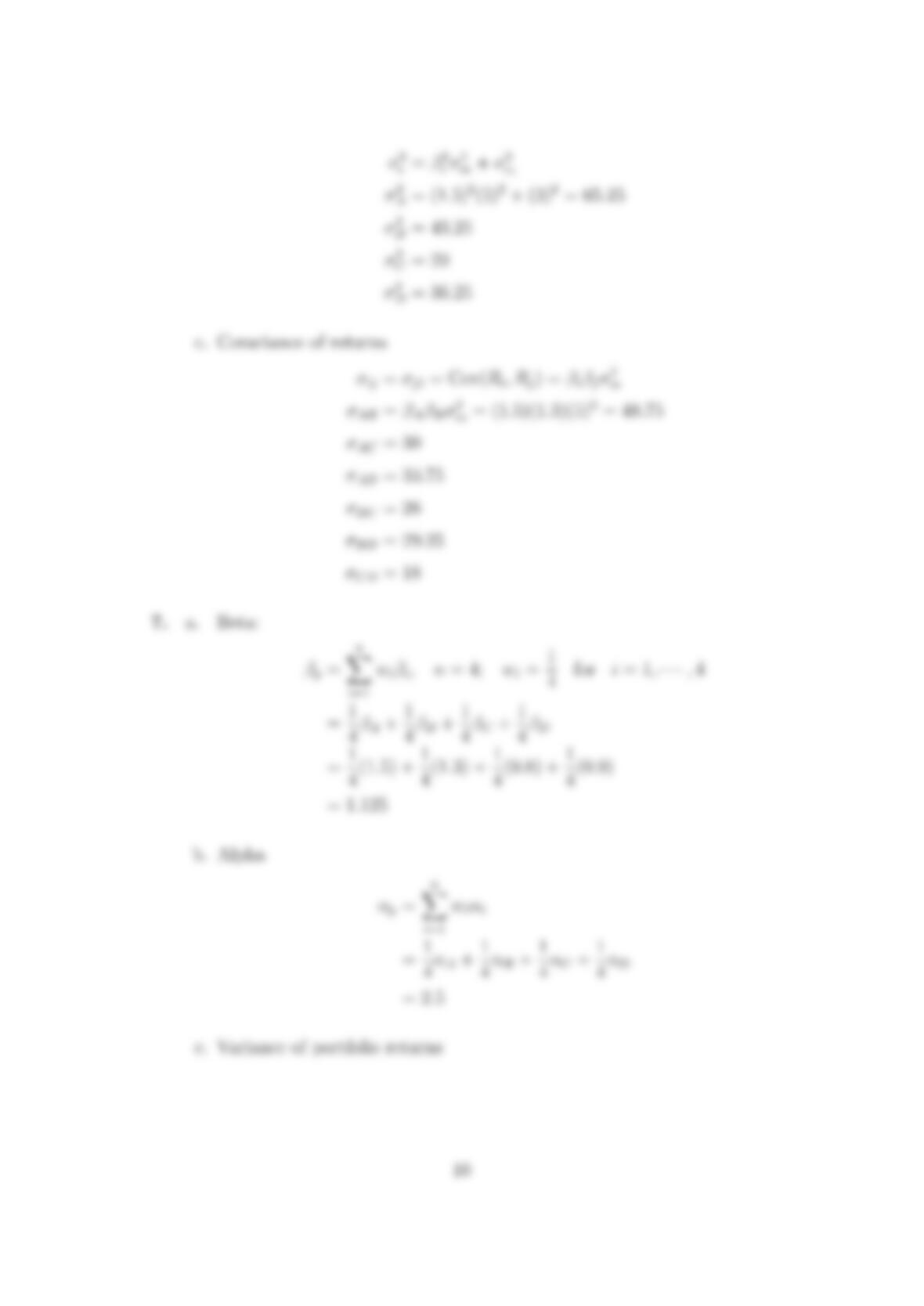
a. the mean return for each security
b. the variance for each security return
c. the covariance of returns between each security
2
7. Using the data from Question 6 and assuming an equally-weighted portfolio,
calculate the following:
a. βp
b. αp
c. σ2
p
d. ¯
R2
p
3
8. MCQ – The separation theorem
a. says that you can determine the optimum portfolio of risky assets for an
investor without having to know anything about that investor
b. implies that all investors hold the same portfolio of the riskless asset and
the risky assets
c. holds even if the lending and borrowing rates are different, provided that
both rates are riskless
d. allows the construction of an efficient portfolio by separating efficient