Pakistan Mobile Communications Limited (PMCL) – Mobilink-GSM
“To be the leading telecommunication services provider in Pakistan by offering
innovative communication solutions for our customers while exceeding shareholder
value & employee expectations”.
Mobilink’s Vision
Sited in the pivotal area of the federal city, “Mobilink GSM” is serving as the leading
telecommunication services provider in the country. Having a family of more than 32.203
million customers by the end of this May, it is enjoying a market share of 33%. As the
company is entering in the more dynamic world of 21st century, the management is going
to face a number of major challenges, for example: How the things will go under the
regime of new owners? Whether Mobilink GSM will be able to maintain its market
leadership or will let the competitors to be triumphant in the arena. How would Mobilink
GSM be able to align its strategies with its vision and mission in this war of technology?
These are some of major concerns about the future of the company which must be
envisaged in order to maintain the competitive advantage.
Telecom Sector in Pakistan
The economy of Pakistan has faced toughest time in the year 2009-10, the ripple effect of
which has reached the telecom sector as well. Although the aftermath of the shaky
security situation and unstable political and economic condition has slowed down the
pace of telecom growth, yet timely interventions by Authority and extraordinary efforts
by telecom companies have ensured that the sector maintains at least a linear growth
pattern. Technological revolutions like SIM Verification System ‘789’, SIM Information
System ‘668’ has contributed much to the growth of telecom sector. Moreover,
formulation of various regulations has made PTA a front runner among the successful
telecom regulators of the world. The industry has shown positive growth of 2.43% in the
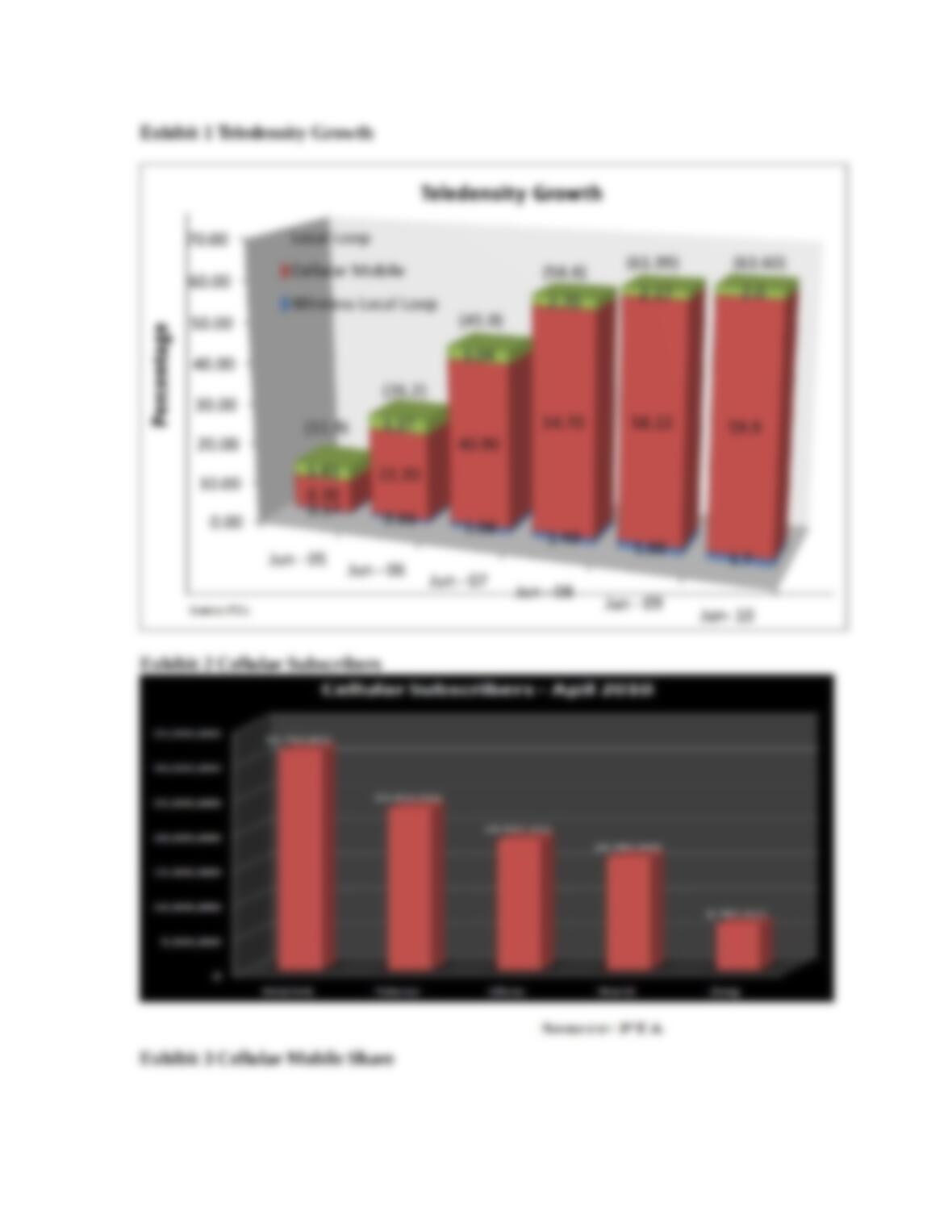
last two quarters of 2009. Teledensity has reached 63.60% (June -10), a sign of
continuous growth in the industry. (See Exhibit 1.) Cellular industry has a 94% share in
total telecom teledensity followed by fixed local loop (FLL) 3.5% and wireless local loop
(WLL) 2.5%, therefore, performance of cellular industry is of utmost importance to the
overall sector growth. By the end of this February, cellular subscribers reached 96.2
million depicting a net addition of 1,889,199 subscribers with an average of 209,911 per
month. Due to Ufone’s churn, the cellular growth rate came to a gradual halt during the
third quarter of 2009. Again due to Warid’s churn of subscribers based on the ‘Active
Subscriber’ definition of PTA, in the first month of this year, the earlier positive trend
suddenly dropped. But the industry is back on its feet and continues to gain momentum,
due to the addition of 2.1 million and 2 million by Mobilink and Telenor respectively.
Whereas, Warid and Ufone has lost about 1.6 million and 1.2 million subscribers
respectively in the same time period. Overall Mobilink clinched the top position
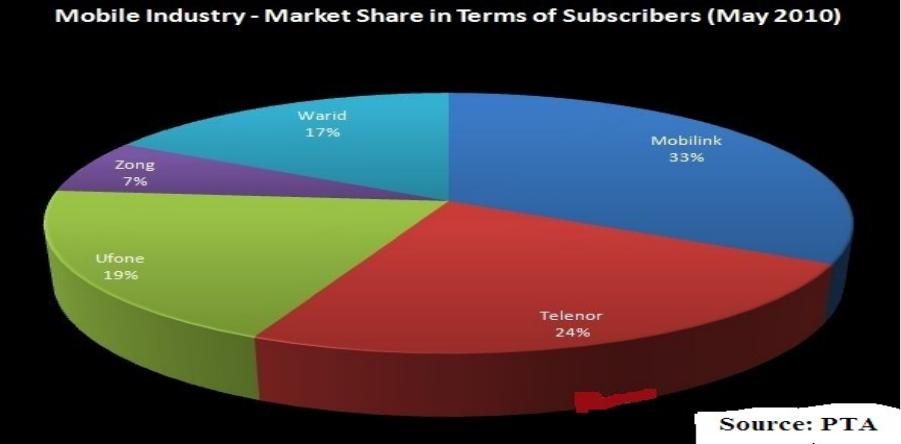
according to the reports of April 2010.(See Exhibit 2.) Mobilink is leading the cellular
industry in terms of share with overall share of 33%. Telenor is holding the second place
with market share of 24%. Ufone and Warid share 19% and 17% respectively, while Zong
is following the market share with 7%. (See Exhibit 3.)
The adverse effects of global financial crisis has also impacted growth rate of the country,
however, the telecom sector continued to grow positively in terms of subscription,
revenue and teledensity. As a result of lucrative investment by foreign investors, the
telecom sector received over US $143 million FDI inflow by end of December 2009.
(See Exhibit 4.)
However, due to economic slowdown, the total investment in the telecom sector during
last year reduced by nearly 47%. Despite the fact that the operators have speedily rolled
out their infrastructure, reaching out to most of the population, there are still potential
areas for the investment, like Broadband, WLL etc. The investment made by all operators
by end of last year totaled to US $ 1.6 billion. (See- Exhibit 5.)
The sector has made a contribution of 1-2% in the total GDP, which has made the share in
the total tax revenue as 6-7% per annum. The sector has made addition to the national
exchequer from Rs.112 billion in 2008-09 in comparison to Rs. 111 billion the previous
year. (See- Exhibit 6.) On the other hand, the sector’s revenue showed a 19.8% growth
during 2008-09 compared to 18.2% in previous year. The sector generated revenue of Rs.
333.9 billion, in which the cellular mobile sector continued to be the leader, whose share
came out to be 64% in the total telecom revenues. (See- Exhibit 7.)
Mobilink GSM Background and History
During 1990s the use of mobile phones paced up all over the world. In 1991, Instaphone,
a subsidiary of Millicom International Cellular based in Luxembourg, started the first