Piper Cherokee 140
PIPER CHEROKEE 140
SPEEDS FOR NORMAL
OPERATION
Vx 64 KTS = Best Angle of Climb
Vy 74 KTS = Best Rate of Climb
Vbst l/d 72 KTS = Best Glide
Vs 56 KTS = Stall Speed, Clean
Vso 48 KTS = Stall Speed, Dirty
Vfo 100 KTS = Max Flap Extension
Va 112 KTS = Maneuvering Speed
Vno 120 KTS = Max Structr’l Cruise
Vne 148 KTS = Never Exceed
90 KTS = Normal Climb Out
64 KTS = Short Field T/O, Flaps 25°
74 KTS = Normal Landing, Flaps Up
66 KTS = Normal Landing, Flaps 40°
66 KTS = Short Field, Flaps 40°
SPECIFICATIONS
2150 lbs = Maximum Gross Weight
1340 lbs = Basic Empty Weight
594 lbs = Payload w/Std Fuel (36 gal)
510 lbs = Payload w/Max Fuel (50 gal)
9 gph = Fuel Flow @ 75% Power
50 gal = Total Fuel Capacity
36 gal = Standard Fuel Capacity
100LL = Fuel Octane Rating (Blue)
8 qts = Oil Sump Capacity
2 qts = Minimum Oil Quantity
150 hp = Lycoming O-320
12 V = Battery
3.8g = Positive Limit Load Factor
0g = Negative Limit Load Factor
PIPER PA 28 SERIES
PASSENGER BRIEFING
Regulations requires the Pilot in
Command to brief all passengers on the
following items prior to each takeoff.
CABIN DOOR
To open cabin door, twist upper door latch
forward lift the lower latch up.
Push door open.
SEATBACKS
Seat backs must be secured in the upright
position during takeoff and landing.
SEATBELTS
Fasten seat belt & shoulder harness
(if present) for take off & landing.
Insert latch into buckle & pull belt snug.
To release belt, pull up on lip of buckle.
SMOKING & ALCOHOL
Smoking and Alcoholic Beverages are not
permitted onboard the aircraft at any stage of the
flight.
FIRST AID
A First Aid kit with sick bags is located behind
the Pilot’s seat in the seat back in case of
emergency.
FIRE EXTINGUICHER
A Fire Extinguisher is located behind the two
rear seats on the floor.
PILOT OPERATION HANDBOOK
The Pilot’s Operating Handbook is located
in the copilot’s seatback. The handbook
(POH) shall be the authority if an
inconsistency exists between this card and
the Pilot’s Operating Handbook.
Piper Cherokee 140
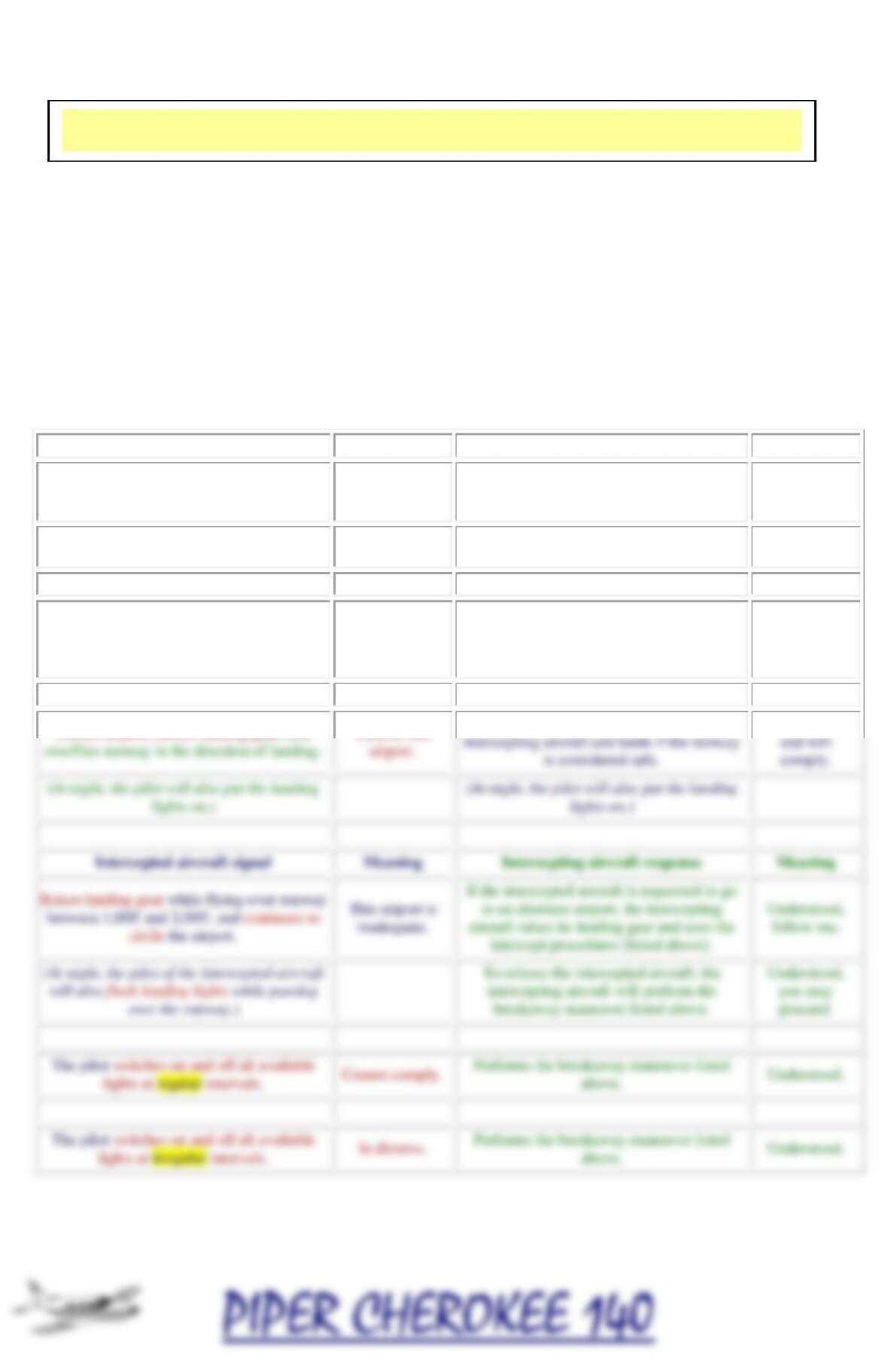
If you are intercepted by a U.S. Military or law enforcement aircraft, immediately:
1. Follow the instructions given by the intercepting aircraft. (See chart below.) Attempt to
communicate with the intercepting aircraft and/or ATC on the emergency frequency 121.5 MHz,
giving the identity and position of your aircraft and the nature of the flight.
2. If equipped with a transponder, squawk 7700, unless otherwise instructed by ATC. If any
instructions received by radio from any sources conflict with those given by the intercepting
aircraft by visual or radio signals, request clarification while continuing to comply with the
instructions given by the intercepting aircraft.
Intercepting aircraft signal
Meaning
Intercepted aircraft response
Meaning
Rocks wings. After acknowledgement
initiates a slow level turn, normally to the
left, onto the desired heading.
You have been
intercepted.
Follow me.
Rocks wings and follows.
I understand
and will
comply.
(At night, the pilot will also flash the
navigational lights at irregular intervals.)
(At night, the pilot will also flash the
navigational lights at irregular intervals.)
Performs an abrupt breakaway maneuver
consisting of a climbing 90 degree turn, or
more, without crossing the intercepted
aircraft’s flight path.
You are released
& may proceed.
Rocks wings.
I understand
and will
comply.
Lowers landing gear, follows the
I understand
MILITRAY INTERCEPT PROCEDURES
and will
comply.