UNIVERSITY OF COLORADO –
COLORADO SPRINGS
Absolute Zero Name
Objective
The purpose of this experiment is to understand the relationship between temperature and pressure,
and to find the value for absolute zero.
Data and Calculations
Part I: Pressure vs. Temperature (Gay-Lussac’s Law)
• Record the values of pressure and temperature of the “Cold First” experiment.
Pressure (kPa)
Temperature (C)
Temperature (K)
80.178
0.81
273.96
86.237
20.80
293.95
100.218
67.84
340.99
• Record the values of pressure and temperature of the “Room Temperature First” experiment.
Pressure (kPa)
Temperature (C)
Temperature (K)
80.202
21.85
295.00
74.2628
0.62
273.77
91.189
60.50
333.65
• Record the values of pressure and temperature of the “Hot First” experiment.
Pressure (kPa)
Temperature (C)
Temperature (K)
80.196
59.27
332.42
71.002
22.61
295.76
65.558
0.66
273.81
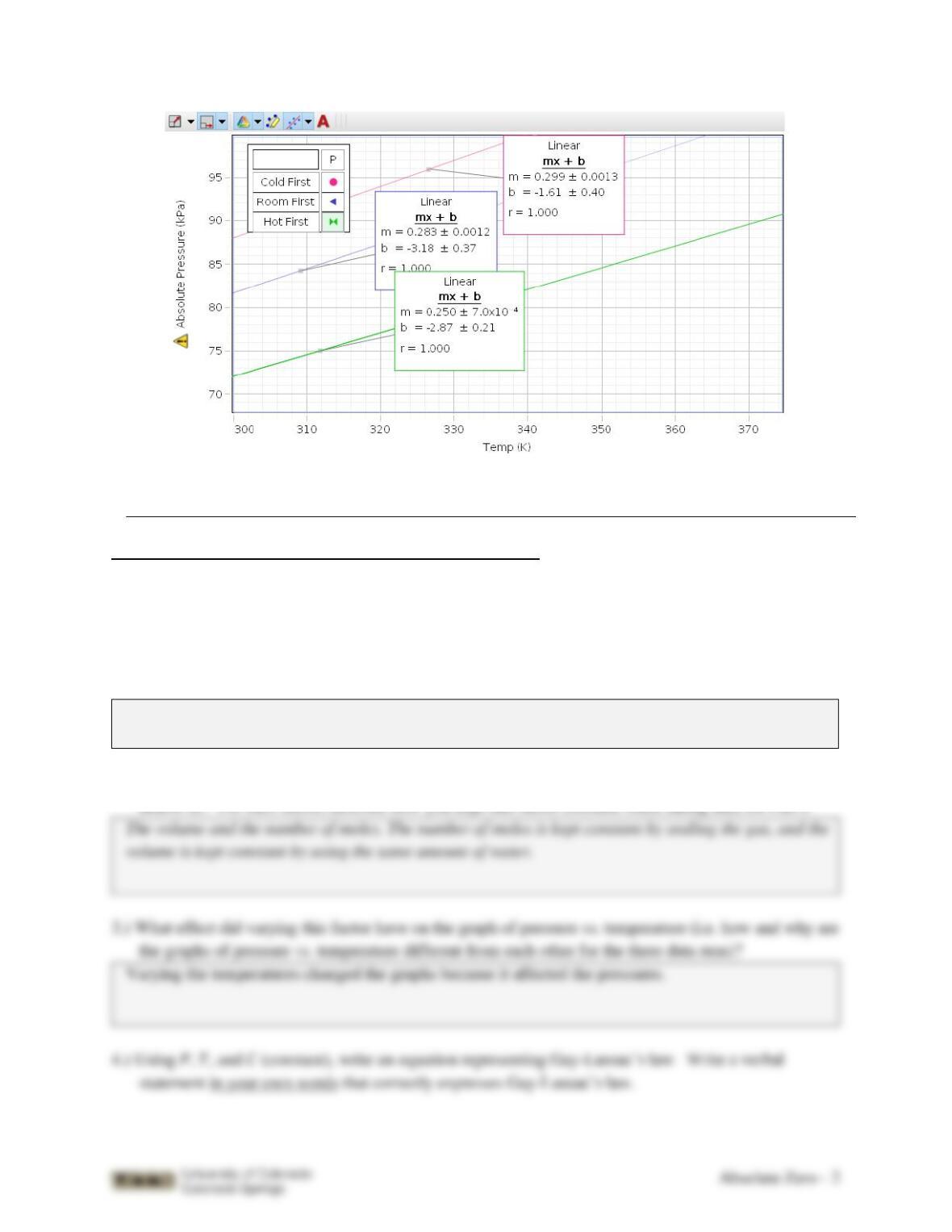
• Include a graph of Pressure vs. Temperature. Make sure you include the curve fit equation for all
experiments.
Curve fit equation:
Cold
y= .299x – 1.61
Room
y = .283x -.0012
Hot
y= .250x – 2.87
P E S 2 1 5 0 – P H Y S I C S LAB O R A T O R Y I I
Results and Questions
Part I: Pressure vs. Temperature (Gay-Lussac’s Law)
1.) Between data runs for Part I, (cold first, room first and hot first runs), the sealed system was broken
and allowed the system to stabilize at a lower (or higher temp) before reconnecting the air line and
resealing the system for the remainder of the run. How does this affect the experiment and its initial
conditions, what experimental factor was varied (P, V, T or n)? Explain.
The temperature was varied, and this of course change the pressure too.
2.) Within a given data run for Part I, what two experimental factors are assumed to be constant (P, V, T