ANALYSIS
Temperature plays a vital role in determining the phenomena behind the
expansion of solids. The said expansion takes place when there is a rise in
temperature. Otherwise, it contracts. The expansion is said to be linear when
it is one-dimensional; it is called area and volume when it has two or three
dimensions.
In this experiment, there were two kinds of rods that were considered in
determining the coefficient of linear expansion. Initially, our group has
obtained the following data:
Type of Tube Aluminum Tube Copper Tube
Initial Length of Tube, Lo705.6 mm 705.7 mm
Initial Resistance of Thermistor
at Room Temperature, Rrm
105400 Ω 109700 Ω
Initial Temperature, trm 24 °C 23 °C
Using the meter stick provided in this experiment, it may be observed
that the initial lengths of the tubes have an almost negligible difference.
By obtaining the resistance of these rods, it could also be observed that
its respective initial temperatures were close to that of the room temperature.
It is because the room where the experiment was conducted had resulting
low temperatures for it was air-conditioned.
The process of expansion occurs when a rubber tube is plugged in to be
able to raise the temperature. The rubber tube serves as a mode of
transportation for the steam to pass through the duct and therefore making
the heat transfer take place. If the rubber tube is not properly laid, however,
may cause the heat of the rods to be transferred to the water.
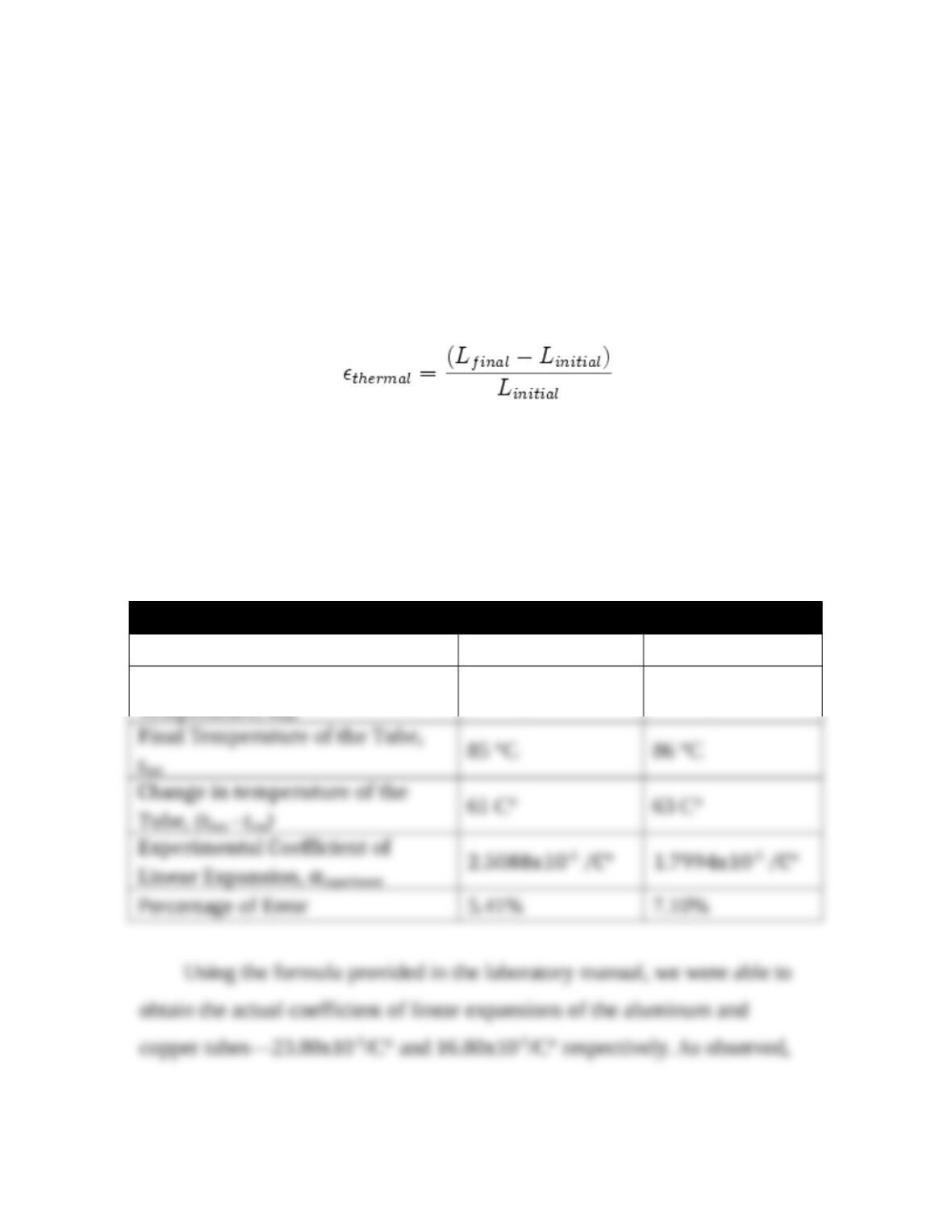
As the experiment progressed, we were able to determine the amount of
the thermal expansion of these two kinds of rods using the equation:
where Linitial is the length of the rod before the heat transfer, and Lfinal is
the length when the heat transfer has already taken place. As a result, we
were able to come up with the following data:
Type of Tube Aluminum Tube Copper Tube
Change in Length of Tube, ∆L 1.08 mm 0.80 mm
Resistance of Thermistor at Final
9070 Ω 8760 Ω