P a g e | 1
THE PHOTOGRAPHIC EYE: A COLLECTION OF ESSAYS AND ARTICLES
Seeing: Developing Your Eye
By Daniel P. Creighton, C. 2001
It is fime to talk about the benefits of a wide view in photography. Saying that immediately brings to
mind the use of wide-angle lenses. But they are only part of a wider view. You see I am talking about
seeing a wider view.
Seeing isn’t just about looking at something. It is about looking at something and then looking closer
unfil you see the li%le details as well as the bigger scene.
Seeing is a developed talent. Some photographers have it. Some may have even been born with it. I
have always had a “knack” for seeing images but that natural ability has been honed by years of pracfice
too.
You can learn to see without even having a camera in your hands. The next fime you see something that
you like stop and think for a second about what exactly it is about that scene that caught your eye. Ws it
the light, was it the pattern of the subject, was it the texture, or was it the color?
Once you see what it was that grabbed your a%enfion you can then go about pu.ng that element on
film in a pleasing manner. A0er all a picture doesn’t lie (well somefimes, but that is a whole other
arficle) and you are basically wrifing a sentence with your picture. But if you don’t know what it is that
you want to say, because you haven’t clearly seen it yet, how can you clearly voice your thoughts through
your picture. That is where seeing makes your pictures clearer and more compelling. Seeing helps you
to know what elements to eliminate fro, a scene as well as which ones actually make the picture
stronger.
And once you learn how to separate your visual reacfions you can also learn to separate images into
manageable smaller images or scenes. For every grand scenic there are literally dozens of smaller
images available for the taking within it, and vice versa. Seeing those secondary images also takes

P a g e | 2
pracfice. You can do this anywhere. Stop look around. Now pull apart the scene into manageable
chunks that have good qualifies about them and then further see what makes those good qualifies
appealing.
Once you can see these secondary images you have the ability to photograph variafions of that scene.
Variafions can be as simple as shoofing a horizontal and a verfical, or shoofing a wide scene then a fight
scene. Shoofing with the light over your shoulder and then shoofing the subject backlit. The variety is
only limited by hour imaginafion, technical ability, possibly your equipment choices, but most of all your
ability to see.
Photographers o0en narrow their view in other ways too. Somefimes they limit their vision based on
the equipment they have available. For instance some may only take macro photos because they only
own a macro lens. But is that really the truth? Perhaps they are truly not opening themselves up to see
the bigger picture. A0er all most macro lenses make today also focus to infinity. Why not use that lens
to capture other images, even other images related to the macro images that already a%racted them. By
expanding their viewpoint their ability to see will be strengthened and empowered.
Others keyhole themselves and eliminate certain themes within their photography, like the work of man
everyday of our lives. And we may be fired of seeing it and want a visual escape to nature, we may even
need it, but ignoring the possibility of great images within our human world is also a very narrow
viewpoint. Somefimes an extra image can be made, and also made more marketable, by adding the
human element into a scene. Or perhaps we want to photograph nesfing birds but ignore the birds
nesfing in a 9owerpot, a glove hanging from a clothesline, a tra:c light, etc. Does that serve the best
interests of the subject and your best interests as an arfist? I don’t think so. By ignoring these images
you don’t show the changes or acceptance that our modern day consumable society needs to gain to
further allow wildlife to 9ourish.
If the general public perceives that nature only needs wide-open spaces and deep woods to live in then
they will be quicker to bull doze the small acre field around the corner. They may not realize that they
can a%ract and view dozens of species of wildlife within their urban backyards. And learning to see these
images that we pass by everyday can also sharpen our vision as arfists. And the images that are the
easiest to market are those that allow the buyer to imagine themselves in. You can create this imaginary
place that they want to be by placing an element of man in the picture.
P a g e | 3
So the next fime you stop to shoot a scene realize that there are variafions within that scene that may
also be interesfing photographically. See them, photography them, and then show them. You will be
safisfied when you do.
How to Obtain A Photographic Eye
Posted Jan 26, 2006 by static
We’ve all seen really beautiful pictures. A quick glance through Time Magazine’s photos of the year or National Geographic
or Rolling Stone or Nylon make us very aware that there are great photographers out there. Problem is, just looking at
these photos doesn’t make us better photographers. I’ve tried to will some of their greatness into me by staring
deeply into the pictures but alas, it doesn’t work!
I’ve also done the deep diggin’ into what cameras are being used, which lens the photos are taken with, the f-stop
they’re shot at and what kind of film is recording it all. While these are all great things to know technically they really
can’t help you produce better pictures any more than knowing what kind of guitar Sigur Ros uses to create such
mesmerizing music. The most perfect guitar in the world couldn’t make me play like them and in the same vain the
best photographic equipment won’t a better photographer make.
So what is it? What’s that super-duper-alla-kazaam of a something that makes a photo so great? Simply – it’s knowing
what to look for.
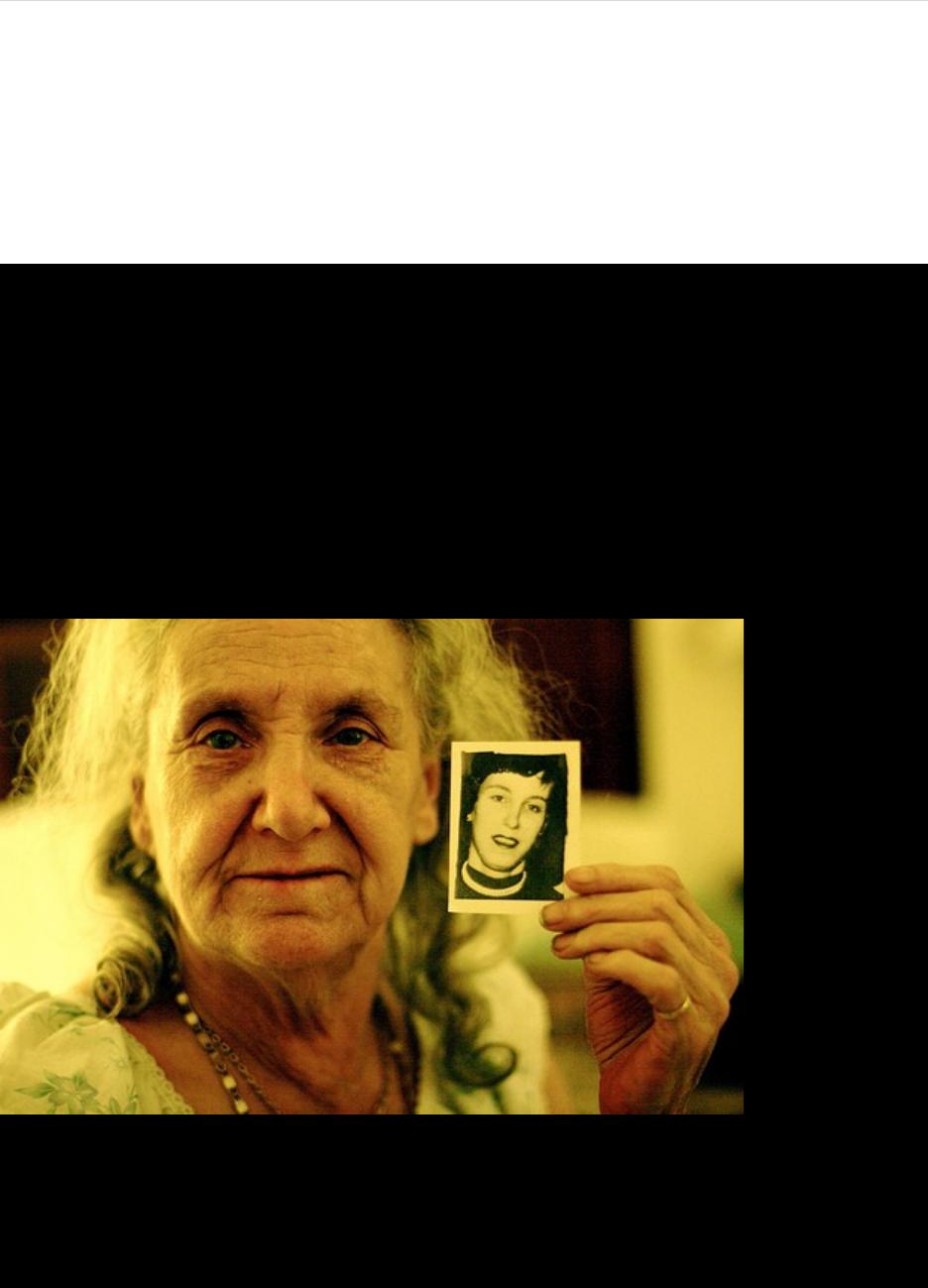
If you think about the following guidelines in relation to the above picture it may help you visualise what I’m talkin’
’bout. Now…without further hesitation I give you my three basic guidelines on what to look for in order to enhance
your photographic eye and use that to make compelling pictures…
1. A good photograph has a theme. It’s about someone or something. It may even tell a story about that subject but
the main point is that the subject is clear and unambiguous. So going into your shot you should know what you want
the theme of it to be and this should be easily distinguishable to your viewers as well. To take it one step further, good
photos most often represent a universal theme – one that everyone can relate to.

P a g e | 4
2. A good photograph focuses attention. Ask yourself how you can draw your viewers eye to the subject of your
photo. This is often done by having one major subject of interest, one thing that really stands out. In order to have
really focused attention you may have to get in closer to an object, gain eye contact with a person, compose the
subject so they stand out within the frame of your viewfinder. There are many ways to do this – but thinking about the
focus is half the battle. If you’re aware of drawing attention to the subject, you’ll likely be doing it.
3. A good photograph simplifies. In order to do this you really just need to ask yourself if you have included only that
which draws attention to the subject. In other words, have you eliminated everything that is non-essential or
distracting? Have you zeroed-in on the key element in the scene? This doesn’t mean that you have to cut out all
backgrounds, just be sure that the surroundings contribute to the story-telling aspect of your shot and that they add
an element of understanding rather than draw viewers away from your subjec
Developing a “Photographic Eye”
View Article List
Autho
r
Tim
Epp
Photography in many ways is an artform. I find this to be true the more time I spend in honing
this craft. Sure in one sense photography can be as simple as taking “snapshots” of the scene you
want to capture without putting a whole lot of thought into the photo, and many are content with
that level of photography.
What I want to share here though are a few things to keep in mind if you want to take a bit more
time and effort in “composing” a photo, which is really more the mindset to be in if you want to
take better photos. The tips I offer here are fairly basic and can be implemented with pretty much
any camera you may have.
I am primary a nature photographer, so it is with this in mind that I write this article.
1. Lighting
Photography literally means “writing with light”, so becomes easy to see that lighting can make
or break a photo. Cloudless blue sunny sky is wonderful weather for being outside, but at the
same time it makes for lousy photography lighting conditions. This is due to the fact that there is
a high contrast between bright light and dark shadows. This type of situation is almost impossible
to expose evenly unless you start getting into some fancy filters. If you set your exposure for the
sky, your ground areas will be dark. If you expose your photo for the ground, your sky will be
overexposed.
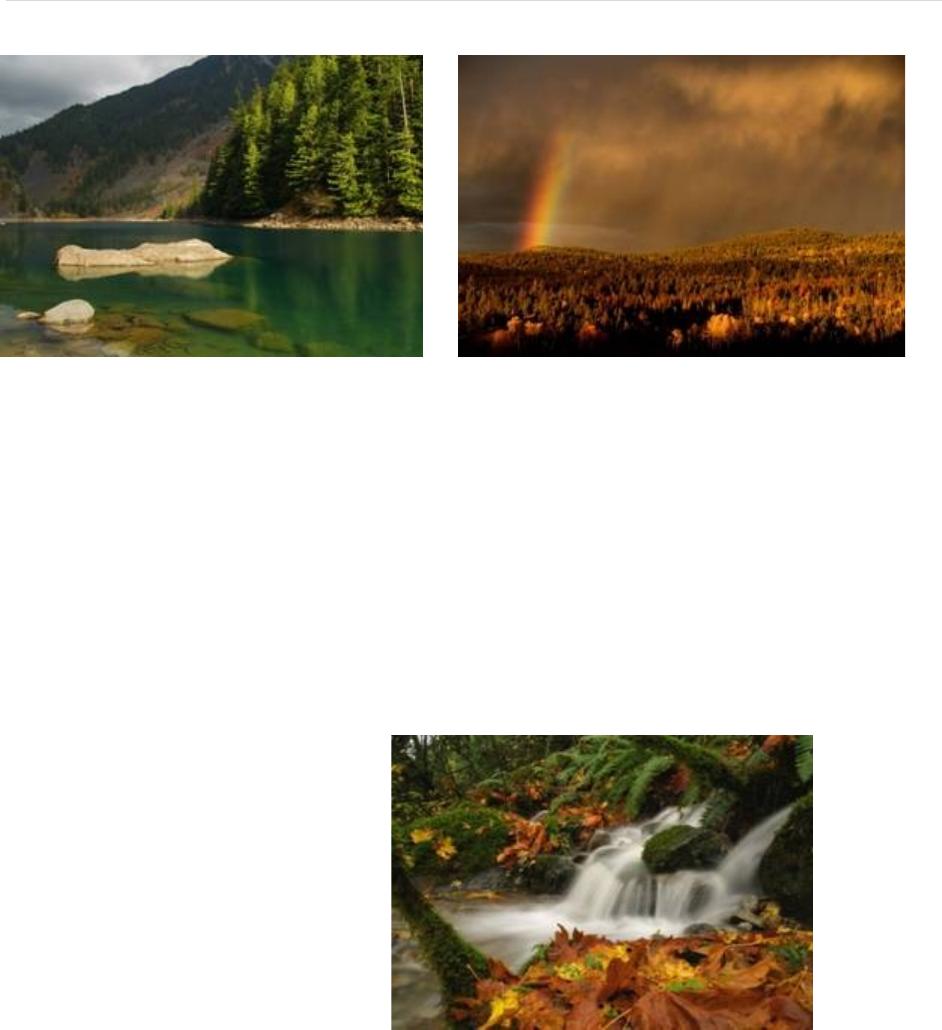
Unique lighting situations can offer up some really great photo opportunities; making what could
be an otherwise bland landscape into a truly memorable photo.
P a g e | 5
Sometimes it takes awhile to get just the right lighting to highlight what you want. This is where
patience and waiting for that right moment comes into play. Some of my favorite times for photos
are during and after storms, as well as the “golden hours” of the warm, low lighting provided by
sunrises and sunsets. A sky with broken cloud, like the photo on the left, also provides some great
unique lighting opportunity. The photo on the right was taken just after a storm, and just before
sunset.
2. Composition
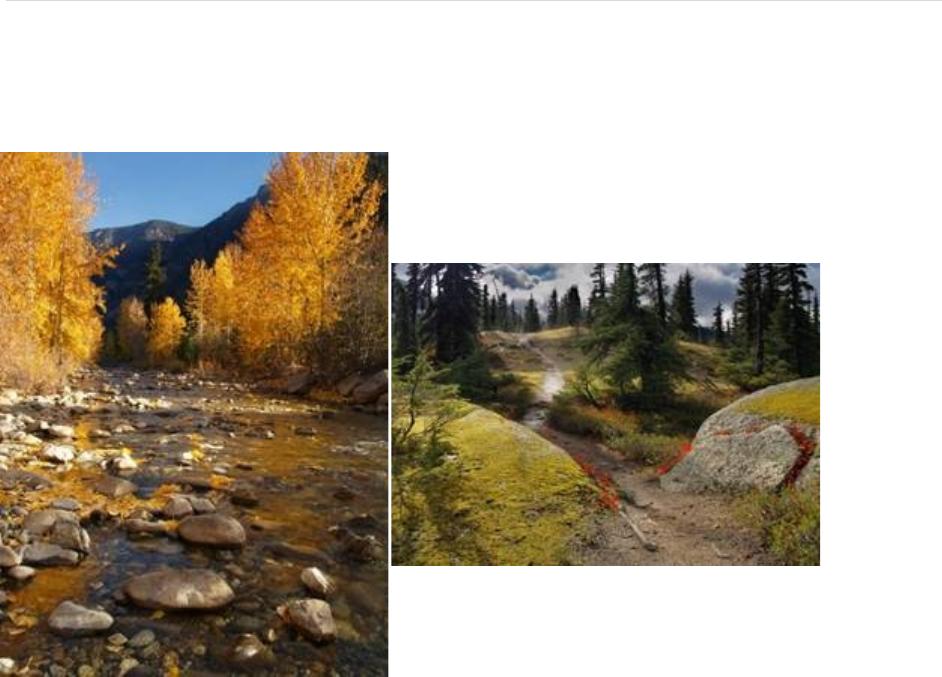
Photos themselves are 2 dimensional, but with some good composition, you can give your photo
a lot more depth of field. This can be a difficult thing to master, but patience and taking the time
to study your subject before taking the shot can really go a long way.
P a g e | 6
All of these above shots involved using a fair bit of Depth of Field, or a combination of subjects
that are both close and far away. One of the tricks is to make your picture naturally “flow” from
one part of the photo to another. All of the above photos tend to “flow” from right to left. Good
photo composition takes into account where your eyes will naturally gravitate first within the
photo, then where they will go from there.
Generally it’s a good idea to practice using the manual settings on your camera if you have that
option. This way you have control over things like shutter speed, aperture, and even your ISO
settings. Explaining this stuff is a bit more technical than what I want to deal with in this article,
but basically the larger number that you have your aperture set, the more everything stays in
focus. This is particularly important when your photo involves subjects that are both close and far
away and you want everything to remain in focus.
A higher ISO, like in film, allows more light sensitivity, but at the same time can also produce
digital noise, or a grainy appearance in your picture. Higher numbered apertures, or “F-stops” lets
less light into your lens, so lower shutter speeds or a higher ISO setting has to be used to
compensate. Ah the balancing act can get tricky!
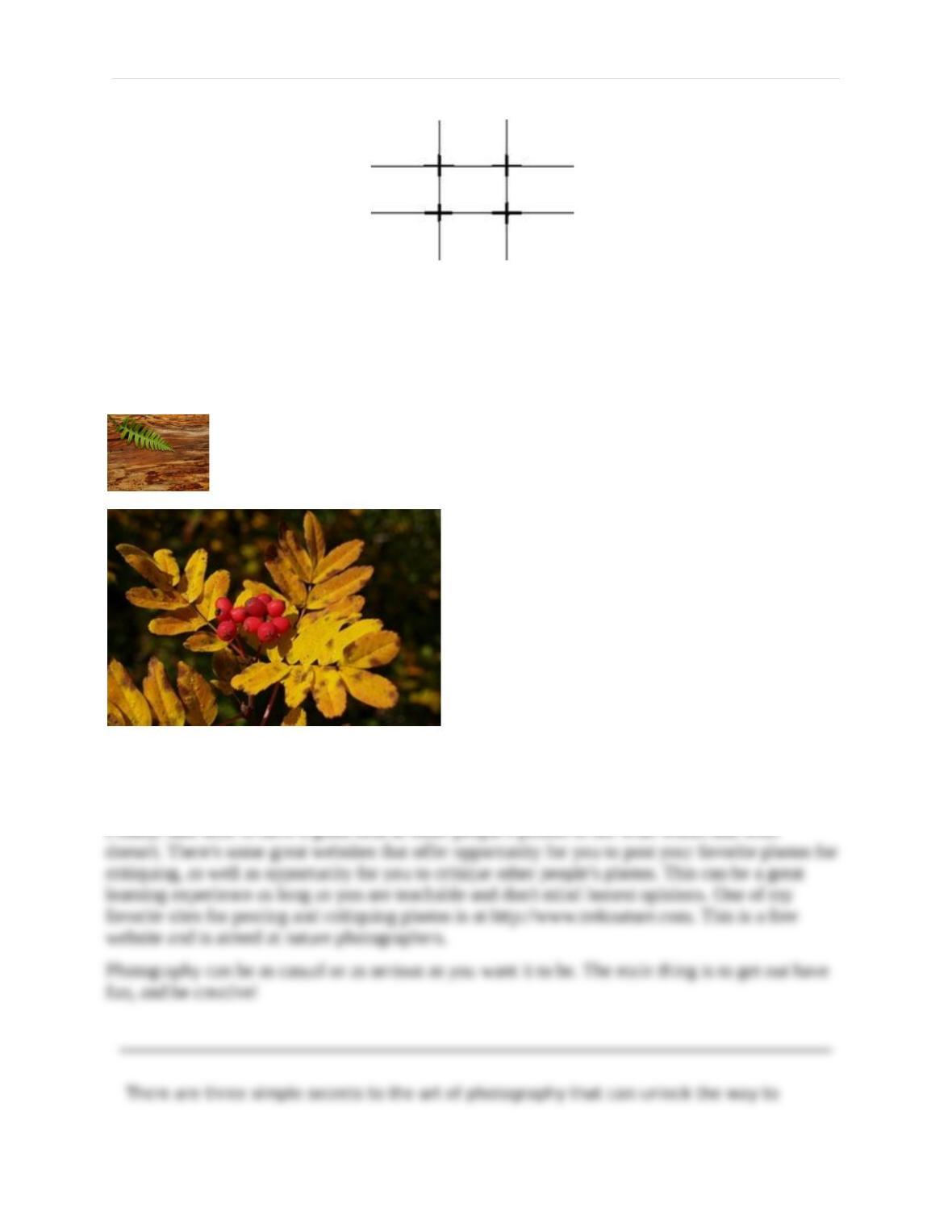
You’ve probably heard about the “rule of thirds” in photography. Basically what this means is that
you want the important elements in your photo to be where where these “one third” lines
intersect:
P a g e | 7
Some cameras even have these lines on the viewfinder. This isn’t a hard and fast rule, but it is a
good rule of thumb to start with.
3. Contrast
Using contrast in photos is kind of a combination of lighting and composition, but using
contrasting colour can offer some really cool photos.
Contrasting colours can really make your subject stand out. This is where the vibrant fall colours
or spring flowers can be a lot of fun. Even contrasts such as dead snags and live trees or other
such natural “opposites” can really add to a photo.