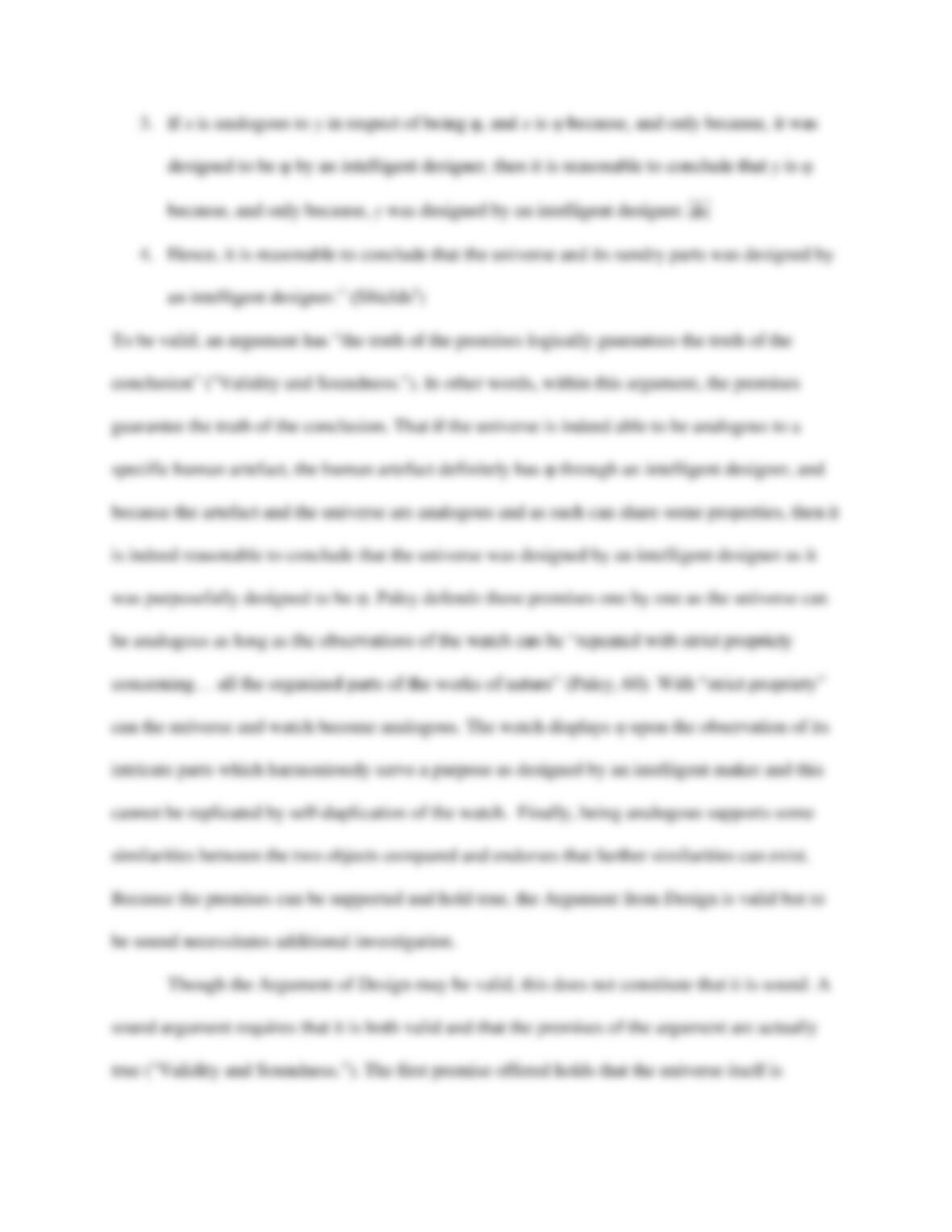
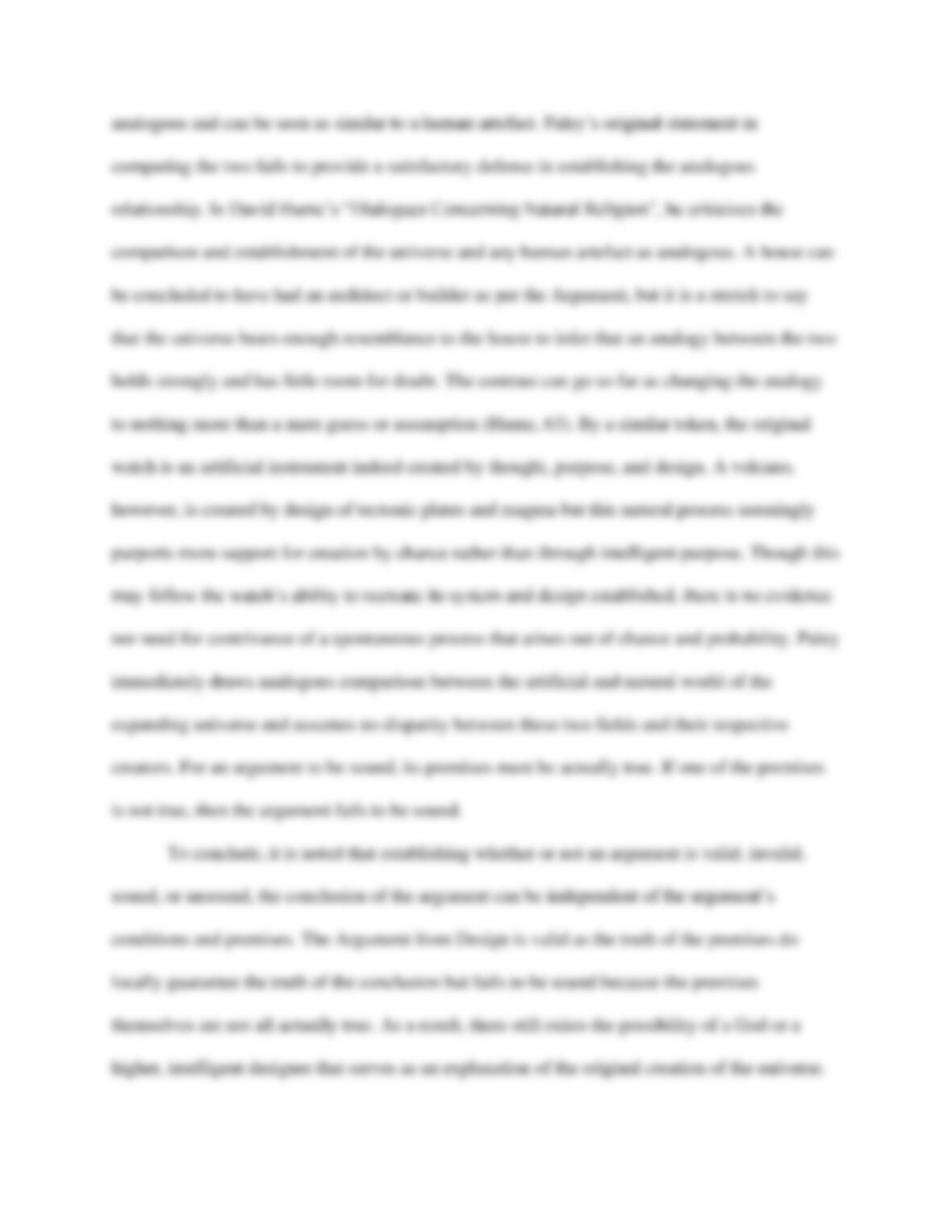
The Argument from Design by William Paley is an a posteriori, an inductive, argument
which attempts to show that the universe is the product of an intelligent and purposeful designer.
It relies on rational grounding to offer reasons why a rational person should conclude God exists
(Shields2). However, though the Argument from Design succeeds in validity, it is not a sound
logical argument.
Suppose that, walking along a path, one finds a common stone and is asked why it is
where it is. A possible answer could be that it had always been there. Though unlikely, there
exists the possibility of the rock having naturally lying in the same spot since its creation. Now,
imagine that a watch is also found on the same path and is questioned why it is there. Yet it
makes little sense to provide a similar answer of the stone to the watch: that the watch had
always been lying there. Why? One can quickly understand that the watch, without having to
understand that it is a watch and by simply observing its components, is composed of multiple
precisely made and intricate parts that cooperate to create the product. It can be inferred that the
watch, or device, was produced by an intelligent designer who both designed the watch’s parts
and did so with comprehension and purpose. If one assumes that there is no watch-maker, then it
is not necessarily a reasonable conclusion that the watch was made by a random process of chaos
and order that formed the distinct principles and functions the watch performs, creating the
design of the object. Nor do the individually created parts of the watch show creation integrated
with purposefulness: that each item of the watch was created with purpose rather than being
created for the sake of random creation and apparent unity. If one also assumes and supposes that
the watch is found to have the property to be able to randomly produce another watch, identical
to the original, one can further admire the design and intricacy of the watch. However, such a
process does not provide any answer to the contrivance, or skillful creation with purpose, of the
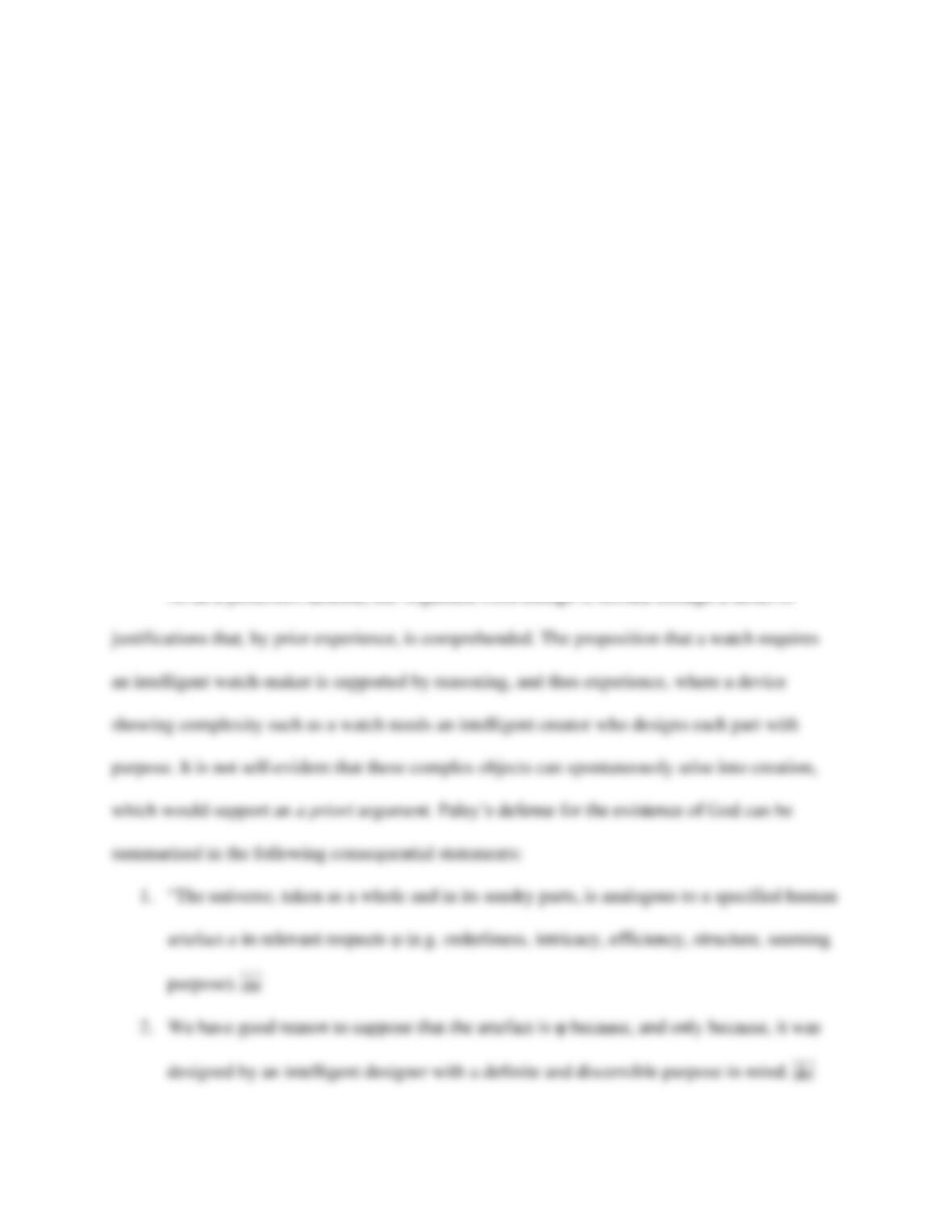
watch. The watch can continue to duplicate into the future and may have done so in the past, but
this process of the watch’s self-creation does not show purpose of design. One cannot have
design (the watch creating itself) without a designer nor can contrivance be created without a
contriver. Thus, it can be understood that there should be a creator who intentionally understands
the watch’s system and designs the watch’s use. Additionally, the watch does not have to be
flawless for it to be understood of the necessity of an intelligent creator for both purpose and
design (Paley, 56-57). The observations of the watch can be applied and repeated towards nature
and the universe itself through an analogy of the necessity of an intelligent creator. As there
must be a watch-maker for the watch, it is rational that there is a creator, a God, for the complex
universe. As per the watch, the universe is drawn to an analogy to which it is then also the
creation of purposeful design by an intelligent maker (Shields1).