

MARKET FORCES JULY-2008
30
Research
1.0.0 INTRODUCTION
The unethical drug practices are common phenomenon
worldwide but it is more severe in developing countries.
Unethical drug practices have two dimensions. One is
drug related, and other is drug promotion related.
Extensive researches on drug related unethical practices
have been carried out internationally. However, there
is a dearth of literature on unethical drug promotion
practices. Parmar and Jalees (2004) observed that
pharmaceutical industry spends a substantial portion
of its budget on market research but do not carry out
the research on how to curb the unethical drug
promotion practices.
Unethical marketing practices have become an
integral part of Pakistans pharmaceutical industry.
These practices is so deep rooted that it has become
extremely difficult for pharmaceutical companies
to compete without indulging in such practices
(Parmar & Jalees 2004). The findings of the study
by Parmar & Jaleees (2004), were mainly focused
to such practices in one city, Hyedrabad, therefore,
it lacked generalizeability. In view of this limitation
there was a need to find whether such unethical
practices exist in other parts of country as well.
This paper has been undertaken with the objective
broadening the scope of the study to the whole of
Pakistan.
Lack of research on the subject does not mean that unethical
drug promotion practices do not exist. The pre-survey and
focus groups discussions indicate that unethical
pharmaceutical marketing practices have become an
acceptable norm of the pharmaceutical industry, and almost
all the pharmaceutical companies patronize these unethical
practices in collaboration with doctors, government and
private hospitals, health related agencies, and pharmacies
at the cost of patients well being.
All the entities as discussed above appear to be directly
or indirectly involved and it would not be fair to blame
any one of them, including pharmaceutical industry.
The focus of the subject study was to identify the
intensity and trends of unethical drug promotion
practices in Pakistan examine. Ascertain the involvement
of doctors, health related institutions and the
pharmaceutical industry in promoting such practices.
1.2.0 LITERATURE SURVEY
The previous researches indicate that unethical
pharmaceutical marketing practices have become an
acceptable norm of the pharmaceutical industry, and
almost all the pharmaceutical companies patronized
these unethical practices in collaboration with doctors,
government and private hospitals, health related agencies
and pharmacies at the cost of patients well being.
(Parmar and Jalees 2004)
PHARMACEUTICAL INDUSTRY IN
PAKISTAN:
UNETHICAL PHARMACEUTICAL
MARKETING PRACTICES
Rizwan Raheem Ahmed Tariq Jalees
SZABIST College of Management Science
Karachi, Pakistan PAF-KIET
tariqj@pafkiet.edu.pk

MARKET FORCES JULY-2008
31
Research
Zaidi, et.al, (1995) observed that in the 13th national
psychiatric conference held at Abbottabad in
September 1999 nine papers were read by different
doctors; however, most of the papers were not on
the subject issue but were mainly focused on their
experience of administrating specific drugs to the
patients. Incidentally, some of the foreign guests
thought that the conference was not on psychiatric
issue but it was more on the specific drug promotion
activity. Two inferences could be drawn from this
incidence. One, the participating doctors were so
involved and occupied in their profession that they
erroneously ignored the themes and the objectives
of the conference; second, that the doctors did not
spend considerable time for developing the
appropriate paper for the conference. (Zaidi, et.al,
1995)
A report on the practices of 20 of the worlds
biggest drug companies revealed that drug
companies use unscrupulous and unethical
marketing tactics not only to influence doctors to
prescribe their products but also subtly to persuade
consumers that they need them. (Pogo et.al, 2006).
The report further alleges that since the drugs
companies cannot legally advertise their product
to the consumers, therefore, in order to circumvent
this drug companies are promoting their products
through patients groups, students and internet chat-
rooms. (Pogo et.al, 2006). The authors also observed
that the pharmaceutical companies through press
releases and web pages educate consumers on
“modern” lifestyle diseases, such as stress and poor
eating habits, but their prime objective for all such
activities is to promote their drugs. [Pogo et.al
2006]
A study on relationship between the medical
professionals and the pharmaceutical industry found
that the pharmaceutical industry is responsible for
corrupting the medical professionals. The study
also found that this un-ethical drug practices is not
limited to developed countries but is also found in
developing countries, also. (Zaidi et.al. 1995). The
authors, also, observed that the industry is rewarding
the doctors for prescribing their medicines, despite
the fact that better and cheaper medicines are
available in the market. The reward is inclusive of
sending physicians and their families to recreational
places within the country and overseas, giving
expensive gifts, footing the bills of doctors birthday
parties, wedding receptions and furnishing doctors
homes and clinics. It has also been alleged that
leased cars have also been provided to the doctors
by the firms for extensively prescribing their
medicines [Zaidi et.al 1995]
A similar research was undertaken in Nepal and
the findings were that doctors, generally prescribes
those medicines that are actively and unethically
promoted by medical representatives. The authors
observed that it is easier for the pharmaceutical
company to entertain doctors demand of personal
traveling, and lodging as these expenses could be
booked in the heads of conferences and seminars.
[Bishnu & Ravi 2005]
Fisher et.al. (1993) observed It is unethical for
journals that publish reports on psycho-
Pharmacology to accept drug company money for
anything. And, I think it equally unethical that the
American Psychiatric Association allows Drug
Company sponsored symposia as part of its annual
meetings. [Fisher, Bryant & Kent 1993]
All promotion by definition is information whose
aim is to market a product and as such has an
inherent bias towards showing the product in the
best possible light. Globally, there is a huge
imbalance between the available resources for
promotional activities viz. independent information.
As a result consumers and doctors are generally
subjected to a positive information bias that is drug
companies portray exaggerated benefits of drug
use while downplaying the risks and the side effects.
(Lexchin, 1995)
Arun ( 1998) observed irrational drug formulation
regulations contributes heavily for increasing the
drug cost. For example, in US the drug development
and approval cost is about $ 9.4 million.
Pharmaceutical companies being profit-oriented
thus have to resort to aggressive marketing in order
to meet this overwhelming drug formulation cost
and to have a reasonable profit to satisfy the stake
holders.

MARKET FORCES JULY-2008
32
Research
Daniella, Zipkin & Michael (2005) studied the
interaction between pharmaceutical representatives
and internee (trainee doctors). They found that it
is common for pharmaceutical sales
representatives to interact with the internees. Most
of the internees were of the opinions that there
is nothing unethical on the interactions of the
sales representatives and internees. However, a
few of them confessed that factors such as visits
& contact of pharmaceutical sales representatives,
gifts and giveaway and quantity of sample
medicines have a positive influence on prescribing
medicines. (Daniella, Zipkin & Michael, 2005)
Parmar and Jalees (2004) developed the distinctions
between ethical, and unethical drug promotions
practices based on the focus group discussions.
The acceptable norms of promoting drugs through
doctors are visiting them, giving them presentations
on the merits and demerits of the drugs. Explicitly,
pointing out the side effects of drugs, giving
nominal quantity of drugs sample. These gifts and
give away must not be highly expensive and
restricted to items such as dairies, calendar, year
planner, etc. (Parmar and Jalees 2004)
Comparatively, unethical drug promotion practices
are prescribing drugs to the patients based on the
monetary considerations, and ignoring the well
being of the patients. The commonly used monetary
rewards for unethical promotion of the drugs are
discussed below: [Parmar and Jalees 2004]
(i) Monetary Reward
The crudest form of unethical drug promotion is
monetary reward. In this category, the cash reward
is linked with the quantum of the drug prescriptions.
The payments, in this case, are made on monthly
or quarterly basis.
(ii) Visits Within Country
In this category, the pharmaceutical companies
arrange conferences and seminars for the doctors
in those cities where doctors are not domiciled.
The objectives of such conferences/seminars may
be to update the doctors on the latest development,
but the real motive is to provide fully paid vacation.
The pharmaceutical companies arrange the air
traveling, lodging and boarding in a five star hotels.
This paid vacation could be for the doctors, and
their family members. Doctors travel to other cities
for personal reasons.
(iii) Foreign Visits
In this category, pharmaceutical companies arrange
foreign visits of the doctors. Like local visits, the
foreign visits again are arranged in the backdrop
of seminar and conferences but again the real
motive is to provide fully paid vacations to the
doctors and their families. All the traveling bills,
boarding and lodging are again borne by the
pharmaceutical companies. These foreign visits are
generally restricted for those doctors who are
actively involved in promoting their drugs.
(iv) Gifts & Give away
a. Medical Equipments:
Pharmaceutical firms give medical equipments like
stethoscope, thermometers, surgical kits and other
expensive medical equipments.
b. Personal Use Items:
In this category the pharmaceutical companies give
personal use items such as mobile, laptop, air-
conditioners, and even cars.
(v) Chamber Decoration
In this category, the pharmaceutical companies,
not only, refurnish the doctors chambers, but also
arrange furniture/fixture, sign boards, air-
conditioners, computers, curtains, etc.
(vi) Home Decoration
The arrangement of the home decoration is similar
to the chambers decorations as discussed above.
1.3.0 PHARMACEUTICAL INDUSTRY
After partition, Pakistan did not inherit any industrial
base. Like other consumer items, Pakistan met the
drugs demand through imports. The situation
remained the same up to 1960. In early sixties the
multinational pharmaceutical companies made heavy
investment in Pakistan for setting up pharmaceutical
manufacturing units. National pharmaceutical
companies also got encouraged, and started making

MARKET FORCES JULY-2008
33
Research
capital investment during the same era. In 1985,
the market share of multinational and national
pharmaceutical industry was 65% and 35%
respectively. [IMS, Q3 & Q4, 2005]
Presently there are about 586 leading Nationals and
Multinational pharmaceutical companies operating
in Pakistan. Of this total, 23 are multinationals and
rest are local companies. The local companies can
be classified into three categories: (1) Manufacturing
units (2) Importers that imports drugs in finished
form, and (3) Franchisers (not to be confused with
the franchisors in the FMCG). These companies
have all the required marketing setup and facilities,
but do not have drug manufacturing facilities. These
companies obtain the drug marketing rights from
other drug manufacturing companies on profit
sharing basis. The prevailing market size of the
industry is of Rs.80.11 billion, of this total the market
share of national pharmaceutical industry is 59%..
[IMS, Q3 & Q4, 2007]
The drugs prices of the national pharmaceutical
companies are lower, as they have a choice of
procuring the raw material from those countries
where it is available at a cheaper rate. The other
reason for the price differential is that the budget
of national pharmaceutical companies on research
and development is nominal as compare to
multinationals companies. Multinational companies
invest a substantial portion of their sales on R &
D. Launching a new molecule in the market cost
billions of dollars, therefore, they have to adapt to
marketing skimming strategy to meet the product
development cost and to skim the profit before
patent period expires. Multinational companies
know that after the expiry of the prescribed patent
period other companies would launch the same
drug or imitated drug at a cheaper rate. The local
national companies have two advantages. One, they
dont invest any funds on Research & Development
and second, they procure raw material from cheaper
resources [Parmar & Jalees, 2004].
1.4.0 STATEMENT OF THE PROBLEM
Is unethical drug promotion practice common in
Pakistan? Who initiated unethical drug promotion
practice in Pakistan? Who is responsible for the
continuation of the same?
2.0.0. METHODOLOGY
The following methodology was adopted for
achieving the objectives of the study:
2.1.0 POPULATION AND SAMPLE SIZE
The defined population of the study comprised of
doctors (General Practitioners, Medical Officers,
Consultants of different specialties, Opinion
Leaders), Pharmaceutical Personnel (Medical
Representatives, Sales Managers, Product Managers),
Pharmacists of different pharmacies, Influential
personnel of private and government hospitals.
The samples size for the subject study was 120. As
per Sekaran (2003) for multivariate sampling a
minimum of 20 samples per variable is required.
Thus the appropriate sample size should have been
80. However, to have a better representation,
samples size of 120 was selected. The breakdown
of the sample size was as follows:
No. Sample No. Of Samples
01 General Practitioners 17
02 Medical Officers 19
03 Consultants 11
04 Opinion Leaders 16
05 Pharma personnel 21
06 Government Hospitals 12
07 Private Hospitals 07
08 Pharmacies 17
The Hypotheses were tested through statistical
techniques such as Z-test, t-test and F-test. A
qualitative analysis was also carried out for analyzing
the other critical factors discussed in the study.
2.2.0 DATA COLLECTION METHOD
The questionnaires were administered in all the 8
cities simultaneously through sales force of a drug
company. All the persons involved in administering
the questionnaire were given an extensive orientation
on the purpose and the objectives of the study.
MARKET FORCES JULY-2008
34
Research
3.0.0 SURVEY FINDINGS
3.1.0 HYPOTHESES TESTING
Four different hypotheses were developed and
tested using Z-test, simple ANOVA and F-test. The
results and interpretation of the four developed
hypotheses are presented below:
3.1.1 HYPOTHESIS 1
H1o: The level of unethical drug promotion
practices in pharmaceutical industry is high (at least
4) on the scale of (5 to 1)
The above hypothesis was tested through Z-test
and the summarized result is presented below:
Table 1
Level Of Unethical Drug Promotion Practices.
Mean 4.39
Standard Deviation 0.54
Hypothesized mean 4.00
Confidence level 0.95
Critical value one tail 1.65
Critical value two tail 1.96
Z-Calculated value 7.96
The hypothesis relating to high level of unethical
drug promotion practices (at least 4 on the scale
of 5-1) was substantiated. At 95% confident level,
Z critical value is -1.65, and Z-calculated value is
7.96 that falls in the non-critical region.
It may be pointed that the level of unethical
drug promotion practices as was ascertained by
Parmar and Jalees (2004) in their research was
3.56. The reason could be that the previous
study of (Parmar and Jalees) was a case study
of Hyderabad only, where as this study is all
Pakistan based, and the sample drawn is a
representative sample.
3.1.2 HYPOTHESIS 2
Focus group discussions indicate that the level of
unethical drug promotion practices is high in rural
areas. Thus the following hypothesis was formulated:
H20:The levels of unethical drug promotion
practices are high in rural areas.
Above hypothesis was tested through Z-Test (two
variables) and the summarized result is presented
below:
Table 2
Level Of Unethical Drug Promotion Practices In
Rural Area
Rural Urban
Mean 4.66 3.83
Known Variance 0.44 0.54
Observations 120 120
Hypothesized Mean Difference 0
Z 9.19
P(Z<=z) one-tail 0
z Critical one-tail 1.64
P(Z<=z) two-tail 0
z Critical two-tail 1.95
The hypothesis relating to higher level of unethical
drug promotion practices in rural areas was
substantiated. At 95% confidence level the Z-critical
value is -1.64 and Z-calculated value is 9.19 that
fall in the non-critical region.
3.1.3 HYPOTHESIS 3
An important aspect is who was responsible for
initiating the unethical drug promotion practices
in Pakistan. Doctors, pharmaceutical companies,
hospitals, and pharmacies all have different
opinions. Thus the following hypothesis was
developed:
H30: There is no significant difference on the
opinions of doctor, pharmaceutical companies,
hospitals, and pharmacies on who initiated
unethical drug promotion practices in Pakistan.
The above hypothesis was tested through simple
MARKET FORCES JULY-2008
35
Research
ANOVA, and the summarized results are presented
below:
Table 3
Opinion On Who Initiated The Unethical
Drug Promotion Practices
Groups Count Sum Average Variance
Pharmaceutical
company 120.00 436.00 3.63 2.52
Doctors 120.00 283.00 2.36 3.12
Hospitals 120.00 138.00 1.15 0.46
Pharmacy 120.00 130.00 1.08 0.18
Source of SS df MS F P- F crit
Variation value
Bt. Groups 521.56 3.00 173.85 110.64 0.00 2.62
Within Groups 747.93 476.00 1.57
Total 1,269.48 479.00
The hypothesis relating to no significant difference
of opinions on who initiated unethical drug
promotion practices in Pakistan was rejected. At
95% confidence level and (3, 476) degree of
freedom the calculated F value of 110.64 is greater
than F- critical values of 2.62.
The above analysis also indicates that the
respondents believe that the pharmaceutical industry
had initiated unethical drug promotion practices in
Pakistan with a mean of 3.63. The doctors
contribution on this issue appears to be on the
lower side with a mean of 2.36.
3.1.4 HYPOTHESIS 4
In the previous hypothesis, it was discussed who
initiated unethical drug promotion practices, in
Pakistan. Focus group had diverse opinions on who
is more responsible for the continuation of this
practice. Thus to resolve the diversified opinion
the following hypothesis was developed.
H40:The contribution of the pharmaceutical
industry in continuation of unethical drug
promotion practices is higher than the doctors.
Above hypothesis was tested through Z-Test (two
variables) and the summarized result is presented
below:
Table 4
Opinion On Who Continued The Unethical Drug
Promotion Practices
Pharmaceutical Doctors
company
Mean 2.78 3.72
Known Variance 3.43 2.56
Observations 120.00 120.00
z (4.18)
P(Z<=z) one-tail 0.00
z Critical one-tail 1.64
P(Z<=z) two-tail 0.00
z Critical two-tail 1.96
The hypothesis relating to a higher contribution
of pharmaceutical industry in unethical drug
promotion practices was rejected. At 95%
confidence level, the Z critical value is -1.64 and
Z-calculated value is -4.18 that falls in the critical
region. Based on the above and previous analysis
the following conclusion could be drawn (1) the
pharmaceutical industry was responsible for
initiating the unethical drug promotion (2) The
doctors appears to be responsible for the
continuation of the same.
3.2.0 QUALITATIVE ANALYSIS
3.2.1 Tools Of Unethical Drug Practices
In the literature survey, it was discussed that the
pharmaceutical industry relies on the factors such
as monetary rewards, local visits, and foreign visits
MARKET FORCES JULY-2008
36
Research
etc. for pursuing the unethical drug promotion
strategy. The intensity of these tools is presented
below:
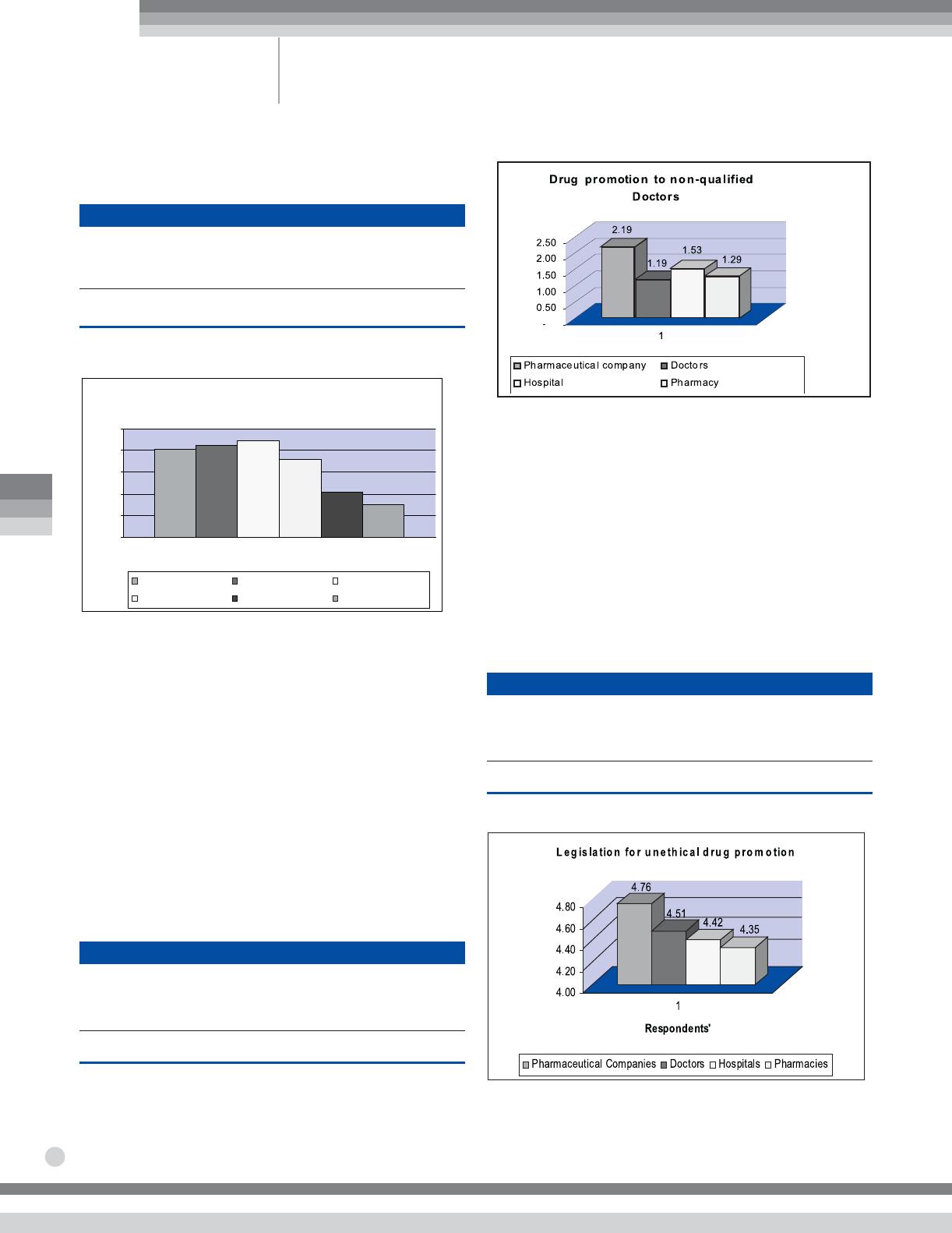
TABLE 5
Monetary Local Foreign Personalized Chamber Home
Rewards visits Visits gifts decoration decoration
4.04 4.23 4.47 3.58 2.07 1.48
GRAPH 1
The above table and graph shows that foreign visits
with a mean of 4.47 are more in demand and local
visits being the second. The reasons for high
preferences for local visits and foreign visits are that
pharmaceutical industry could justify these expenses
by charging these expenses in the heads of
conferences and seminars.
3.2.2 Drug Promotion To Non-Qualified Doctors
Opinions on drug promotion to non-qualified doctors
were obtained. Ethically, the firms should not promote
their drugs through them. The respondents opinions
are presented below:
TABLE 6
Pharmaceutical Doctors Hospital Pharmacy
company
2.19 1.19 1.53 1.29
GRAPH 2
Majority of respondents of all the segments such as
doctors, Pharmaceutical companies, hospitals,
pharmacies, were strongly against drug promotion to
the non-qualified doctors. However, despite their
opinions it is a fact that the drugs are being promoted
through non-qualified doctors.
3.2.3 Legislation For Unethical Drug Promotion
Respondents opinions were obtained on the prospects
of strong legislation against unethical drug promotion
practices. The respondents opinions are presented
below:
TABLE 7
Pharmaceutical Doctors Hospital Pharmacy
company
4.76 4.51 4.42 4.35
GRAPH 3
4.04
4.23
4.47
3.58
2.07
1.48
–
1.00
2.00
3.00
4.00
5.00
1
Monetory Rewards Local visits Foreign Visits
Peronalized gifts Chamber decoration Home decoration
Tools used for nethcial drug prmotion practicesu
MARKET FORCES JULY-2008
37
Research
The majority of respondents were strongly in the favor
of strong legislation against the unethical drug promotional
practices in Pakistan. Although there are already some
legislation on this issue it is not being implemented.
3.2.4 ERADICATION OF UNETHICAL
DRUG PROMOTION
Opinions on of the respondents were taken whether
it is possible to stop this unethical drug promotion
practices in Pakistan. The respondents opinions are
presented below:
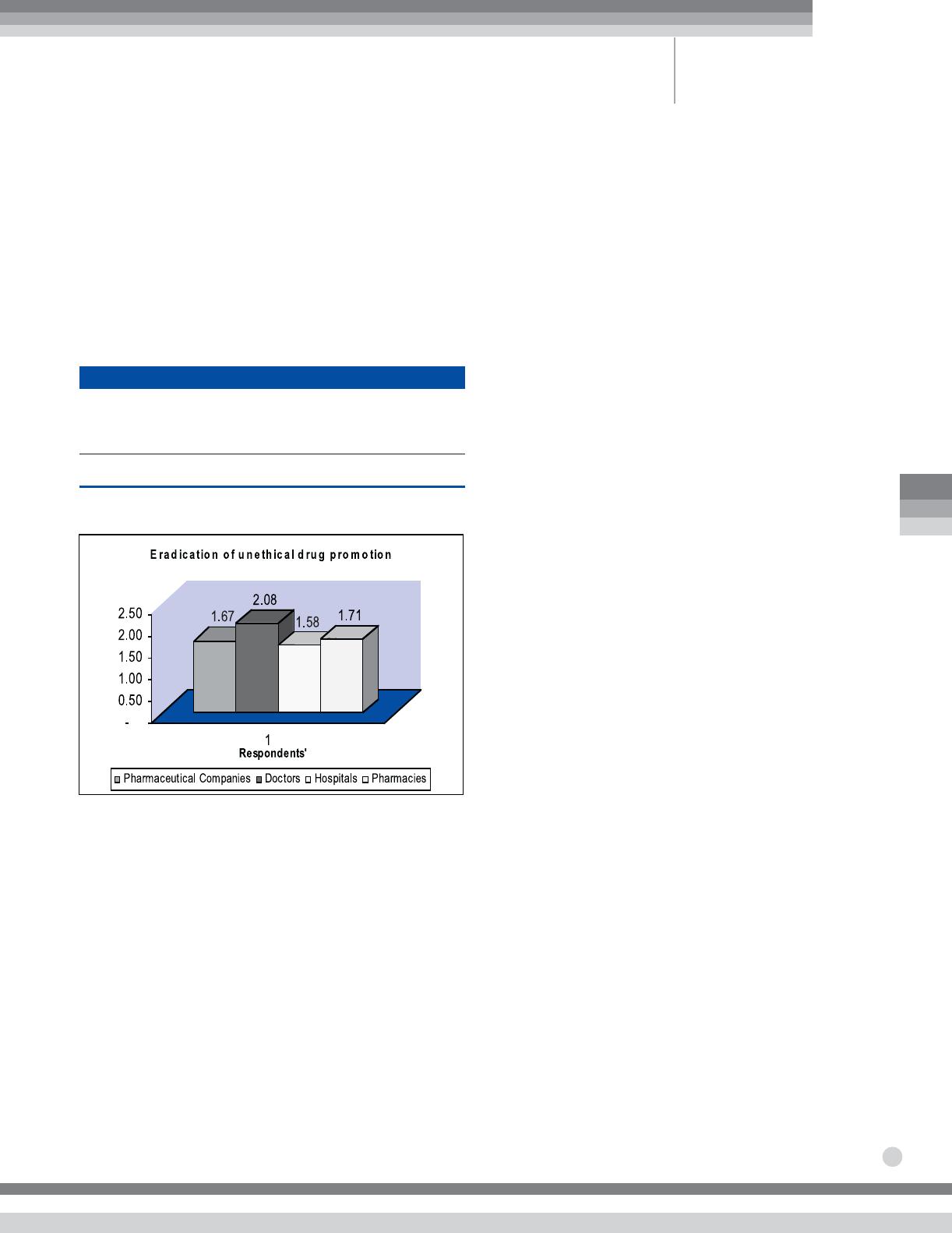
TABLE 8
Pharmaceutical Doctors Hospital Pharmacy
company
1.67 2.08 1.58 1.71
GRAPH 4
Above graph shows that the majority of the
respondents i.e. doctors, pharmaceutical personnel,
hospitals and pharmacies, strongly disagreed with
the statement that the unethical drug promotion
practices cannot be stopped, now. Majority of
respondents were of the opinion that these
unethical practices can still be stopped.
4.0.0 CONCLUSIONS
The doctors and the pharmaceutical companies are
equally responsible for unethical drug promotion
practices in Pakistan. However, an interesting aspect
on this issue is that pharmaceutical companies were
responsible for initiating these unethical drug practices
in Pakistan, and the doctors are responsible for the
continuation of the same. The doctors not only demand
different rewards for prescribing medicine but a few
of them do not prescribe the medicines of those
companies who are reluctant to give monetary rewards.
The summarized results of the tested hypothesis are
presented below:
1) The hypothesis relating to high level of unethical
drug promotion practices (at least 4 on the scale of
5-1) was substantiated. At 95% confident level, Z
critical value is -1.65, and Z-calculated value is 7.96
that falls in the non-critical region.
It may be noted that the level of unethical drug
promotion practices as was ascertained by (Parmar
and Jalees, 2004) in their research was 3.56. The
reason for such a difference in the findings could
be that the study of (Parmar and Jalees) was a case
study of one city (Hyderabad) only, where as this
study is all Pakistan based.
2) The hypothesis relating to higher level of unethical
drug promotion practices in rural areas was
substantiated. At 95% confidence level the Z-critical
value is -1.64 and Z-calculated value is 9.19 that fall
in the non-critical region. Therefore, it has been
concluded that the level of unethical drug practices
are higher in rural areas as compared to urban areas.
3) The hypothesis relating to no significant difference
of opinions on who initiated unethical drug
promotion practices in Pakistan was rejected. At
95% confidence level and (3, 476) df the calculated
F value of 110.64 is greater than F- critical values
of 2.62.
The general perception was that the pharmaceutical
companies were responsible for starting this unethical
drug promotion practices with a mean of a mean
of 3.63.
4) The hypothesis relating to a higher contribution of
pharmaceutical industry in continuation of unethical
drug promotion practices was rejected. At 95%
confidence level, the Z critical value is -1.64 and Z-

MARKET FORCES JULY-2008
38
Research
calculated value is -4.18 that falls in the critical
region. Therefore, it has been concluded that
pharmaceutical industry is not responsible for
continuation of unethical drug promotion practices
but the doctors are responsible for the same.
The qualitative aspects of the analyses are presented
below:
a) The commonly used tools for unethical drug
promotion practices were monetary rewards, local
visits, and foreign visits etc. The drug industry prefers
arranging foreign and local visits of doctors for
prescribing their medicines as these expenses could
be charged in the heads of seminar and conferences.
b) Although majority of respondents were strongly
against drug promotion to non-qualified doctors,
but still the same is being practiced, especially in
rural areas.
c) The majority of respondents were in favor of
strong legislation against the unethical drug
promotional practices.
d) Majority of the respondents were of the opinion
that it would be very difficult to stop the unethical
drug promotion practices.
REFERENCES
Baum, C. & Anello, C., 1989. The spontaneous
reporting system in the United States In Strom BL
(Ed) Pharmacoepidemiology, New York: Churchill
Livingstone. pp. 107-118.
Bishnu, P. & Ravi, S., 2005. An educational initiative
looks critically at the drug industry’s promotional tactics.
Journal.pmed.0020256, August 30.
Brenann, T. 1994. Buying Editorial, New Engl J Med;
331; 10
Daniella, A. & Michael. A., 2005. Interactions between
Pharmaceutical Representatives and Doctors in Training.
Journal of International Medicine. August; 20(8): 777786.
Fisher, S & Kent, T.A. & Bryant, S.G., 1995. Post
marketing surveillance by patient self-monitoring:
Preliminary data for sertraline versus fluoxetine, Journal
of Clinical Psychiatry ;56:288-296.
Fisher, S. & Bryant, S. G. Kent, T. A., 1993. Post
marketing surveillance by patient self-monitoring:
trazodone versus fluoxetine. Journal of Clinical
Psychopharmacology; 13:235-242.
Fisher, S., 1993. Patient self-monitoring: a challenging
approach to Pharmacoepidemiology; 13:235-242.
Harris, G., 2004. Guilty plea seen for drug maker. New
York Times, July 16:A1.
Harris G., 2004. As doctor writes prescription, drug
company writes a check. New York Times, June 27:A1.
Laing, R. O. & Hogerzeil H.V. & Ross-Degnan, D.,
2001. Ten recommendations to improve use of
medicines in developing countries. Health Policy Plan.
16: 1320.
Libman, M. 2003. Drawing line between education and
promotion; new regulations are reshaping the way
Pharma companies work with the medical profession,
and adding a new level of complexity to this fast
growing educational effort, Medical Marketing and Media,
August 01.
Lewis, J.H., 2002. The rational use of potentially
hepatotoxic medication in patients with underlying liver
disease., Expert Opinion Drug Saf, 1(2): 159-172.
Lexchin, J. 1995., Deception by design: pharmaceutical
promotion in the third world. Consumers International,
Malaysia.
Lexchi, J., 1992. Pharmaceutical promotion in the third
world. Journal of Drug Issues; 22(2):417-422.
Petersen, M., 2003. AstraZeneca pleads guilty in cancer
medicine scheme. New York Times, June 21:C1.
Phatak A., 1998. The pharmaceutical industry and the
medical profession. Indian Journal of Medical Ethics, Oct-
Dec, 6 (4).

39
Research
Katz, D. & Caplan, AL. Merz, JF., 2003. All gifts large
and small: toward an understanding of the ethics of
pharmaceutical industry gift-giving., Am J Biotech; 3(3):39-
46.
Pakistan Pharmaceutical Market Information Medical Statistics
(IMS) (2005), 2nd issue, 2: 33-44.
Pakistan National Code of Pharmaceutical Marketing
Practice (incorporating IFPMA Code with Drugs Rules
1994) Pakistan Association of Pharmaceutical Physicians
2002.
Parmar, V. & Jalees, T., 2004. Pharmaceutical
Industry in Hyderabad, Unethical Practices in Drug
Promotion, Independent Study for MS, Shaheed
Zulfiqar Ali Bhutto Institute of Science &
Technology, Karachi, May.
Phillips, I. & Shannon, K., 1978. The activity of
cephalosporins on beta-lactamase-producing Neisseria
gonorrhoeae. : 23-26.
Rohra, K. & Gilani, H. & Zafar H. & Kumar, R.,2006.
Critical evaluation of the claims made by pharmaceutical
companies in drug promotional material in Pakistan.,
J Pharm Pharmaceut Sci, 9(1):50-59.
Sekaran, U. 2003., Research Methods for Business A skill
building approach, Third Edition, New York City: John
Willey & Sons, Inc.
Wilmshurst, P. 2000. Academia and industry. The Lancet;
56:338-44
Gavin, Y., 2001. Pen amnesty for doctors who shun
drug companies. News. BMJ; 322:69
Zaidi, SH. & Niaz U. & Jafary, MH & Jawaid SA.,
1995. Medical Ethics in the Contemporary Era. (Eds)
Pakistan Medical Journalists Association, Karachi,
Pakistan.