2
TABLE OF CONTENTS
List of Abbreviation 3
List of
Fig
u
re
s 3
1. Introduction 4
2. Literature review 6
2.1. Career development 6
2.2. Individual perspective of career development 6
2.3. Knowledge management in career development 7
2.4. Knowledge management in value chain perspective 7
2.4.1. Value chain theory 7
2.4.2. Knowledge management in value chain perspective 8
3. Value Chain focused analysis of personal career development 9
3.1. Issues in personal career development 10
3.1.1. Personal Disorientation 10
3.1.2. De-motivated for routine tasks 11
3.1.3. Fake feeling for satisfaction 11
3.1.4. External factors 12
3.2. Application of value chain concept in personal career development 12
3.3. Implication (contribution) of value chain focused career development 17
4. Discussion 18
5. Conclusion 19
List of reference 21
3
List of Abbreviation
HR – Human Resource
CEO – Chief Executive Officer
CFO – Chief Financial Offer
FDI – Foreign Direct Investment
List of Figures
Figure 1: Value Chain (Michael Porter, 1985) 8
Figure 2: Knowledge value chain model (Tamara et al, 2006) 9
Figure 3: Proposed Value Chain for Career Development 13
Figure 4: Management skills required for each management position (Management System, 2014) 14
Figure 5: Global Executive Competencies (McCall and Hollenbeck, 2002) 15
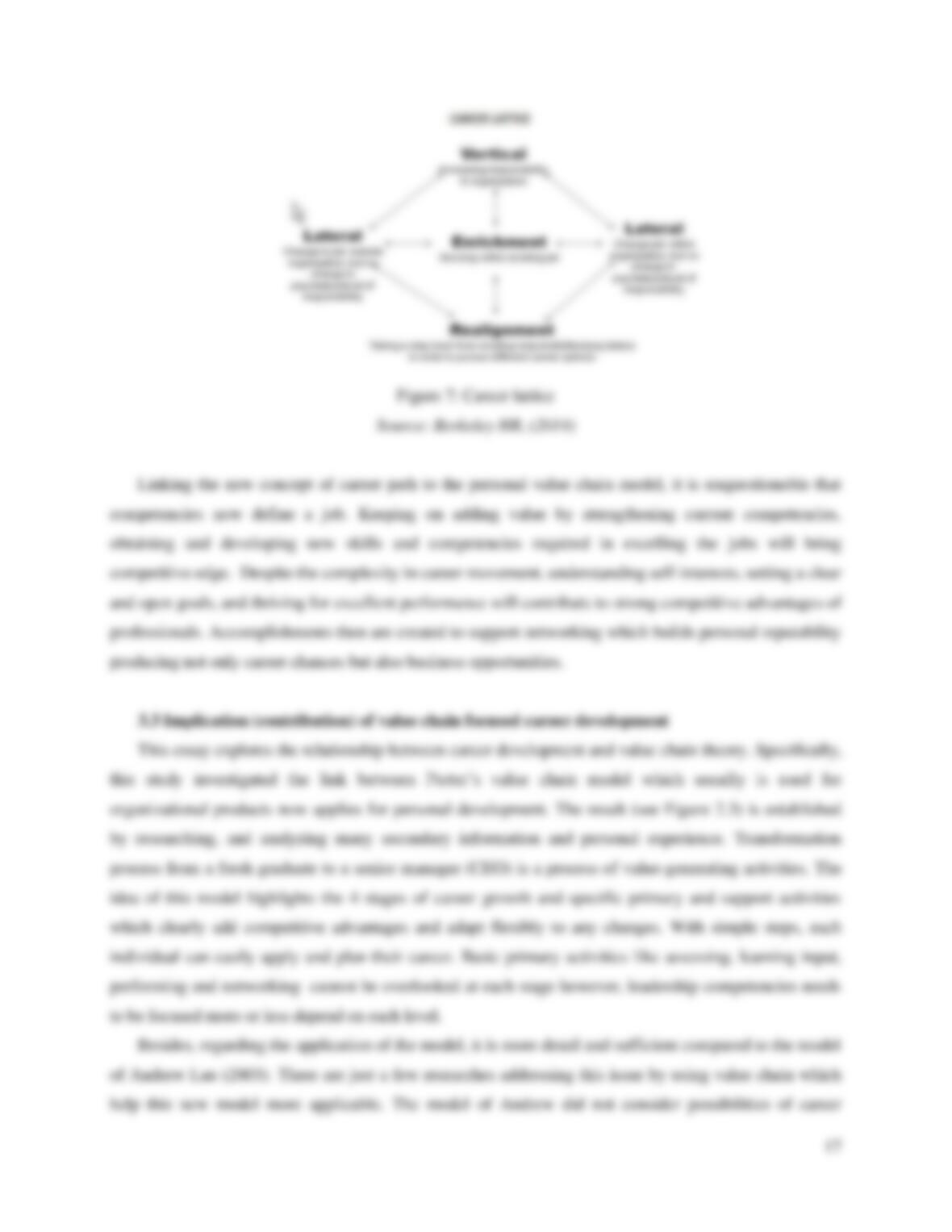
Figure 6: From Career Ladder to Career Lattice (Deloitte, 2011) 16
Figure 7: Career lattice (Berkeley HR, 2014) 17
4
1. Introduction
“Your work is going to fill a large part of your life, and the only way to be truly satisfied is to do what
you believe is great work. And the only way to do great work is to love what you do. If you haven’t found it
yet, keep looking. Don’t settle. As with all matters with the heart, you’ll know when you find it. And like
any great relationship, it just gets better and better as years roll on. So keep looking until you find it.
Don’t settle.” Steve Jobs (2005)
In today’s society, it is a fact that many training courses are being held more than in the past ten years
to guide and educate employees ways to become a Chief Executive Officer (CEO) or to take over high
positions in multinational corporations. This trend happened due to globalization and strong penetration
from a lot of international firms within the last decade into many new markets including Vietnam, which
increases the demand in high-level leaders. Currently, working for international companies is a
mainstream career objective of many fresh graduates. They are holding a strong belief that would expand
their job scope, bring them more challenging roles and maximize their learning opportunities.
From observing and researching more than 400 Foreign Direct Investment (FDI) companies’ profiles
on reliable resources including American Chamber, European Chamber, and German Business Associate
in Vietnam, there is only 20% of the highest positions in charge by Vietnamese professionals while more
than 80% belongs to expatiates. However, it cannot be denied that Vietnamese people are becoming more
and more ambitious and confident with their clear goals to reach for ultimate target in their career path.
The result from the observation does not state that Vietnamese professionals are incapable or not qualified
enough to handle senior roles but this circumstance can be attributable to their deficiency at indentifying
and strengthening competitive advantages which are vital foundation for further development. This state
of affair is also observable in developing countries which have been changing dramatically following the
globalization trend. Throughout the world, thousands of people are struggling to achieve their desired
career. Therefore, a possible solution should be addressed and put in consideration.
In terms of competitive advantages, employees can stand out and differentiate themselves from the
others, which will help them compete and get the position they desire. The whole process of adhering
those should be strategically managed linking with whole life-long process of career development. The
importance of managing a career journey lands into the necessity of strategic competitiveness in the global
labor market, and the fulfilling desire of reaching the final point of career path. Then the question
addressed here is how to develop a career life by building and improving personal competitive advantages.
Like Steve Jobs (2005) shared with Stanford graduates, work fills a large part in a personal life, and it
should be satisfied by great work. The work also needs to be developed, to be grown. Passion and desire
are undeniably initial competitive advantages of one’s career development. However, they are not
sufficient to success without the strategic management. The world keeps on changing and emerging and so
the labor market does, for example, the rise in woman leadership, cultural-diversified workforce, or
5
requirement on new skills and competencies. Therefore, a personal career can be compared to a product or
service development which requires competitive advantages to grow sustainably.
Regarding product and service development, value chain model presented by Michael Porter (1985) is
one of important theories, which identifies where the value is added in an organization and links the
process with the main functional parts of the organization (Lynch, 2006). The value here is defined by the
user or the customer of the company’s products or services. The value chain model can be then applied
and expanded for personal career development, in which the customers will be international corporations
and competitive advantages created from various value-generating activities deciding an individual career
growth. Linking this to the above stated question, the personal competitive advantages in career
development can be gained based on value chain model.
The value chain in production is contributed by many value-added activities, so the career
development value chain should also be develop based on this theory. The values are added to your career
by graduating from top-notch universities. Past research shows that graduates from Harvard University are
paid much more than fresh graduates from lower ranking universities. It is agreed that university
background does not determine success in career path but it is undeniably an adding value point. In case
two candidates both qualified, employers will be likely to recruit the ones from more reputable
universities. They also prefer candidates studying related majors. However many people do not realize its
importance and make a proper investment from the start. For most people, their career development only
counts on their employers’ training and development plan, which reduces activeness in defining personal
path. There are many faster ways to get to a higher desired position apart from self-devoting in one
organization and waiting for coming-up opportunities depends on each person’s goal and personalities.
The aim of this study is to present the value chain model and propose a personal value chain model
that can facilitate career growth path, so that employees can apply, develop and follow the process easier.
The essay consists of introductory information about competitive advantages of career development,
literature review of career development, knowledge management and value chain theory. Then, a personal
value chain will be proposed in the third part while the forth part illustrates a discussion of the model’s
application.
6
2. Literature Review – 4 pages
2.1 Career Development
“Career development is the ongoing process of managing your life, learning and work. It involves
developing the skills and knowledge that enable you to plan and make informed decisions about your
education, training and career choices” (Australian Government – Department of Education, 11.04.2014).
From a personal point of view, career development is a life-long process of continuing self assessment,
learning and managing a personal career to achieve occupational objectives. This process together with
career planning keep track and help people heading straight forward to the goals without feeling frustrated
or illustrated. The purpose of career development is to help each individual grow and maximize his/ her
personal potential in the work force.
2.2 Individual perspective of career development
Career development is not only a responsibility of organizations but also an important task for each
individual proactively managing his/her own career life. Investing for career development is essential to
help oneself build up his/ her competitive advantages by excelling working competencies and bringing up
vision or mindset of a leader. From an employees’ perspective, depending on only organization‘s training
and development is definitely risky in terms of transition or company’s downsizing or restructure.
Personal career development supports actively managing career life, adding up more competitive
advantages in order to keep improving in this continuously changing world.
Tarun Signh, Director of Kenex Technologies (2006) explained that “the typical employee views a
career development as a path to upward mobility, the manager sees it as a retention and motivational tool,
and the top management view it as a tool for succession planning”. Another HR professional also shared
that “As per the motivational theories, achievement orientation, growth and development are the basic
human needs. Possibility and hope for career development motivates employees to perform better. It is an
ongoing, dynamic process; employees may need encouragement and support in reviewing and re-assessing
their goals and activities,” (Ulhas Aher, 2006). Employees consider some factors for their own career
development such as career orientation, on-going training and development, learning from challenging
projects, promotion, job enlargement, cross-functional projects, and educational background. Moreover,
passion and determination can keep them focused on the race.
Another important point is the organization’s vision and development strategies. Employees are given
challenging opportunities, inspirational mentor or career advice from organizations; therefore effort and
opportunities need to come from both sides. This study will only focus on the employees’ perspectives and
propose a new model to help employees take ownership of their career. There are some specific factors
that employees consider for their own career development namely entering reputable organizations which
match their career goals, being provide challenging responsibilities; being well-trained and mentored by
7
great bosses, promotion, and increase in compensation and benefit package. System International (2005)
stated that exciting work & challenge and career growth; and Learning & Development are the two most
important factors out of 15 to get them continue to work with any organization.
2.3 Knowledge management in career development
“Knowledge is familiarity, awareness or understanding of someone or something, such as facts,
information, descriptions, or skills, which is acquired through experience or education by perceiving,
discovering, or learning” (Wikipedia, 11.04.2014). Ching and Yang (2000) defined knowledge as
transforming information from reading, understanding, to applying to a specific work function.
Knowledge then becomes visible when experienced persons put into a practice lessons learned over time.
Nowadays, people have been bombarded with a large amount of information. Selecting and turning it to
knowledge considered as invaluable asset should be taken into account.
Knowledge management is the process of creating, capturing, and using knowledge to enhance
organizational performance, such as documenting and codifying knowledge and disseminating it through
databases and other communication channels in the view of Bassi (1997). “Knowledge is raw material,
work in process and the finished good of decision making” mentioned Hosapple and Joshi (1999).
Another researcher – Hariharan (2002) stated that the key objective of knowledge management is to be
certain that the right knowledge us available for the right person at the right time. From these points
knowledge management can be linked to value chain management which turns raw materials, (can be seen
as knowledge in this case) to final products and deliver to the final customer. Knowledge is competitive
advantages for not only organization but also employees in his on-going learning process of career
development.
2.4 Knowledge Management in Value Chain perspective
2.4.1 Value chain theory
Michael Porter (1985) introduced the value chain concept defined as a whole series of activities which
create and add value to service or products of an organization. These activities aim to offer customer value
generating products which exceed the cost, therefore can maximize the margin and bring the organization
real competitive advantages. Porter divided the activities into two types: Primary activities and Supporting
activities. Primary activities involved directly in the product flow which consists of Inbound logistics
(adds value through processing or collecting raw materials from suppliers), Operation (value generates
from manufacturing process which creates final products from raw materials), outbound logistics (value
continues to be added from distribution to the point of sales), Marketing and Sales (Products will be sold,
promoted to the end-user) and Service After sales.
Support activities will handle indirect activities which include:
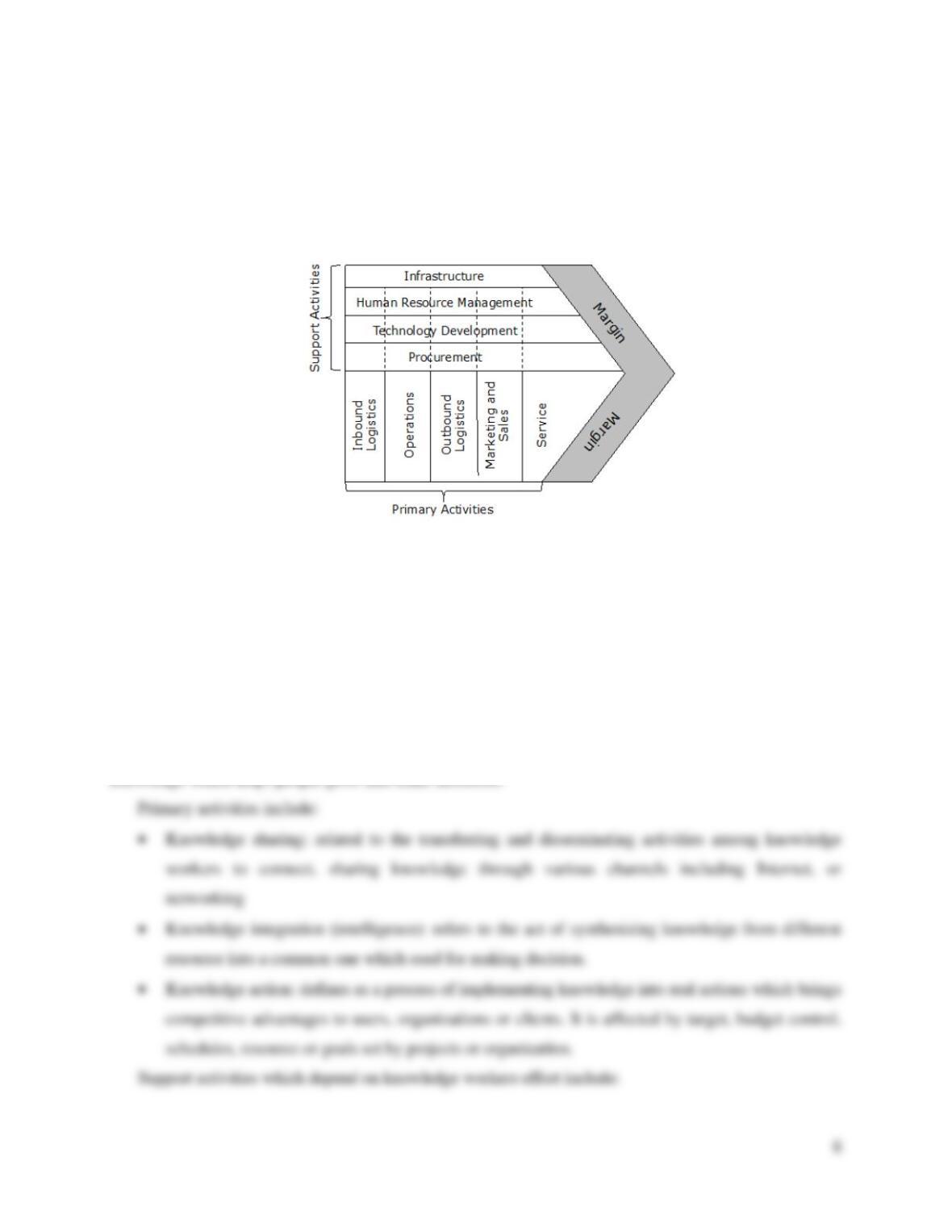
• The infrastructure: Management structure, financial controlling system, company’s culture, etc
• Human resource management: recruit, hire, train and develop the right people for the right jobs
• Technology development: technologies can drive innovation which will bring competitive
advantages thanks to the technology-oriented world.
• Procurement: getting raw materials within the budget
Figure 1: Value Chain by Michael Porter (1985)
2.4.2 Knowledge management in value chain perspective
A knowledge value chain is a sequence of intellectual tasks by which knowledge workers build their
employer’s unique competitive advantage and/or social and environmental benefit (Wikipedia,
13.04.2014). During the whole chain, knowledge management guides the way of individual knowledge
activities which lead to organizational competitive advantages (Ching and Yang, 2000). Tamara et al
(2009) proposed a knowledge value chain based on various researches transforming data/ information into