BALDWIN-WALLACE UNIVERSITY
Personal Leadership Paper
BUS 709: Micro-Organizational Behavior
Marissa DeJane
12/05/2014
I. Reference Point / Introduction
I have made the choice to write my personal leadership paper on “Level 5
Leadership.” Prior to writing this paper, we were asked to consider different leadership
styles, and chose the one that we could best relate to, or the style that “spoke to us.” I
started the process of reviewing different leadership styles and nothing was jumping out
at me like I hoped it would. One night as I was riffling through my closet, trying to find
an item of clothing, I came across my boyfriend’s copy of Jim Collins’ “From Good to
Great.” I was pretty perturbed at this sight of it and exclaimed out loud, “What the hell?
I told you I was writing a paper on a leadership style of my choice and you neglected to
tell me that you had this book?” At any rate, I started to read the book and became
surprisingly engrossed in its contents. I liked many of the attributes of the Level 5
leaders, as well as the concept of different development levels.
I found several other articles to supplement Collins’ work. Through my research,
I found that there are, as the name states, five levels of hierarchy that a Level 5 Leader
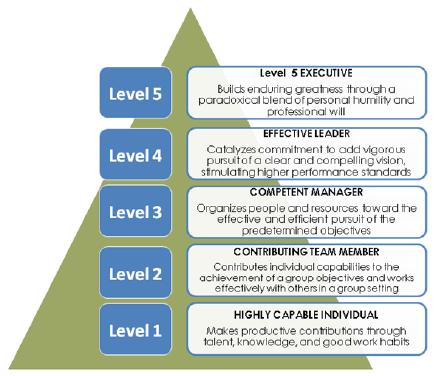
can attain. These levels in chronological order include; highly capable individual,
contributing team member, competent manager, effective leader, and level 5 executive. I
also noticed the reoccurring theme that Level 5 Leaders display compelling modesty and
unwavering resolve. I feel like the type of leader I strive to be is one that is down to
earth, yet extremely committed to their goals.
My personal leadership paper is organized in the following way. Section two will
include in-depth research and analysis of Level 5 Leadership as well as what personal
leadership means to me, section three will discuss the kind of leader I am now, section
four will cover the type of leader I aspire to be, section five will touch on what my
organization requires of me, section six is a review of my development plan, and finally
section seven will sum everything up.
II. What does Personal Leadership Mean?
In our Micro-Organizational Behavior class, we defined leadership as “a complex
process by which a person sets direction and influences others to accomplish a mission,
task, or objective, and directs the organization in a way that makes it more cohesive and
coherent.” We also discussed the difference between a manager and a leader. Both are
necessary for an organization to achieve its goals, but the behaviors of each are different.
A manager is someone who directs employees and is responsible for the results of their
work. On the other hand, a leader is a person who inspires employees and helps them
deal with change.
Level 5 Leadership is a progression through various levels to achieve optimum
results and leadership performance.
(“5 levels of Leadership | Rajesh Tedla’s
Personal Blog,” n.d.)
This illustration shows how one might start in middle management, become a
higher level “manager” and eventually work their way up to being a “leader.” My
interpretation of moving through the steps of Level 5 Leadership was like learning to
crawl before you learn to walk. Everything in Level 5 builds upon its self, in that you
must master one level before moving on to the next. Only when you achieve mastery of
each level, can you be considered a Level 5 Executive.
What is Level 5 Leadership?
In “Good to Great” Jim Collins describes Level 5 Leadership as “a five level
hierarchy of executive capabilities, with level 5 at the top. Level 5 leaders embody a
paradoxical mix of personal humility and professional will.” He goes on to state that
their ambitions for their company come before their personal goals (Collins 40).
After considering the writings of Collins’ (2001) and other authors on the subject
of Level 5 Leadership, and leadership in general, I found that there are six factors or
skills that many great leaders posses. Jim Collins specifically discusses these skills in
“Good to Great “and” Level 5 Leadership The Triumph of Humility and Fierce Resolve.
They are as follows.
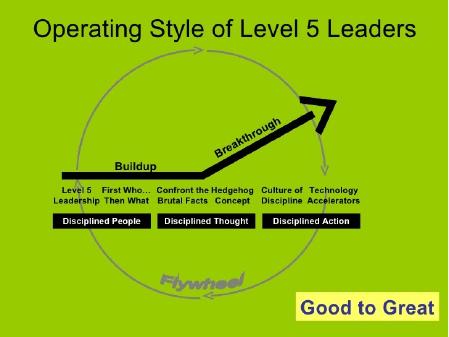
1. First Who: Collins (2001) says that the leaders who took their companies from
good to great started by getting the right people on the bus and the wrong people
off. Once the right people were in place, the leaders could decide where to drive
the bus, rather then having a destination set before filling the positions. I really
like this idea because I feel that if you can find people that are committed to your
cause, regardless of the direction, their motivation will stay high and they will be
more likely to accept change in the future.
2. Stockdale Paradox: this idea says that great leaders confront the most brutal
facts of their reality head on. There are no rose colored glasses when it comes to
the state of their business. However, these leaders lose faith that their
organization will prevail. I think that this is a very important quality for leaders
because you need to be aware and come to terms with what is going on around
you. If you lose touch with that, it might be very difficult to make decisions that
are in the best interest of the company. Faith in yourself and those around you is
pertinent, in my opinion, because it keeps the moral high by example. It is very
hard to keep a positive attitude when your leadership is lacking in positivity.
3. Buildup-Breakthrough Flywheel: This idea states the fact that transformations
do not happen over night. Instead, it is a slow and steady process. Collins (2001)
relates this to pushing a large, heavy flywheel in one direction. Great leaders
keep on pushing and putting their focus in one direction until there is a
breakthrough. This is where unwavering resolve comes into play. I took this
point to also mean that it is good to stay focused on a major goal rather then to
have everyone branch out in different directions, which takes energy away from
the big picture.
4. The Hedgehog Concept: Collins (2001) describes this factor with a parable
about a hedgehog and a fox. The fox is cunning and knows many things, while
the hedgehog is dowdy but knows one big thing. Day after day the fox tries
several tactics to catch the hedgehog. Each time the fox pounces; the hedgehog
curls up in a ball, exposing its quills. Despite the fact that the hedgehog uses the
same strategy, the fox is never able to win. To me, this means that sometimes the
simplest solution is the best. As a leader it may be best to focus on what your
organization is the best at, and build upon this.
5. Technology Accelerators: Collins (2001) states “good to great companies have a
paradoxical relationship with technology” (Collins 71). These leaders avoid
jumping on the new technology bandwagon, but can be considered pioneers in
making bold, farsighted investments in carefully selected technologies that they
feel will accelerate the flywheel effect. I think that it is good for leaders to stay
grounded and remain focused on the major goals of the company. It’s important
not to get distracted by the glitz and glitter of new technology. Investing in the
newest fad might not pay off in the end.
6. A Culture of Discipline: This idea embodies a company culture of disciplined
people, thought, and action. When there is strong discipline in all of these areas a
leader doesn’t have to be as hands on, or do any babysitting. Having strong
discipline also allows for consistency and opportunities for growth.
In addition to the work of Collins, I came across something interesting that was
put together by the Hill Consulting Group. This text is titled “Was Jesus a ‘level 5
leader’? Five Questions for Good to Great author Jim Collins by Helen Lee.” This
document posed the question of “How do Good to Great companies treat their
employees?” Collins (2001) covered the leaders of great companies, but did not
speak of those behind the leaders. “We came across a number of paradoxical
findings. Clearly the notion of people came first, but not in the way you normally
think about it. We learned that people are not the most critical asset. The right people
are. So much so that great companies will put picking the right people ahead of
picking the right strategy. Secondly, these Good to Great leaders were in service to
their company, not to their people. This is a different idea from servant leadership. So
these great companies were bipolar—they were great places to work for the right
people. But they were terrible places for the wrong people. Great company leaders
didn’t see it as their objective to make it a great place to work. There was an absence
of motivational programs. That’s because they had the right people: those who wanted