An Internship Report
On
Performance Management System of Citibank N.A Bangladesh
Master of Business Administration (MBA)
BRAC Business School (BBS)
BRAC University
Supervised by:
Dr. Salehuddin Ahmed
Former Governor. Bangladesh Bank
Professor. School of Business
BRAC University
Submitted by:
Sabiha Sultana
ID: 16164001
Date of Submission: 17th April, 2019
Letter of Transmittal
17th April, 2019
Dr. Salehuddin Ahmed
Former Governor. Bangladesh Bank
Professor. School of Business
BRAC University
Subject: Submission of internship report on “Performance Management System of Citibank
N.A Bangladesh”
Dear Sir,
With due respect, as student of BRAC Business School, I have prepared my internship report on
“Performance Management System of Citibank N.A Bangladesh”.
Your valuable advice, suggestion and guidance have helped me to prepare the report with ease.
I have done the study in a complete form and I have tried my level best to conduct this in a
professional manner. I had little help from office due to extreme work load at office and because
of busy schedule of my supervisor. I hope you will assess my report considering the limitations
of the study. I have tried my best to make this report as informative and comprehensive as
possible. However, due to various constraints there may be some mistakes for which I consent
your apology.
Thank you for your kind considerations. It has always been my pleasure to work under your
guidance.
Thank you
Sincerely Yours,
Sabiha Sultana
ID: 16164001
Masters of Business Administration
BRAC University
Letter of Endorsements
It is indeed a great pleasure to certify that the internship report titled “Performance Management
System of Citibank N.A Bangladesh”, completed under my guidance and supervision, is a unique
work of Ms. Sabiha Sultana. The internship report is an individual achievement of the candidate’s
own effort. Also I would like to acknowledge this internship report acceptable of submission to
BRAC Business School, BRAC University for partial fulfillment of the prerequisite for the
degree if Master un Business Administration (MBA).
Dr. Salehuddin Ahmed
Former Governor. Bangladesh Bank
Professor. School of Business
BRAC University
i
Acknowledgement
A successful Internship report reflects the affiliated organizations activities as it provides a
virtual ground where the implication of theoretical knowledge experience with the practical
teaching. It would not get its complement without active assistance of few people from Citibank
N.A. I become more benefited and decorated for being oriented with a group of qualified and
benevolent people. Their assistance and guidance can never be paid back.
I am thankful to Asif Zaman (Head of HR) and Pulok Debnath (Head of Regulatory Reporting),
Citibank N.A for helping and guiding me while doing the internship program. They supported
me and taught me various strategies, theories, tactics & philosophies while doing internship
program. They shared a lot of information and allowed me to know about overall HR policies.
Finally, I specially acknowledge, Dr. Salehuddin Ahmed, Professor, BRAC Business School,
BRAC University for his instructions and guidance. He is the man behind my diligence,
inspiration and devotion. An instructor creates insight in students, which he did very successfully.
ii
Executive Summary
Citibank N.A is present on the ground more than 200 years and serving more than160 countries
and territories. Citi is relentless in driving winning performance for its clients and franchise
anytime, anywhere. That’s why Citi never sleeps. Employees share success and are committed
to making a difference in the lives of people, organizations and communities around the world.
Citibank N.A Bangladesh has a formal and structured performance management in their
organization which makes the professionalism of the organization. They do the performance
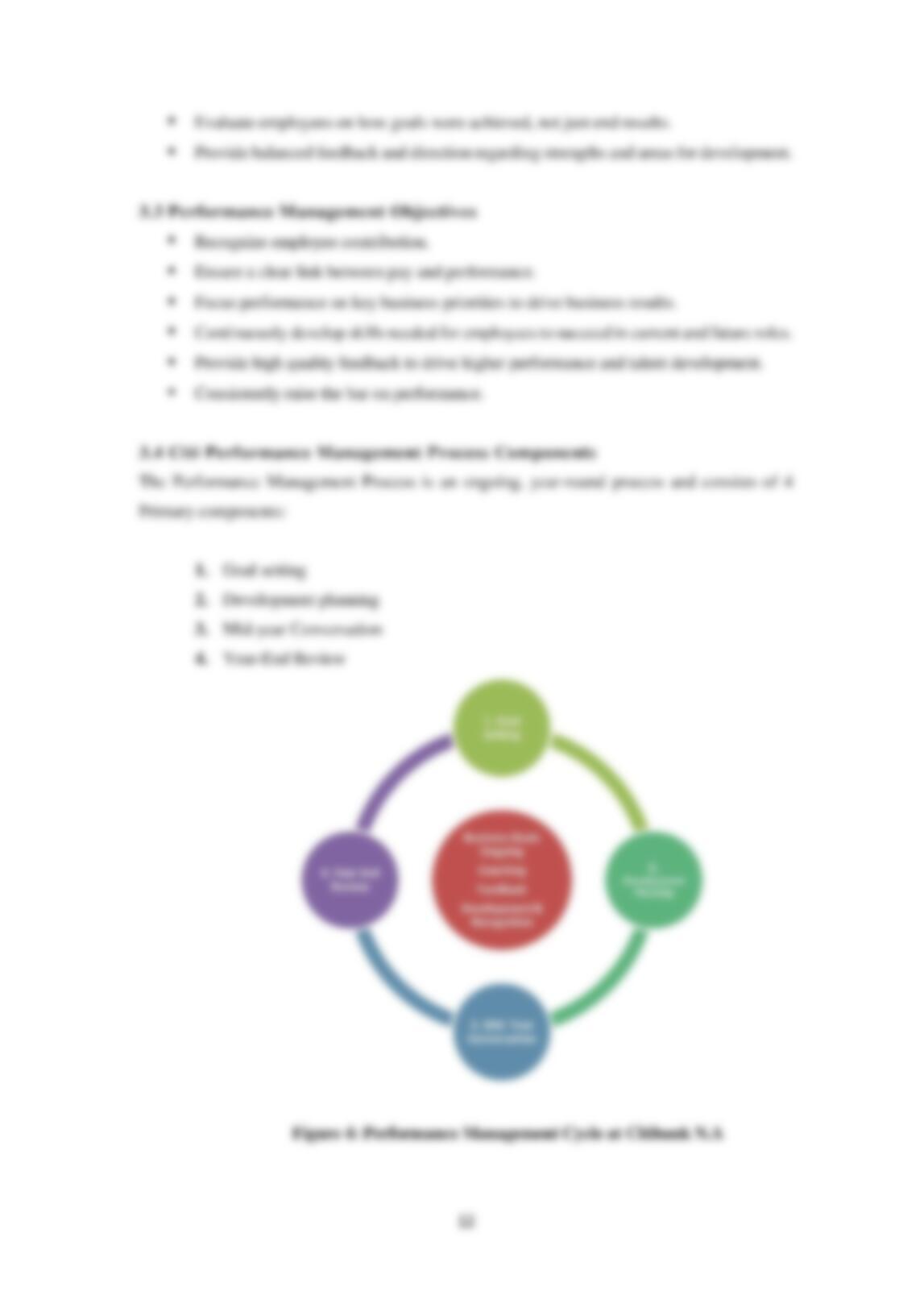
measurement at the end of the year via its own database input. Citi has 4 parts of performance
management which includes: Goal setting, Development planning, Mid-year conversation and
Year-end review. Every employee has maximum 7 goals. To determine the goals employees
consult with their line manager. The manager uses previous year assessment data of the
employee. The goals are weight based. . Citi’s development plan is designed to identify and track
action plans to enhance employees’ short term and long term job performance, as well as career
objectives.
Citi also give emphasis on the values that the employees process during the job. To measure the
values they use numeric rating. At the middle of the year, the managers make mid-level review
and at the end of the year, they do the final performance evaluation. All employees who join
before 30th June have to face the whole performance management. They follow the behavior
approach to measure performance. The final evaluation rating is given on Citi’s website and
approved by the individual, line manager, matrix managers and HR head. Overall, the
performance management system is fair, structured and good one to increase the capabilities of
the organization.

iii
Table of Contents
Executive Summary
ii
1.0 Introduction
1
1.1 Origin of the Report
2
1.2 Objectives of the Report
2
1.2.1 Broad objectives
2
1.2.2 Specific objectives
2
1.3 Scope of the report
2
1.4 Methodology
3
1.5 Limitations
3
2.0 Organizational Overview of Citibank N.A
4
2.1 Citi’s Mission
5
2.2 Citi’s Key Principles
5
2.3 Citigroup Regions
6
2.4 About Citibank, N.A. Bangladesh
6
2.5 Branches in Bangladesh
6
2.6 Product & Services offered by Citibank N.A. Bangliiiadesh
7
2.7 Organizational Structure of Citibank N.A. Bangladesh
8
2.8 Human Resource Department at Citibank N.A. Bangladesh
9
3.0 Performance management system at Citibank N.A. Bangladesh
10
3.1 Performance Management
11
3.2 Performance Management Philosophy at Citi
11
3.3 Performance Management Objectives
12
3.4 Citi Performance Management Process Components
12
3.4.1 Goal Setting
13
3.4.2 Development plan
16
3.4.3 Mid–year conversation
19
3.4.4The year–end review process
21
3.5 Coaching and feedback
27
3.5.1 Models for coaching
27
3.5.2 Steps for coaching
27
3.6 Reward and Recognition
28
3.7 Talent Path
29
4.0 Findings
30
4.1 Findings
31
5.0 Recommendation and Conclusion
32

5.1 Recommendations
33
5.2 Conclusion
33
Bibliography
34
35
Appendices
Appendix A: Questionnaire
35