LESSON 10
PERFORMANCE APPRAISAL
CONTENTS
10.0 Aims and Objectives
10.1 Introduction
10.2 Definition
10.3 Features
10.4 Methods
10.4.1 Individual Evaluation Methods
10.4.2 Multiple-person Evaluation Techniques
10.5 Problems and Solutions
10.5.1 Solutions
10.5.2 The Appraisal Interviews
10.6 Performance Appraisal in Practice
10.6.1 Performance Appraisal Practices in India
10.7 Job Evaluation
10.7.1 Job Evaluation Techniques
10.8 Merit Rating
10.8.1 Objectives of Merit Rating
10.8.1.1 Administrative objectives
10.8.1.2 Personnel Development
10.8.2 Job – Evaluation and Merit Rating – Difference
10.9 Promotion, Transfer, Demotion, Discharge, Dismissals and
Lay-offs
10.9.1 Promotion
10.9.2 Transfer
10.9.3 Demotion
10.9.4 Lay – Off
10.10 Let us Sum Up
10.11 Lesson End Activity
10.12 Key Words
10.13 Questions for Discussion
10.14 References
10.0 AIMS AND OBJECTIVES
After reading this lesson you should be able to:
Discuss methods, problems and solutions of performance
appraisal and
Analyse performance appraisal in practice.
10.1 INTRODUCTION
After an employee has been selected for a job, has been
trained to do it and has worked on it for a period of time, his
performance should be evaluated. Performance Evaluation or
Appraisal is the process of deciding how employees do their jobs.

Human Resource
Management
112
Performance here refers to the degree of accomplishment of the tasks
that make up an individual’s job. It indicates how well an individual is
fulfilling the job requirements. Often the term is confused with efforts,
which means energy expended and used in a wrong sense.
Performance is always measured in terms of results. A bank
employee, for example, may exert a great deal of effort while
preparing for the CAIIB examination but manages to get a poor grade.
In this case the effort expended is high but performance is low.
10.2 DEFINITION
Performance appraisal is a method of evaluating the
behaviour of employees in the workspot, normally including both the
quantitative and qualitative aspects of job performance. It is a
systematic and objective way of evaluating both work-related
behaviour and potential of employees. It is a process that involves
determining and communicating to an employee how he or she is
performing the job and ideally, establishing a plan of improvement.
10.3 FEATURES
The main characteristics of performance appraisal may be
listed thus:
i. The appraisal is a systematic process involving three steps:
a. Setting work standards.
b. Assessing employee’s actual performance relative to
these standards.
c. Offering feedback to the employee so that he can
eliminate deficiencies and improve performance in
course of time.
ii. It tries to find out how well the employee is performing the job
and tries to establish a plan for further improvement.
iii. The appraisal is carried out periodically, according to a
definite plan. It is certainly not a one shot deal.
iv. Performance appraisal is not a past-oriented activity, with the
intention of putting poor performers in a spot. Rather, it is a
future oriented activity showing employees where things have
gone wrong, how to set everything in order, and deliver
results using their potential in a proper way.
v. Performance appraisal is not job evaluation. Performance
appraisal refers to how well someone is doing an assigned
job. Job evaluation, on the other hand, determines how much
a job is worth to the organisation and therefore, what range of
pay should be assigned to the job.
vi. Performance appraisal is not limited to ‘calling the fouls’. Its
focus is on employee development. It forces managers to
become coaches rather then judges. The appraisal process
provides an opportunity to identify issues for discussion,
Performance
Appraisal
113
eliminate any potential problems, and set new goals for
achieving high performance.
vii. Performance appraisal may be formal or informal. The
informal evaluation is more likely to be subjective and
influenced by personal factors. Some employees are liked
better than others and have, for that reason only, better
chances of receiving various kinds of rewards than others.
The formal system is likely to be more fair and objective,
since it is carried out in a systematic manner, using printed
appraisal forms.
10.4 METHODS
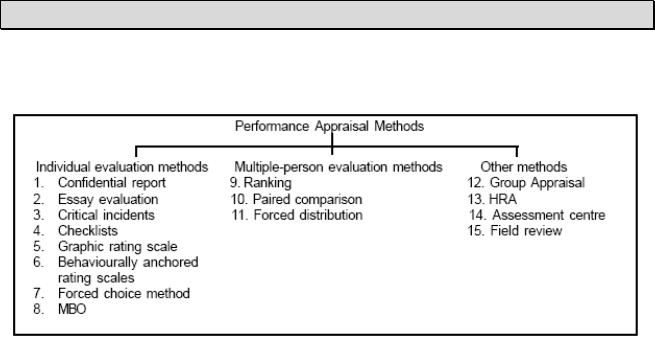
The performance appraisal methods may be classified into
three categories, as shown in Figure 10.1.
Figure 10.1 Performance Appraisal Methods
10.4.1 Individual Evaluation Methods
Under the individual evaluation methods of merit rating,
employees are evaluated one at a time without comparing them with
other employees in the organisation.
1. Confidential report: It is mostly used in government
organisations. It is a descriptive report prepared, generally at
the end of every year, by the employee’s immediate superior.
The report highlights the strengths and weaknesses of the
subordinate. The report is not databased. The impressions of
the superior about the subordinate are merely recorded there.
2. Essay evaluation: Under this method, the rater is asked to
express the strong as well as weak points of the employee’s
behaviour. This technique is normally used with a
combination of the graphic rating scale because the rater can
elaborately present the scale by substantiating an
explanation for his rating. While preparing the essay on the
employee, the rater considers the following factors:
(i) Job knowledge and potential of the employee;
(ii) Employee’s understanding of the company’s
programmes, policies, objectives, etc.;
(iii) The employee’s relations with co-workers and
superiors;
Human Resource
Management
114
(iv) The employee’s general planning, organizing and
controlling ability;
(v) The attitudes and perceptions of the employee, in
general.
Essay evaluation is a non-quantitative technique. This
method is advantageous in at least one sense, i.e., the essay
provides a good deal of information about the employee and
also reveals more about the evaluator. The essay evaluation
method however, suffers from the following limitations:
i. It is highly subjective; the supervisor may write a
biased essay. The employees who are sycophants
will be evaluated more favourably than other
employees.
ii. Some evaluators may be poor in writing essays on
employee performance. Others may be superficial in
explanation and use flowery language which may not
reflect the actual performance of the employee. It is
very difficult to find effective writers nowadays.
iii. The appraiser is required to find time to prepare the
essay. A busy appraiser may write the essay hurriedly
without properly assessing the actual performance of
the worker. On the other hand, appraiser takes a long
time, this becomes uneconomical from the view point
of the firm, because the time of the evaluator
(supervisor) is costly.
3. Critical incident technique: Under this method, the
manager prepares lists of statements of every effective and
ineffective behaviour of an employee. These critical incidents
or events represent the outstanding or poor behaviour of
employees on the job. The manager maintains logs on each
employee, whereby he periodically records critical incidents
of the workers’ behaviour. At the end of the rating period,
these recorded critical incidents are used in the evaluation of
the workers’ performance.
This method provides an objective basis for conducting a
thorough discussion of an employee’s performance. This
method avoids recently bias (most recent incidents get too
much emphasis). This method suffers, however, from the
following limitations:
i. Negative incidents may be more noticeable than
positive incidents.
ii. The supervisors have a tendency to unload a series of
complaints about incidents during an annual
performance review session.
iii. It results in very close supervision which may not be
liked by the employee.
Performance
Appraisal
115
iv. The recording of incidents may be a chore for the
manager concerned, who may be too busy or forget to
do it.
Most frequently, the critical incidents method is applied to
evaluate the performance of superiors.
4. Checklists and
weighted checklists
: Another simple
type of individual evaluation method is the checklist. A
checklist represents, in its simplest form, a set of
objectives or descriptive statements about the
employee and his behaviour. If the rater believes
strongly that the employee possesses a particular listed
trait, he checks the item; otherwise, he leaves the item
blank. A more recent variation of the checklist method is
the weighted list. Under this, the value of each question
may be weighted equally or certain questions may be
weighted more heavily than others.
A rating score from the checklist helps the manager in
evaluation of the performance of the employee. The
checklist method has a serious limitation. The rater may
be biased in distinguishing the positive and negative
questions. He may assign biased weights to the questions.
Another limitation could be that this method is expensive
and time consuming. Finally, it becomes difficult for the
manager to assemble, analyse and weigh a number of
statements about the employee’s characteristics,
contributions and behaviours.
5. Graphic rating scale: Under this method, a printed form, is
used to evaluate the performance of an employee. A variety
of traits may be used in these types of rating devices, the
most common being the quantity and quality of work. The
rating scales can also be adapted by including traits that the
company considers important for effectiveness on the job.
From the graphic rating scales, excerpts can be obtained
about the performance standards of employees. For instance,
if the employee has serious gaps in technical professional
knowledge (knows only rudimentary phases of job); lacks the
knowledge to bring about an increase in productivity; is
reluctant to make decisions on his own (on even when he
makes decisions they are unreliable and substandard);
declines to accept responsibility; fails to plan ahead
effectively; wastes and misuses resources; etc., then it can
safely be inferred that the standards of performance of the
employee are dismal and disappointing.
The rating scale is the most common method of evaluation of
an employee’s performance today. One positive point in
favour of the rating scale is that it is easy to understand, easy
to use and permits a statistical tabulation of scores of
employees. When ratings are objective in nature, they can be
effectively used as evaluators. The graphic rating scale may,
Human Resource
Management
116
however, suffer from a long standing disadvantage, i.e., it
may be arbitrary and the rating may be subjective. Another
pitfall is that each characteristic is equally important in
evaluation of the employee’s performance and so on.
6. Behaviourally anchored rating scales: Also known as the
behavioural expectations scale, this method represents the
latest innovation in performance appraisal. It is a combination
of the rating scale and critical incident techniques of
employee performance evaluation. The critical incidents
serve as anchor statements on a scale and the rating form
usually contains six to eight specifically defined performance
dimensions.
7. Forced choice method: This method was developed to
eliminate bias and the preponderance of high ratings that
might occur in some organisations. The primary purpose of
the forced choice method is to correct the tendency of a rater
to give consistently high or low ratings to all the employees.
This method makes use of several sets of pair phrases, two
of which may be positive and two negative and the rater is
asked to indicate which of the four phrases is the most and
least descriptive of a particular worker. Actually, the
statement items are grounded in such a way that the rater
cannot easily judge which statements apply to the most
effective employee.
The favourable qualities earn a plus credit and the
unfavourable ones earn the reverse. The worker gets an
overall plus rating, when the positive factors override the
negative ones or when one of the negative phrases is
checked as being insignificantly rated. They overall objectivity
is increased by using this method in evaluation of employee’s
performance, because the rater does not know how high or
low he is evaluating the individual as he has no access to the
scoring key. This method, however, has a strong limitation. In
the preparation of sets of phrases trained technicians are
needed and as such the method becomes very expensive.
Further, managers may feel frustrated rating the employees
‘in the dark’. Finally, the results of the forced choice method
may not be useful for training employees because the rater
himself does not know how he is evaluating the worker. In
spite of these limitations, the forced choice technique is quite
popular.
8. Management by Objectives (MBO): MBO requires the
management to set specific,measurable goals with each
employee and then periodically discuss the latter‘s progress
towards these goals. This technique emphasises
participatively set goals (that are agreed upon by the superior
and the employee) that are tangible, verifiable and
measurable. MBO focuses attention on what must be
accomplished (goals) rather than how it is to be
accomplished. It is, thus, a kind of goal setting and appraisal
programme involving six steps:
Performance
Appraisal
i. Set the organisation’s goals: Establish an
organisationwide plan for next year and set company
goals.
ii. Set departmental goals: Departmental heads at this
stage take the broader company goals (such as
improving profits by 20 per cent, increasing market
share by 10 per cent etc.) and, with their superiors,
jointly set goals for their departments.
iii. Discuss departmental goals: The departmental
goals are now put to discussion in a departmental
meeting with subordinates. The departmental heads
would require the subordinates to set their own
preliminary individual goals, focusing mostly on what
they can do to achieve the department’s goals.
iv. Define expected results: In the next step, the
departmental heads and their subordinates agree on
a set of participatorily set short term, and individual
performance targets.
v. Performance reviews: Departmental heads compare
each employee’s actual and targeted performance,
either periodically or annually. While periodic review is
intended to identify and solve specific performance
problems, the annual review is conducted to assess
and reward one’s overall contribution to the