Pejenca Industrial Supply LTD.
Case 3.9
COMM 1007EL-02
Austin Davey
Dominique Bennett, Kyla Keast, Kyla Henry, and Melissa Perih
February 15, 2012
Executive Summary
Pejenca Industrial Supply Limited of London is in need of an $150,000 extension to their
facility to provide them with additional inventory space that they are in desperate need for.
Pejenca needed to decide whether or not they were in need of a loan to finance this
extension or whether it could be paid through their cash and revenues on hand. Pejenca
had a time limit of one week to make their decision regarding the expansion and how they
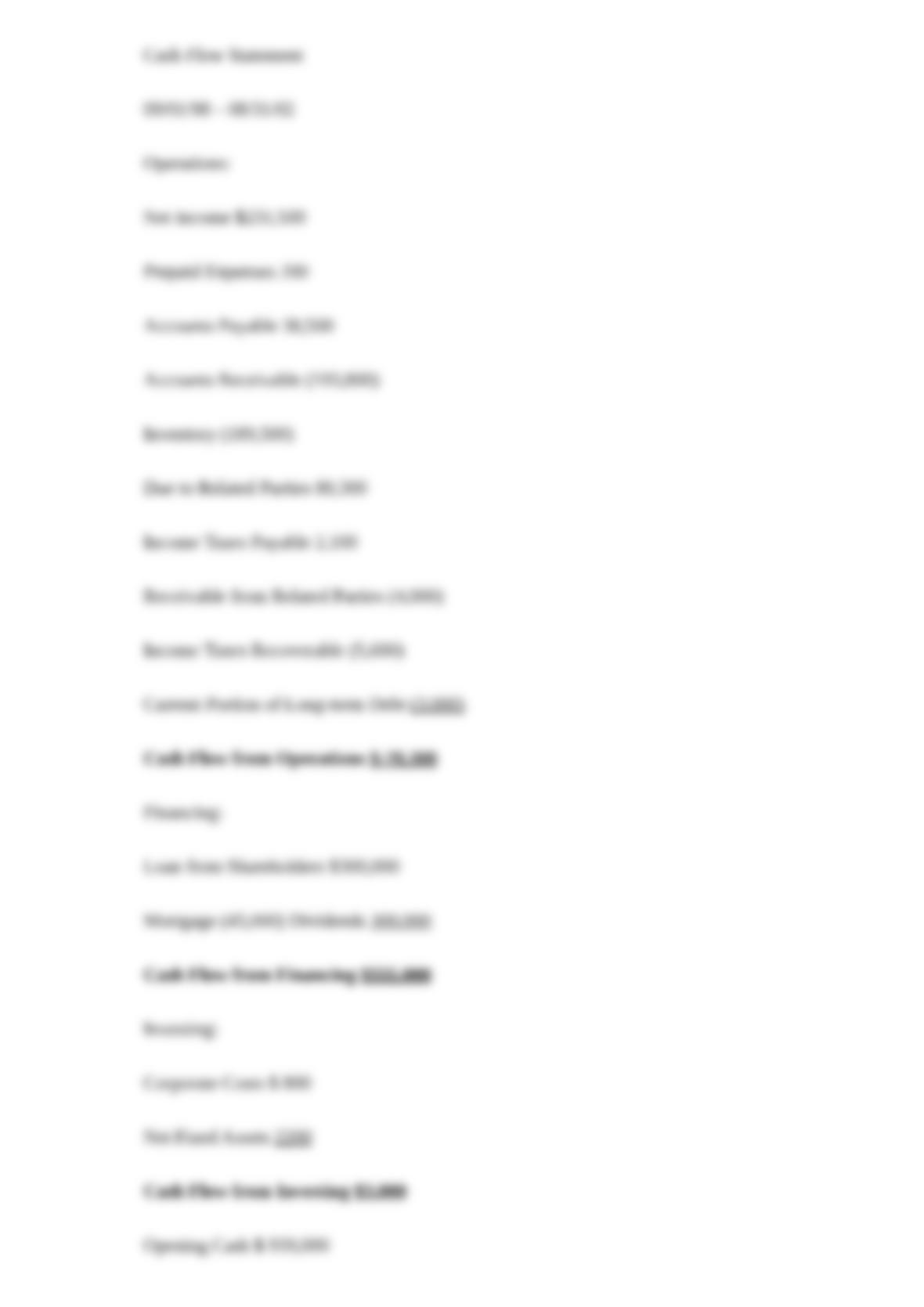
were going to finance it. The cash sources and uses analysis showed that Pejenca in its
current time has a negative cash flow from operations, which could have potential meaning
that Pejenca cannot handle to finance its current amount of inventory, this however does
not mean that Pejenca has no cash. The ratio analysis’ were more positive, showing that
Pejenca has strength in their liquidity, stability, profitability, however not so much in their
growth which was potentially due to the inventory limitations. From looking at the
projected financial statements it was clear that even without the loan Pejenca had enough
money to finance the extension themselves as their cash balance in the projections was
much above the required $130000. Because of these factors discussed briefly above and
more in depth below, our recommendation was that Pejenca not request a loan and finance
the extension themselves. A loan costs extra money due to interest payments, and since
Pejenca has the cash to finance the extension themselves it would be pointless to have a
bank loan to finance it if it was ultimately going to cost Pejenca more money.
Problem Statement
In early June, 2003 the president and major shareholder, Peter Charles, must determine
how much financing is required for a new extension to the company’s building. Due to the
company’s operations exceeding the space of the facility, Pejenca Industrial Supply
Limited (Pejenca) of London, Ontario is in need of a $150,000 extension. However, before
approaching the bank, Charles wants to ensure that he has suitable answers for all the
objections or concerns the bank might have about Pejenca’s financing. Desperately in need

of more inventory storage space, Peter Charles must make a decision quickly as his
appointment with the bank is in less than a week.
The main problem in this case is Peter Charles’ decision on the amount of a loan required
for Pejenca’s new extension. Charles must make a well thought out decision to ensure that
the company can comfortably handle any additional debt. He must consider that the
company is currently operating without a working capital loan from the bank. Charles
must also prevent any inadequate inventory space, so his decision is needed as quickly as
possible to avoid any potential customer service delays.
Sub Problems
There are several considerations that Charles will have to take into account before deciding
on a specific required financial amount for a loan. This includes the time constraint of just
one week for Charles to come to a conclusion of an overall financial decision before seeing
the bank. Charles should keep in mind the other medium sized company competition. This
includes the heavy emphases on good customer service, competitive pricing, quality
goods, and the fact that customers expect a five-to-six-day delivery terms. Lastly, Charles
must recognize that the company is operating without a working capital. Pejenca needs at
least $130,000 in cash to sustain the company throughout the whole year.
There are some potential issues that could arise and effect the company either greatly or
very little. Even though it may not have an effect on Pejenca, these potential issues should
be made known. A specific potential issues is Pejenca’s involvement with the Independent
Distributions Inc. (IDI). This opportunity gives Pejenca the ability to buy any product from
any of more than one hundred other IDI members across Canada. There is a down side to
IDI where a cost-plus basis is put in place where Pejenca must agree and pay a certain fee
or percentage. Another up-side to IDI is the excluded rights to excluded competitors from
joining IDI. However, there is a negative. If this competitor can benefit IDI greatly, then
Pejenca loses all of these specific veto rights, and the company is no longer allowed to
exclude them. Another potential issue is Pejenca’s exclusive distribution rights. This
benefits Pejenca to be able to distribute numerous exclusive products in the calling are.
However, this could cause the company’s future expansion opportunities to be limited. One
potential issue could be the amount of employees that Pejenca contains. Though the
company is working very efficiently with only thirteen employees, will Pejenca require
more employees in the years to follow? With the upcoming year, Charles has predicted a
15% sales growth. A last potential issue could be Pejenca’s minimum billing requirement.
Their saying “no customer is too big or too small” could affect the operations and either
cause the company to have a surplus or deficit of their resources and inventory.
Throughout Pejenca’s financial statements, some red flags arise. Though some of these
issues will not necessarily concern the company as a whole, Charles should be aware of
them. In the cash flow statement the total cash flow from operations is a negative number.
This means that more cash spent than received during the questioned period. This could