MKT 5070 – Managerial Marketing
Nova Southeastern University
Main Campus
Assignment for Course: MKT 5070 – Managerial Marketing
Submitted to: Dr. Kathleen O’Leary
Date of Submission: 08/11/2014
Title of Assignment: Pedigree Case Study
CERTIFICATION OF AUTHORSHIP: I certify that I am the author of this paper and that any
assistance I received in its preparation is fully acknowledged and disclosed in this paper. I have
also cited any sources from which I used data, ideas or words, either quoted directly or
paraphrased. I have added quotes whenever I used more than three consecutive words from
another writer. I also certify that this paper was prepared by me specifically for this course.
Student’s Signature: ______________________________
Instructor’s Grade on Assignment:
Instructor’s Comments:
1
MKT 5070 – Managerial Marketing
Table of Contents
Attrativeness of Dog Food…………………………………………………………………………………………..…….3
Segmentation and the Implications for Brand Marketing…………………………………………………….…5
Pedigree’s Brand Loyalty………………………………………………………………………….………………….…..5
Pedigree’s Financial Overview……………………………………………………………………………..…….……..5
Pedigree’s Positioning……………………………………………………………………………………….……………..5
Moving Forward………………………………………………………………………………………………..…………….7
2
MKT 5070 – Managerial Marketing
Attractiveness of Dog Food
There are close to 72 million dogs in the United States. Dogs reside in 37.2 percent of
U.S. households. In 2004, dogs were the most popular pets in the world, and there has been a
continuing trend in dog ownership. With every new dog owner, there is a market for dog
products such as food and toys. This market will increase relative to the change in dog
ownership. [CITATION Cal04 \l 1033 ]
Table 1 illustrates the high rate of dog owner increase since 2001.
Table 1: Pet-Owning Households in the United States
Animal
Number (in millions)
Change vs. 2001(%)
Dogs 43.0 +13.8
Cats 37.5 +13.0
Fish 9.0 +27.9
Birds 4.5 (6.3)
Horses 2.1 +5.9
Rabbits 1.9 (5.0)
Table 1. Pet-Owning Households in the United States reprinted from
“Pedigree Growth Strategy (A)” by Calkins, T. (2010) page 1.
The overall growth rate increase amongst dog owners and the subsequent increase in the
dog food market; as a result, present a positive look for the investment into dog related products.
The dog food industry is a growing industry in the United States. In 2004, the dog food
industry totaled roughly $8.2 billion in sales, which only accounted for a portion of the $23
billion in global sales. Several major corporations including Nestle, Mars, and Procter &
Gamble dominated the industry. This large market with growth potential made the dog food
market attractive for investment.[CITATION Cal04 \l 1033 ]
The dog food industry is very competitive. All the major players invested heavily in
innovation and marketing, and endured major restructuring in the 1990’s as each company made
efforts towards securing strong positions in global consumer packaged good companies. By
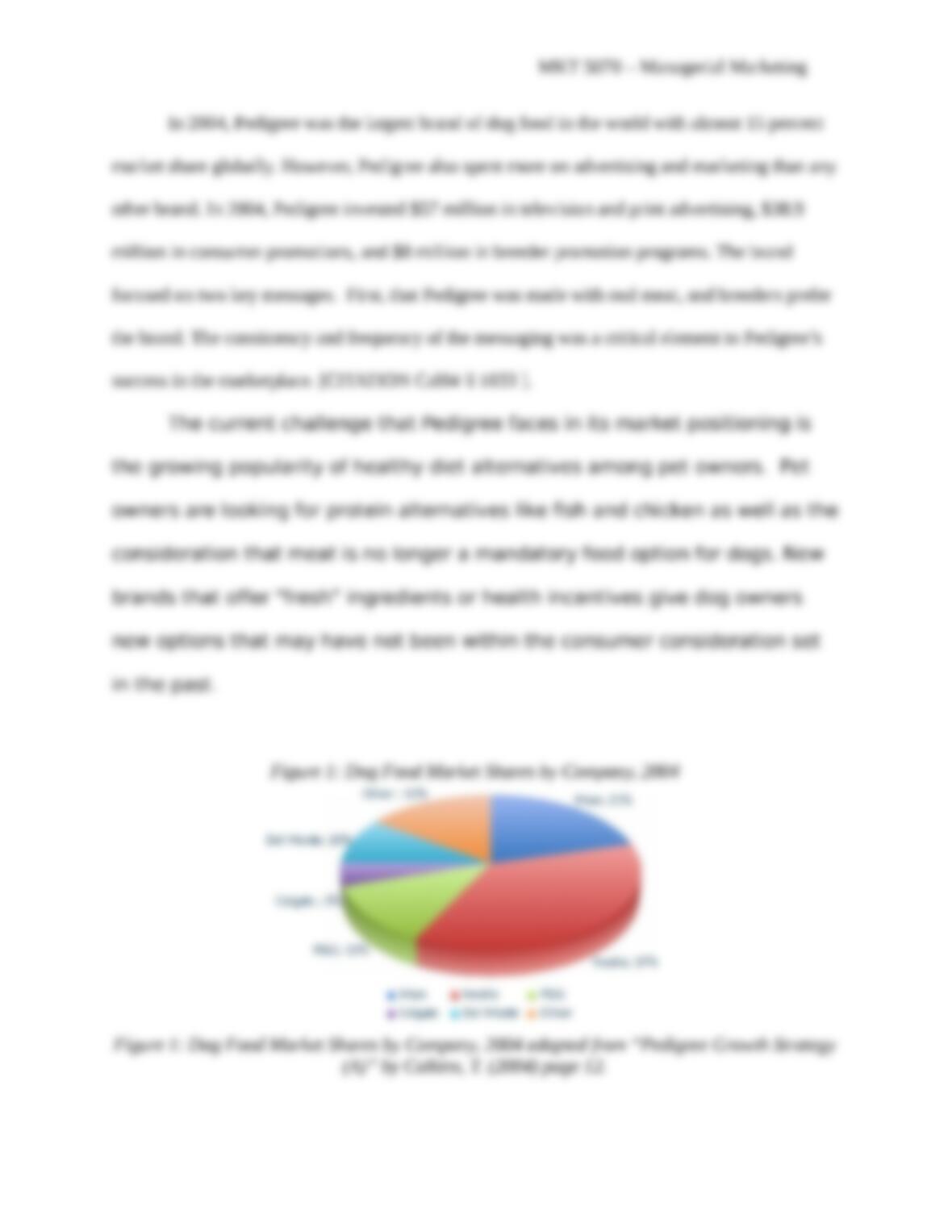
2004, the dog food industry was dominated by five huge global players: Nestle, Mars, Procter &
MKT 5070 – Managerial Marketing
Gamble, Del Monte, and Colgate. Mars, Inc. was the global leader in dog food industry and was
one of the world’s largest privately held companies. Nestle spent an average of $55 million on
advertising across all of its dog food brands, while Procter & Gamble spent $35 million in
advertising in 2004. Colgate and Del Monte were smaller, less competitive players in the
industry. Colgate owned the super-premium brand, Hill’s Science Diet. Del Monte, a new brand
to the category, had acquired the Heinz pet food portfolio in 2002, which included the
mainstream brands Gravy Train and Kibbles ’n Bits. In 2006, Del Monte acquired the Milk-Bone
brand and focused its marketing strategy on trade promotions, with limited advertising.
[CITATION Cal04 \l 1033 ]
The evaluation of the dog food market shows a large trend in the growth of the market for
the foreseeable future. However, major corporations that support large, well-established brands