P
P
Pa
a
ar
r
rt
t
ti
i
ic
c
ci
i
ip
p
pa
a
an
n
nt
t
t’
’
’s
s
s
G
G
Gu
u
ui
i
id
d
de
e
e
Created by
Arthur A. Thompson, Jr.
The University of Alabama
Gregory J. Stappenbeck
GLO-BUS Software, Inc.
Mark A. Reidenbach
GLO-BUS Software, Inc.
Ira F. Thrasher
GLO-BUS Software, Inc.
Christopher C. Harms
GLO-BUS Software, Inc.
GLO-BUS is published and marketed exclusively
by McGraw-Hill Education, Inc., 1333 Burr Ridge
Parkway, Burr Ridge, IL 60527
Copyright © 2021 by GLO-BUS Software, Inc. All rights reserved.
No part of this document may be reproduced or distributed in any form or by any means,
or stored in a database or retrieval system, without the prior written consent of GLO-BUS
Software, Inc., including, but not limited to, in any network or other electronic storage or
transmission, or broadcast for distance learning.
G
G
GL
L
LO
O
O–
–
–B
B
BU
U
US
S
S
Developing Winning
Competitive Strategies
2021 Edition

GLO-BUS: Developing Winning Competitive Strategies Participant’s Guide
Copyright © GLO-BUS Software, Inc. Back to Top
2
GLO-BUS
This Participant’s Guide provides you with information about GLO-BUS and suggestions for successfully
managing your camera and drone company. Here is a quick reference to the contents:
How the GLO-BUS Exercise Works ………………………………………………………………………………………… 3
Your Company’s Operations………………………………………………………………………………………………….. 3
The Worldwide Market for Action-Capture Cameras ………………………………………………………………. 6
The Worldwide Market for UAV Drones ………………………………………………………………………………….. 6
Performance/Quality (P/Q) Ratings of AC Cameras and UAV Drones ……………………………………… 7
The Retailers and Buyers of Action-Capture Cameras and UAV Drones …………………………………. 8
The Competitive Factors that Determine AC Camera Sales and Market Share ………………………… 9
The Competitive Factors that Determine UAV Drone Sales and Market Share ………………………. 13
The Importance of the Competitive Factors that Determine Sales and Market Share …………….. 16
Crafting a Strategy to Be Competitively Successful ……………………………………………………………… 17
Making Decisions ………………………………………………………………………………………………………………... 19
Product Design Decisions ……………………………………………………………………………………………… 20
AC Camera Marketing Decisions ……………………………………………………………………………………. 21
UAV Drone Marketing Decisions…………………………………………………………………………………….. 24
Compensation, Training, and Facilities Decisions …………………………………………………………….. 26
Corporate Social Responsibility and Citizenship Decisions ……………………………………………….. 29
Finance and Cash Flow Decisions ………………………………………………………………………………….. 29
Decision-Making Procedures …………………………………………………………………………………………. 31
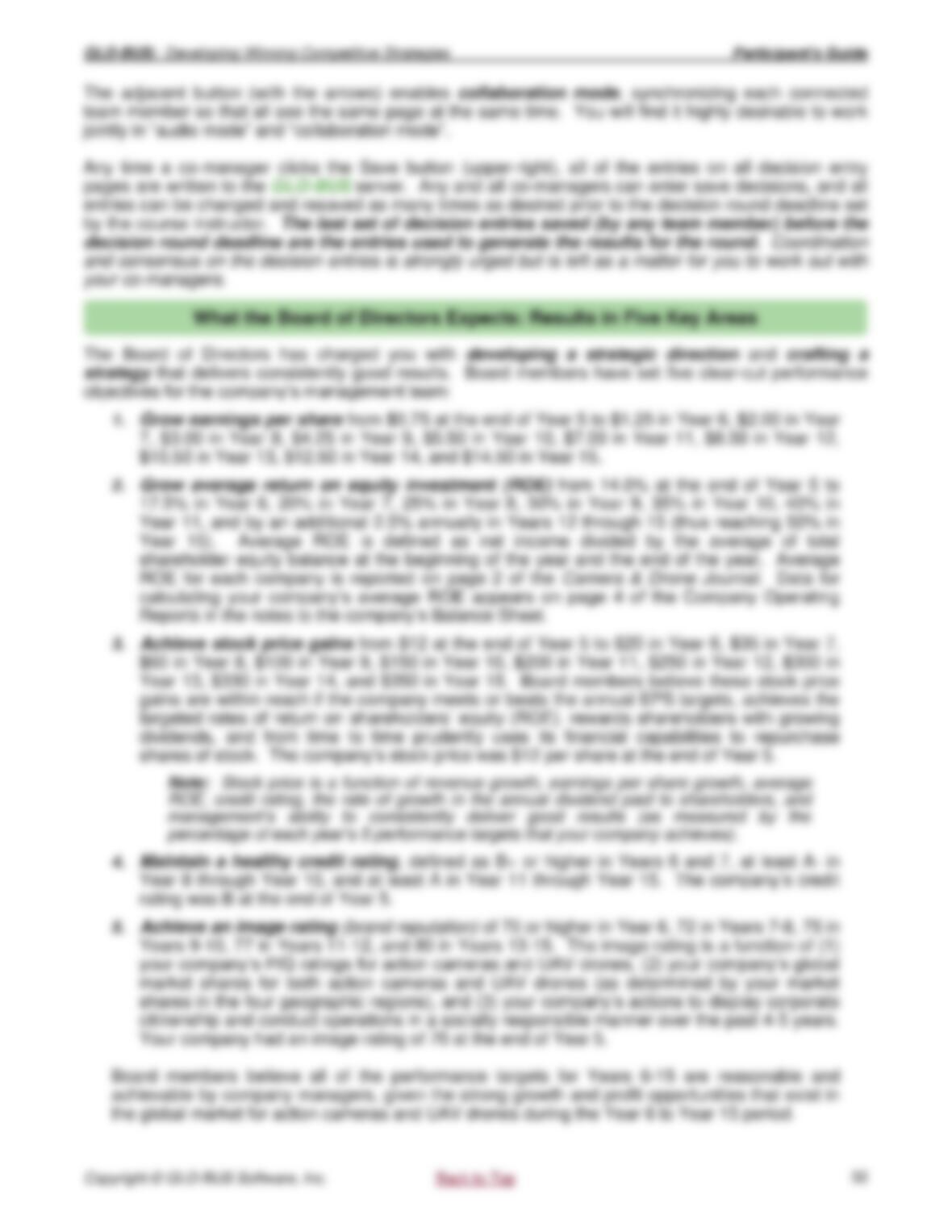
What the Board of Directors Expects: Results in Five Key Areas…………………………………………. 32
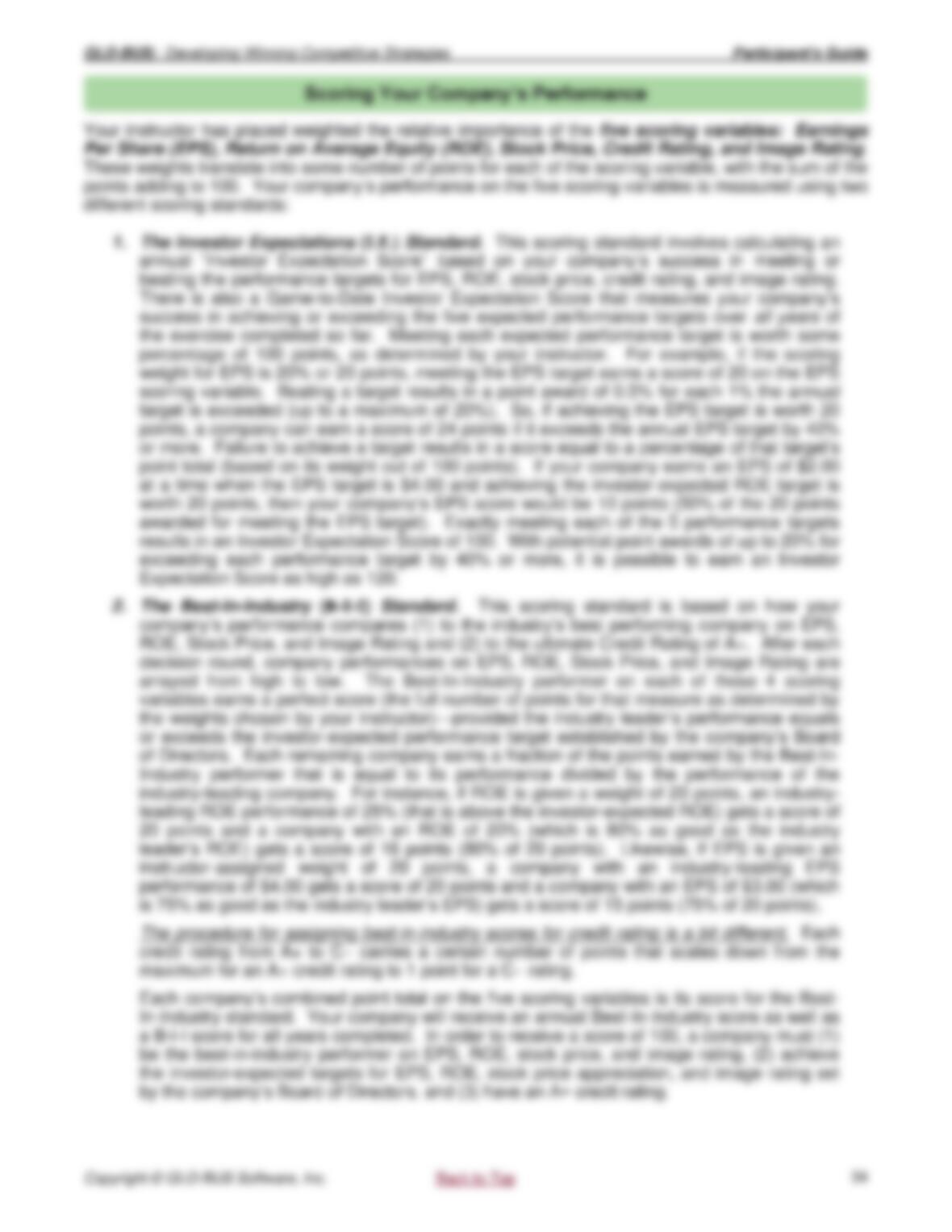
Scoring Your Company’s Performance ………………………………………………………………………………… 34
Important Advice …………………………………………………………………………………………………………………. 35
What You Can Expect to Learn …………………………………………………………………………………………….. 36
Welcome to GLO-BUS. You are taking over the operation of a company that is in a neck-and-neck
race for global market leadership in two product categories: action-capture cameras (comparable to
those designed and marketed by global industry leader GoPro) and unmanned aerial view (UAV)
drones that incorporate a company designed and assembled action-capture camera. Your company
competes against rival companies that design, assemble, and market these same two products and
that are run by other members of your class. All makers of these two products—action-capture (AC)
cameras and UAV drones—compete head-to-head in four market regions across the world—Europe-
Africa, Asia-Pacific, Latin America, and North America, and all companies currently have the same unit
sales volumes, revenues, and global market shares in both product categories.
In the most recent year, your company had worldwide sales of 840,000 action-capture cameras and
140,000 UAV drones. Prior-year revenues were $334.1 million and net earnings were $15 million,
equal to $0.75 per share of common stock. The company is in sound financial condition, is performing
well, and its cameras and drones are well-regarded by buyers. Your company’s board of directors has
charged you with developing a winning competitive strategy—one that capitalizes on growing consumer
interest in action-capture cameras and UAV drones and improves the company’s overall performance
year-after-year.
Your first priority as a GLO-BUS participant should be to absorb the contents of this Participant’s Guide
and get a firm grip on the character of the market for action-capture cameras and UAV drones, the
operations of your company, the cause-effect relationships affecting various aspects of your company’s
operations, and the procedures for participating in the exercise.

GLO-BUS: Developing Winning Competitive Strategies Participant’s Guide
Copyright © GLO-BUS Software, Inc. Back to Top
3
GLO-BUS is a computer-based exercise, modeled to reflect the real-world character of the globally
competitive market for AC cameras and UAV drones. The operations of your company and the
companies run by other students in your class are patterned after those of actual enterprises that
design, assemble, and market AC cameras and UAV drones. Cause-effect relationships and revenue-
cost-profit relationships are based on sound business and economic principles. GLO-BUS enables you
and your co-managers to apply what you have learned in business school and to practice making
reasoned, businesslike decisions aimed at improving your company’s overall performance. Everything
about your company and the competitive environment in which your company operates has been made
“as realistic as possible” in order to provide you with a close-to-real-life managerial experience.
Each decision period in GLO-BUS represents a year. The first set of decisions you will make is for
Year 6. You will make decisions each period relating to the design and performance of your company’s
two products (21 decisions), assembly operations and workforce compensation (up to 8 decisions for
each product), pricing and marketing (7 decisions for cameras and 6 for drones), corporate social
responsibility and citizenship (up to 6 decisions), and the financing of company operations (up to 8
decisions). In addition, there are 9 entries for cameras and 8 entries for drones involving assumptions
about the competitive actions of rivals; these entries help you to make useful forecasts of your
company’s unit sales (so you have a good idea of how many cameras and drones will need to be
assembled each year to fill customer orders). Plus, there is accounting and cost data to examine,
import duties and exchange rate fluctuations to consider, and shareholder expectations to satisfy.
Video Tutorials for each decision page will help you get started. And there are Help sections for
each page that provide valuable information about each decision entry, important cause-effect
relationships, and decision-making tips.
Complete results of each decision period become available online about 15 minutes after the deadline
for each decision round. Detailed information and feedback provided in the Camera & Drone Journal,
the Competitive Intelligence Report, and the Company Operating Reports provide essential information
about each company’s performance, assorted industry outcomes, updated demand forecasts, your
company’s competitive standing vis-à-vis rivals, and other statistics that enable you to determine what
actions to take to improve your company’s performance in upcoming decision rounds.
The decision round schedule developed by your instructor indicates the number of decision periods that
you will be running the company. You should use the practice round(s) to become familiar with the
software, digest all the information provided on the decision pages and in the reports, and get a glimpse
of what to expect before your management team’s decisions start to count.
The Corporate Lobby page functions as your “gateway” for all GLO-BUS activities—click the buttons at
the top to see everything that is available. Plus, the Corporate Lobby page reports the latest interest
rates and exchange rate impacts. Take a couple of minutes to familiarize yourself with the features and
information on your Corporate Lobby page, all of which will come into play during the exercise. The
Recommended Decision Procedures link (Participant’s Materials button) is especially worth a few
minutes of your attention.
Your company began operations five years ago and maintains its headquarters in Taiwan. It
assembles wearable or mountable video cameras smaller than a teacup and camera-equipped drones
at recently-constructed facilities in Taiwan. The company’s action-capture camera models deliver
stunning video quality and have powerful photo capture capabilities. Once the cameras are assembled
and tested, they are shipped directly to multi-store chains and online retailers that sell electronics
products and to a wide variety of local retail shops selling cameras or sporting goods equipment or
outdoor adventure trips in Europe-Africa, Asia-Pacific, Latin America, and North America. For example,
shops selling or renting snow skis, snowboards, snowmobiles, all-terrain vehicles, go kart racers, water
skis, surf boards, bicycles, hunting and fishing equipment, sky-diving gear, and scuba diving gear often
sell or rent miniature, wearable action-capture cameras to customers wanting to video their
How the GLO-BUS Exercise Works
Your Company’s Operations

GLO-BUS: Developing Winning Competitive Strategies Participant’s Guide
Copyright © GLO-BUS Software, Inc. Back to Top
4
experiences; likewise, the providers of white-water rafting trips, sky-diving and parasailing flights, deep
sea fishing trips, helicopter rides, nature trips, and other outdoor action experiences frequently sell or
rent action-capture cameras to their customers.
The unmanned aerial view (UAV) drones assembled at the Taiwan plant are sold directly to buyers at
the company’s website and to other online retailers of commercial drones. These drones are much
more sophisticated and multi-featured than inexpensive toy drones sold for recreational use. Indeed,
the company you will manage and the drone-makers you will be competing against produce copter
drones as wide as four-feet that can be used for a variety of commercial and business purposes and
retail in the $850 to $2,000+ range. UAV drones are commonly used by professional photography
enterprises movie studios and to capture often stunning shots (panoramic scenery, hovering over an
open shark’s mouth, explosive action scenes) from heights and angles not feasible with handheld or
tripod cameras. Network and local TV stations use UAV drones to take videos of fires, storm damage,
a live volcano, sporting events (golf and football), and other newsworthy events where film footage
taken from particular angles or heights or distances is more revealing. Insurance companies use UAV
drones to document damage to homes and buildings inflicted by hurricanes, tornadoes, hail, and floods,
thereby expediting the process of paying claims; drones are particularly useful in helping insurers
inspect areas that are hard to access (such as roofs and condemned buildings). Fire departments use
camera drones to monitor fires in large buildings and direct where fire hoses and other firefighting
efforts need to be aimed. Large commercial farms use camera drones to monitor crops and crop
harvesting; ranchers use drones to track the location and well-being of farm animals. Construction
companies use daily drone flights to gather data and 3-D images showing progress at project sites and
identify areas where the project might be falling behind schedule. Companies use periodic drone flights
to help protect against theft and vandalism at plant sites and remote facilities. Indeed, unmanned
drones equipped with professional quality, action-capture cameras are being used by growing types of
private and public enterprises for a growing variety of purposes, resulting in rapidly-growing market
demand for UAV drones across the world.
The two product categories your company competes in consists of as few as 4 or as many as 12
companies, as determined by your instructor. All companies begin the GLO-BUS exercise in the
same competitive position—equal sales volumes in each of the world’s four geographic regions,
equal global market shares in both cameras and drones, and equal revenues, profits, costs, product
quality and performance, brand recognition, and so on. All competing companies are thus presently on
an equal footing in all respects.
In upcoming years, the managers of all companies will undertake strategic actions to boost the
performance of their respective companies—these actions will involve altering prices, product
performance and quality, advertising, and other competitively-relevant factors that impact buyer choices
of which company’s brand to purchase. The differing actions of competing companies will almost
certainly result in substantially different cross-company unit sales volumes and market shares in all
regions of the world because the actions of some companies will prove more effective in attracting
buyers than the actions of other companies. Companies that succeed in outcompeting rivals in the
sales of either cameras or drones or both will gain sales and market share at the expense of rivals.
Some companies will suffer losses of sales and market share in cameras and/or drones in one or more
geographic regions—despite striving (or hoping) to do the opposite—because they are outcompeted by
one or more rivals offering what buyers consider to be more attractive products.
Bigger sales and market shares, of course, do not necessarily equate to better profitability and overall
performance than below-average sales volumes and market shares—firms that sell top-quality products
at premium prices often have smaller unit sales volumes and smaller revenues, yet their profits and
returns on investment may well be greater than those of firms selling less expensive, lower-performing
products to the mass market. Moreover, each competing company’s production and other operating
costs for cameras and drones are certain to change over time, as managers of the competing
companies pursue different actions to operate efficiently and build a competitive advantage linked to
lower costs or better product quality or some other factor that yields competitive advantage. It remains
to be seen which companies will end up being the most profitable and achieving the best overall
performance.

GLO-BUS: Developing Winning Competitive Strategies Participant’s Guide
Copyright © GLO-BUS Software, Inc. Back to Top
5
The company has regional facilities in Milan, Italy; Singapore; Sao Paulo, Brazil; and Dallas, Texas to
conduct the company’s marketing efforts in the four geographic regions of the world market, to support
the merchandising efforts of regional retailers who stock the company’s action cameras and UAV
drones, and to process camera/drone warranty claims (including making needed repairs).
Assembly and Shipping. The company assembles cameras and drones usually within two weeks of
receiving an order and strives to ship an order no later than 2-3 days after assembly. No camera
models or drone models are assembled in advance, warehoused in company facilities, and then used
to fill incoming orders.
The company has a staff of people engaged in product R&D; this group has the capability to develop
new and improved models of cameras and drones as directed by top management. Once company co-
managers settle on the desired specifications and performance features for the company’s line-up of
camera and drone models, the needed parts and components are obtained from suppliers having the
capabilities to make deliveries to the company’s Taiwan assembly site on a just-in-time basis, thus
eliminating the need to maintain inventories of parts or components.
The company has two buildings for assembling products at its Taiwan site—one for cameras and one
for drones (the drone assembly process also includes assembly of an action-camera model having
features and specifications suitable for use in camera-equipped drones). Both cameras and drones are
assembled by four-person product assembly teams (PATs), with each PAT performing the needed
tasks at its own assigned workstation. Shipping department personnel package orders for shipment
and stack them on the loading dock for pickup by independent freight carriers. The cameras are
delivered to buyers anywhere from 3 days to 3 weeks later, depending on a retailer’s location and the
means of transportation—shipments to distant retailers are shipped via a combination of air and ground
freight and those to customers in select parts of Asia are shipped by ground freight. The cost of boxing
cameras, packaging them for shipment, and freight averages $5 per camera. Shipping costs for
drones, most of which are air freighted to customers and delivered within 5 to 10 business days after
receipt of the order, average $60 per unit.
Many countries have opted to impose import duties on cameras and drones sourced from Taiwan.
Going into Year 6, import duties equal 4% of the average price the company charges customers in
Europe-Africa, and 6% of the average price being charged to customers in both Latin America and the
Asia-Pacific; there are no import duties on either cameras or drones shipped to customers in North
America. Import duties in all four regions of the world market are subject to change in upcoming years.
Competitive Efforts. To capitalize on ongoing technological advances and the pipeline of product
enhancement capabilities flowing from the company’s expenditures for product R&D, each year the
company typically changes the specs for important components, adds/modifies performance features,
upgrades the internal software, makes assorted other design-related changes, and introduces new
and/or improved models. In addition, strong competition from rival companies pushes management to
make price and marketing adjustments to improve buyer appeal for the company’s camera/drone
models and to enhance the company’s ability to compete more effectively.
Stock Listings. The company’s stock is publicly traded on the NASDAQ exchange in the United
States. The closing price in Year 5 was $12 per share. The company’s financial statements are
prepared in accord with generally accepted accounting principles and are reported in U.S. dollars. The
company’s financial accounting is in accord with the rules and regulations of all authorities where its
stock is traded.
Worldwide unit sales of wearable and/or mountable, miniature action-capture cameras are reliably
projected to grow 6-8% annually for the next five years (Years 6-10) and then to grow at a slower 4-6%
annual rate during the following five years (Years 11-15). However, the projected growth rates differ by
geographic region, as shown below.
The Worldwide Market for Action-Capture Cameras

GLO-BUS: Developing Winning Competitive Strategies Participant’s Guide
Copyright © GLO-BUS Software, Inc. Back to Top
6
Projected Growth of Unit Sales of Action-Capture Cameras
Worldwide
North America
Europe-Africa
Latin America
Asia-Pacific
Years 6-10
6.0%-8.0%
4.5%-6.5%
4.5%-6.5%
8.5%-10.5%
8.5%-10.5%
Years 11-15
4.0%-6.0%
2.5%-4.5%
2.5%-4.5%
6.0%-8.0%
6.0%-8.0%
Note: Actual growth within the forecast 2% range varies from region to region. In one region the
actual growth rate may be near the high end of the forecasted range, in another region in the
same year it may be near the low end, and in still another region it may be near the midpoint of
the range. Moreover, the forecast growth rates are all based on the assumption that in future
years the competitive efforts of rival companies will, on the whole, not differ significantly from the
levels prevailing at the end of Year 5. Future growth rates may turn out to be higher than forecast
in the event more buyers are attracted to purchase action-capture cameras because of a
dramatic decline in camera prices and/or significantly higher camera quality/performance and/or
sharp and sustained increases in the marketing and competitive efforts of rival companies to grow
camera sales volumes. Conversely, factors that can drive away potential buyers and cause the
growth in buyer demand to fall below the forecast amounts include sharply higher camera prices
and/or a strong downward trend in camera quality/performance and/or complacent efforts on the
part of rival companies to please buyers and capture the available growth opportunities. In other
words, the forecast growth rates, while reliable, are not guaranteed in the event the competitive
efforts in the industry become significantly stronger or weaker than the levels prevailing in Year 5.
Because the growth rate in four geographic regions can be anywhere within the forecast 2
percent range, company managers have to deal with uncertainty about where within the projected
growth range the actual growth rate in camera demand for a particular geographic region in a
particular year will turn out to be. Bear in mind here that the managers of real-world companies
do not operate with certainty about what their industry’s growth rate in unit volume for the
upcoming year will turn out to be, correct to the first decimal place—a forecast somewhere within
a 2-percentage-point range is really a pretty good forecast!
Competition. Competition in the worldwide market for action-capture cameras revolves around price,
product quality and performance, the number of models offered, the number and types of retailers that
stock and merchandise each brand of camera, the amount of merchandising support companies
provide to these retailers, advertising, sales promotion activities (the duration of sales promotion
campaigns and the sizes of the price discounts offered to retailers during these promotional
campaigns), the length of warranties, and brand reputation.
Worldwide unit sales of unmanned aerial view (UAV) drones are reliably projected to grow 15.5%-
17.5% annually during Years 6-7, 12.0-14.0% annually during Years 8-9, 9.0%-11.0% annually in Years
10-11, 6.0% -8.0% annually in Years 12-13, and 3.75%-5.75% annually during Years 14 and 15.
However, the projected growth rates differ considerably by geographic region, as shown below.
Projected Growth of Unit Sales of Unmanned Aerial View Drones
Period
Worldwide
North America
Europe-Africa
Asia Pacific
Latin America
Years 6-7
15.5%-17.5%
15.0%-17.0%
15.0%-17.0%
17.0%-19.0%
17.0%-19.0%
Years 8-9
12.0%-14.0%
11.0%-13.0%
11.0%-13.0%
14.0%-16.0%
14.0%-16.0%
Years 10-11
9.0%-11.0%
8.0%-10.0%
8.0%-10.0%
11.0%-13.0%
11.0%-13.0%
Years 12-13
6.0%-8.0%
5.0%-7.0%
5.0%-7.0%
8.0%-10.0%
8.0%-10.0%
Years 14-15
3.75%-5.75%
3.0%-5.0%
3.0%-5.0%
5.0%-7.0%
5.0%-7.0%
The Worldwide Market for Unmanned Aerial View Drones
GLO-BUS: Developing Winning Competitive Strategies Participant’s Guide
Note: As noted above in regard to the growth rates of action-capture cameras, actual growth of
for UAV drone sales within the forecast ranges varies from region to region. The forecast growth
rates, while reliable, are not guaranteed in the event the competitive efforts in the industry
become significantly stronger or weaker than the levels prevailing in Year 5.
Again, while company managers have to deal with uncertainty about where within the projected 2%
growth range the actual growth rate for drones for a particular geographic region in a particular year will
turn out to be, a forecast somewhere within a 2-percentage-point range is really a pretty good forecast!
Competition. Competition in the worldwide market for UAV drones differs somewhat from that for
action-capture cameras and is centered on price, product quality and performance, the number of
models offered, the relative appeal of rival company websites as concerns providing complete
information about different models and the ease of placing orders, the comparative amounts
competitors elect to spend on search engine advertising to help draw shopper traffic to their website
(where a big percentage of drone sales are transacted), the length of warranties, the relative success
competitors have in attracting third-party online retailers to display and merchandise their brand of UAV
drones (and thereby broaden their access to potential purchasers of drones), and brand reputation.
P/Q Ratings for Action-Capture Cameras. The World Digital Video Federation (WDVF), a well–
respected affiliation of camera industry trade groups and camera experts, tests the performance and
quality of the action-capture camera models of all competitors and assigns a performance-quality or
P/Q rating ranging from a low of 1.0 stars to a high of 10.0 stars to each company’s line of action-
capture cameras—each company’s star rating is reported to the nearest tenth of a star (i.e. 2.3, 4.7,
6.5). The WDCF’s P/Q ratings are based on an array of factors: (1) image sensor size, (2) size of the
LCD display screen, (3) image quality of the pictures/video, (4) number of modes for videos and still
photos, (4) camera housing, (5) editing/sharing capabilities, (7) included accessories (such as capacity
of flash memory card, rechargeable batteries, a plug-in battery-charger, and carrying case) (8) number
of extra performance features, (9) the number of camera models a company offers, (10) a company’s
Performance/Quality (P/Q) Ratings of AC Cameras and UAV Drones