Sung-Min Park
May 2010
Oakridge International School
Extended Essay
1
EXTENDED ESSAY
SUBJECT: HISTORY
TITLE: Park Chung Hee’s Export-Led-Industrialization
RESEARCH QUESTION:
In what ways did President Park Chung Hee’s export-led-policies on industrialization,
help to transform South Korea into one of the major industrial nations in Asia (1961-
1979)?
Name: Sung Min Park
Session: May 2010
Candidate Number: dbf022 (002198 – 014)
Supervisor: Dr. Sudeshna Bhattacharya Word Count: 3963
Sung-Min Park
May 2010
Oakridge International School
Extended Essay
2
Abstract
This extended essay deals with the export-led industrialization policies of Park Chung Hee
and their impact on the economy of South Korea (1961-1979). It makes a historical investigation of
the economic condition of South Korea before Park Chung Hee’s rule, of Park Chung Hee’s policies,
the Five Year Plans and their effectiveness in transforming South Korea. More specifically the essay
discusses target growth and the growth achieved during Park’s rule to show the success of his policies.
In this context my research question is “In what ways did President Park Chung Hee’s export-led-
policies on industrialization, help to transform South Korea into one of the major industrial
nations in Asia (1961-1979)?”
The scope of the essay is limited to those policies that affected export and could be
substantiated with proper evidence. To narrow down the scope of research, I have restricted the
investigation of South Korea’s economic growth to the period during which Park Chung Hee was the
president.
The essay also reviews the historical debate about whether an authoritarian government is
better for economic development of a country than a democratic government and I draw my
conclusions from the data obtained.
The investigation is undertaken by looking at the data regarding the economic growth and by
critical analysis of data.
In order to answer the research question, relevant primary sources (government published
records and fist hand information on Park Chung Hee), secondary and tertiary sources (internet, books
and encyclopedia) are used.
Word Count: 242 words

Sung-Min Park
May 2010
Oakridge International School
Extended Essay
3
Table of Contents
Acknowledgement 4
Introduction 5
Chapter 1 – Economic situation before Park Chung Hee came to power
1.1 Economic condition of South Korea before Park Chung 7
Hee assumed power
1.2 The motive of the 5.16 Military Revolution 10
Chapter 2 – Park Chung Hee’s export-led-policies
2.1 The major policies which contributed to export growth 11
2.2 The impact of Park Chung Hee’s policies on the industrialization 19
2.3 Export-led-businesses in South Korea 22
Chapter 3 – Criticism against Park Chung Hee Historical Debate on
authoritarian and democratic governments
3.1 Criticism against Park Chung Hee 24
3.2 Supporters of authoritarian rule 25
3.3 Supporters of democratic rule 26
3.4 An analytical view of both types of governments 26
Conclusion 27
Bibliography 28

Sung-Min Park
May 2010
Oakridge International School
Extended Essay
4
Acknowledgement
I am grateful to my mentor, Mrs. Alka Rangnekar, for her valuable suggestions and
supervision and for her encouragement with my extended essay. I also would like to thank my
supervisor, Dr. Sudeshna Bhattacharya, for helping me with resources, for kindly answering my
questions and also for formatting my extended essay.
I also would like to acknowledge the support provided by the IBDP coordinator, Mr. Biju
Baby, for giving me enough time to spend with my mentor and my supervisor in school. Finally, I
again would like to thank Dr. Sudeshna Bhattacharya for guiding me in all areas of the essay writing.

Sung-Min Park
May 2010
Oakridge International School
Extended Essay
5
Introduction
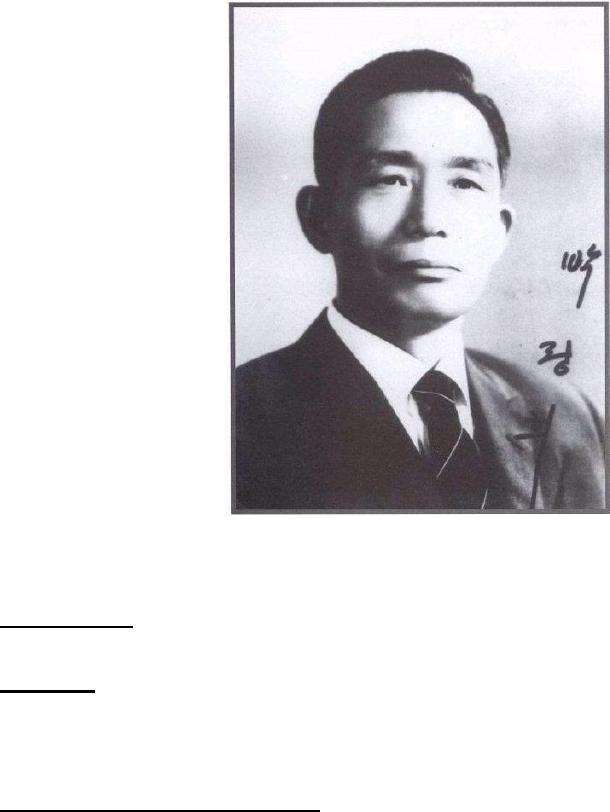
Park Chung Hee (1917-1979) a soldier, revolutionary leader, and president of South Korea. Park
Chung Hee was an autocratic dictator who held power over the country for about twenty long years
from 1961 to 1979.1
I am interested in understanding the impact of his export-led-policies as they played a crucial role in
the development of the economy of South Korea. I believe that today Korea is one of the powerful
countries in Asia because of foundation laid by Park’s export-led-policies.
The research question has been narrowed to concentrate on Park Cung Hee’s export-led-policies and
its consequences and will not deal with Park’s other policies that are not related to export. The
research question is therefore “In what ways did President Park Chung Hee’s export-led-policies
on industrialization, help to transform South Korea into one of the major industrial nations in
Asia?”
In 1961 General Park Chung-Hee overthrew the popularly elected regime of Prime Minister Chang
Myon. A nationalist, Park wanted to transform South Korea from an agricultural nation into a modern
industrial nation. Park sought both legitimacy for his regime and greater independence for South
Korea in a vigorous program of economic development that would transform the country. The Park
administration decided that the central government must play the key role in economic development to
bring about drastic change in a short time.2
South Korea’s economy grew rapidly under Park. Park’s policies encouraged private entrepreneurs.
Businesses were given powerful incentives to export, including preferential treatment in obtaining
low-interest bank loans, import privileges, permission to borrow from foreign sources, and tax
benefits.3
The GNI (Gross National Income) increased almost twentyfold within 20 years from 1961 to 1979.
The success of Park’s export-led-policies helped South Korea to transform into one of the four Asian
Tigers (the four economical powerhouse of Asia include Hong Kong, Taiwan, Singapore and South
Korea). This economic success became known as Miracle on the Han River (the river which is in
Seoul, the capital of Korea)4 and this miracle was brought about by Park Chung Hee.5 I want to
1 http://www.encyclopedia.com/doc/1G2-3404704961.html (accessed Sep 3, 2009)
2 http://en.wikipedia.org/wiki/Economy_of_South_Korea (accessed Sep 4, 2009)
3 http://countrystudies.us/south-korea/15.htm (accessed July 12, 2009)
4 http://en.wikipedia.org/wiki/Four_Asian_Tigers (accessed July 13, 2009)

Sung-Min Park
May 2010
Oakridge International School
Extended Essay
6
investigate how this was achieved in 20 years. I also want to understand the transformation of Korean
economy from a weak power to industrial power.
Park Chung Hee strongly believed that in order to achieve progress, Korea had to have huge foreign
reserve, which was possible by exporting as many goods (including raw materials, semi-finished
products and finished products) as possible.
In this extended essay, my aim is to investigate how Park Chung Hee’s export-led-policies
transformed the Korean economy during his term as president of South Korea (1963-1979).
There is also criticism about the way he governed a democratic country in an autocratic way. Many
historians have argued about his dictatorial style of leadership and its effects. I will discuss the
historical debate about whether economic growth takes place better under an authoritarian government
or under a democratic government, because although I am an advocate of freedom and democracy, I
believe that under certain situations; only an authoritarian rule can bring about change faster than a
democratic rule. In the last chapter I shall discuss my views on whether Park’s way of governing the
country was correct.
The sources of information included in this essay are websites, newspapers, books and other material
published during Park’s rule.
5 http://blog.naver.com/greenmou?Redirect=Log&logNo=100011069570 (accessed Feb 1, 2009)
Sung-Min Park
May 2010
Oakridge International School
Extended Essay
Chapter 1
Economic Situation before Park Chung Hee came to Power (1953-1961)
1.1 Economic condition of South Korea before Park Chung Hee assumed power (~1961)
In order to explain the change in the economy of South Korea under Park Chung Hee, I will first
describe the economic situation before Park Cung Hee came to power.
Before the coup led by Park Chung Hee in 1961, South Korean economy was extremely
miserable. South Korea was one of the poorest countries in the world. There were no modern
industries and the only goods exported were those produced in primary industries, such as agar-
agar, tungsten, black lead and pig fur (pig fur was used to produce toothbrush).6
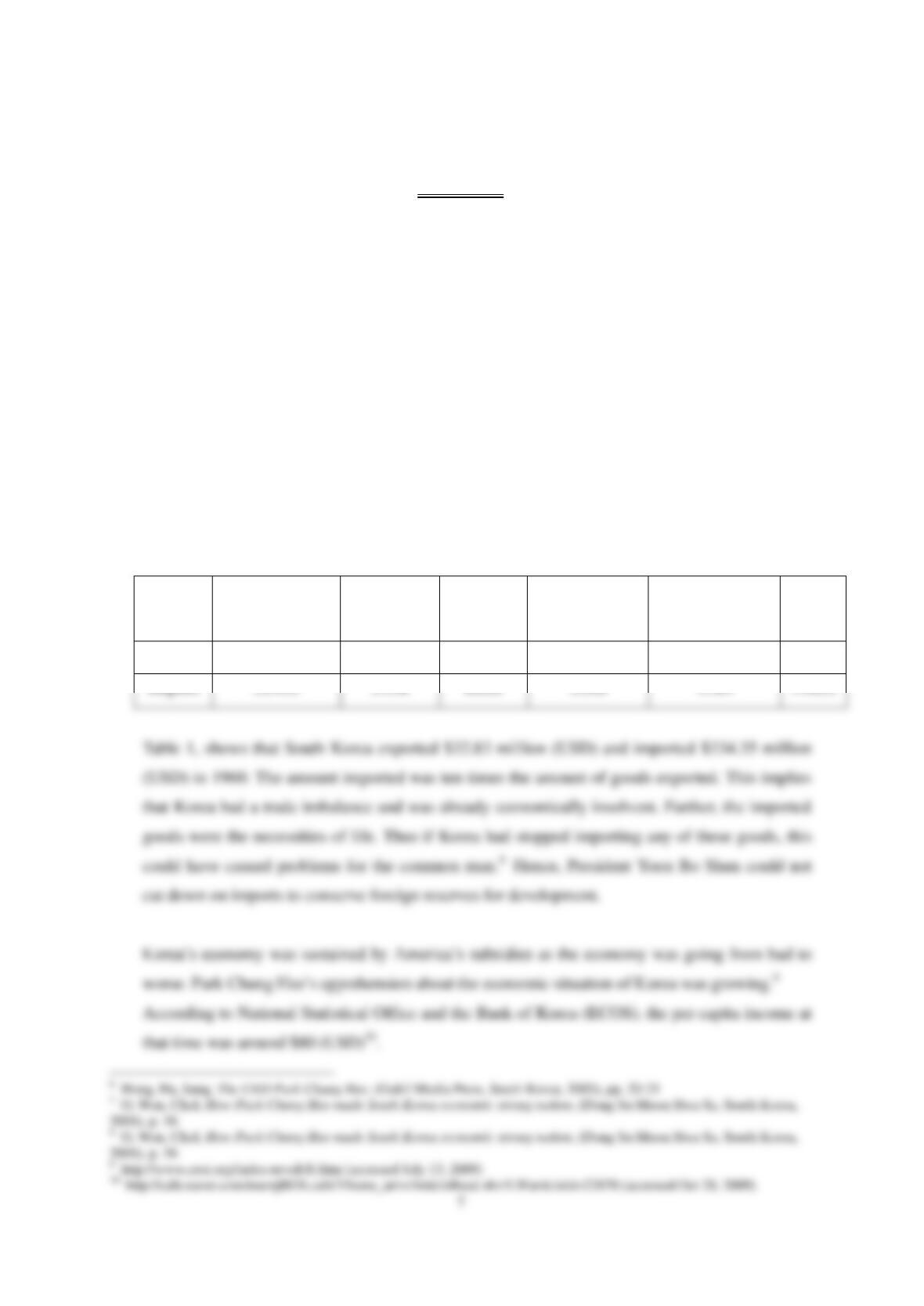
Table 17
Total (US$ in
ten thousand)
foodstuffs
Raw
materials
Mineral row
materials
Semi-finished
goods
other
Export
3283
970
1582
115
394
49
Import
6850
4704
11622