1
The Parable of the Sadhu
On a mountain climbing expedition to the Himalayas, Bowen
McCoy, a managing director of the Morgan Stanley Company,
and his party found a pilgrim, or Sadhu, dying of cold.
Although the climbers helped the holy man, Mr. McCoy and his
team ultimately pressed on with their trek, determined to
reach the summit. This unexpected ethical dilemma left them
questioning their values—and the values of business, which
often places goal achievement ahead of other considerations.
In this moving article, which received the Harvard Business
Review’s Ethics Prize in 1983, Mr. McCoy relates his
experience in the distant mountain of Nepal to the short and long-term goals of
American business.
Last year, as the first participant of in the new six-month sabbatical program that
Morgan Stanley has adopted, I enjoyed a rare opportunity to collect my thoughts
as well as do some traveling. I spent the first three months in Nepal, walking 600
miles through 200 villages in the Himalayas and climbing some 120,000 vertical
feet. On the trip my sole Western companion was an anthropologist who shed light
on the cultural patterns of the villages we passed through.
During the Nepal hike, something occurred that has had a powerful impact on my
thinking about corporate ethics. Although some might argue that the experience
has no relevance to business, it was a situation in which a basic ethical dilemma
suddenly intruded into the lives of a group of individuals. How the group responded
I think holds a lesson for all organizations no matter how defined.
Bowen McCoy
Photos by Mike Brozda
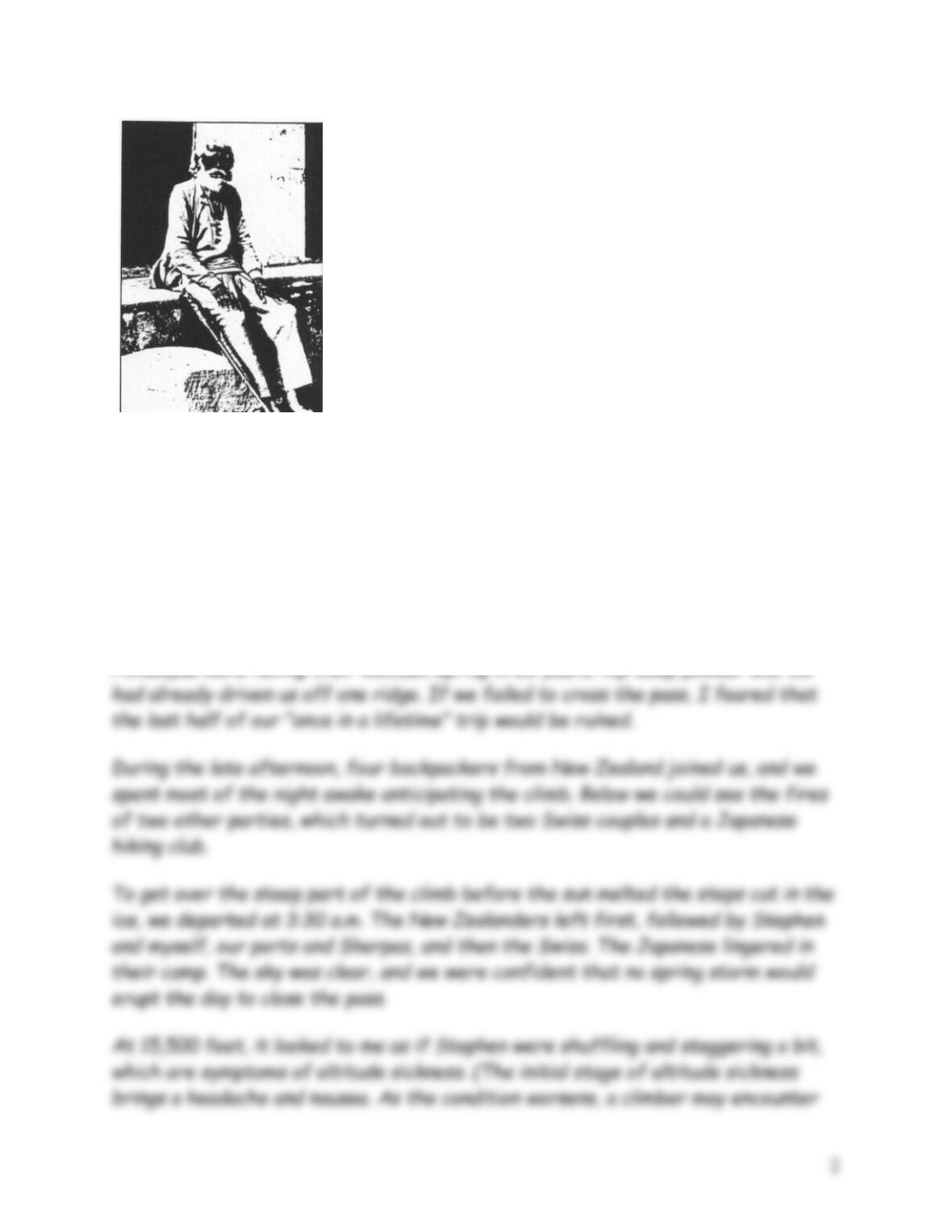
Sadhus, or holy men, roam
the countryside of India and
Nepal, begging for food
The Sadhu
Nepal experience was more rugged and adventuresome
than I had anticipated. Most commercial treks last two
or three weeks and cover a quarter of the distance we
traveled.
My friend Stephen, the anthropologist, and I were
halfway through the 60-day Himalayan part of the trip
when we reached the high point, an 18,000-foot pass
over a crest that we’d have to traverse to reach the
village of Muktinath, an ancient holy place for pilgrims.
Six years earlier I had suffered pulmonary edema, an acute form of altitude
sickness, at 16,500 feet in the vicinity of Everest base camp, so we were
understandably concerned about what would happen at 18,000 feet. Moreover, the