Duygu Keser
1909621
Section:Wednesday Morning
BIO310 Laboratory Report
Experiment 2: Colorimetric Methods For the Determination of Amino acids and
Proteins
AIM:
To be familiar with Beer-Lambert law and spectrophotometer, to understand applying serial
dilution and BCA colorimetric methods and in order to determine protein concentration from
unknown samples by using BCA method.
INTRODUCTION:
Each chemical substance absorb, transmit or reflect the light at different wavelength. A
spectrophotometer is a device to measure the absorbtion of light of chemical solutions measuring
the intensity of light which pass through the solution. Spectrometer produce light which has desired
wavelength and photometer measure the intensity of light. The absorbtion is depend on
concentration of solution and wavelength of light. A spectrophotometer consists of a light source, a
collimator(lens), a prism(monochromator), sample solution in a cuvette, a detector. Different
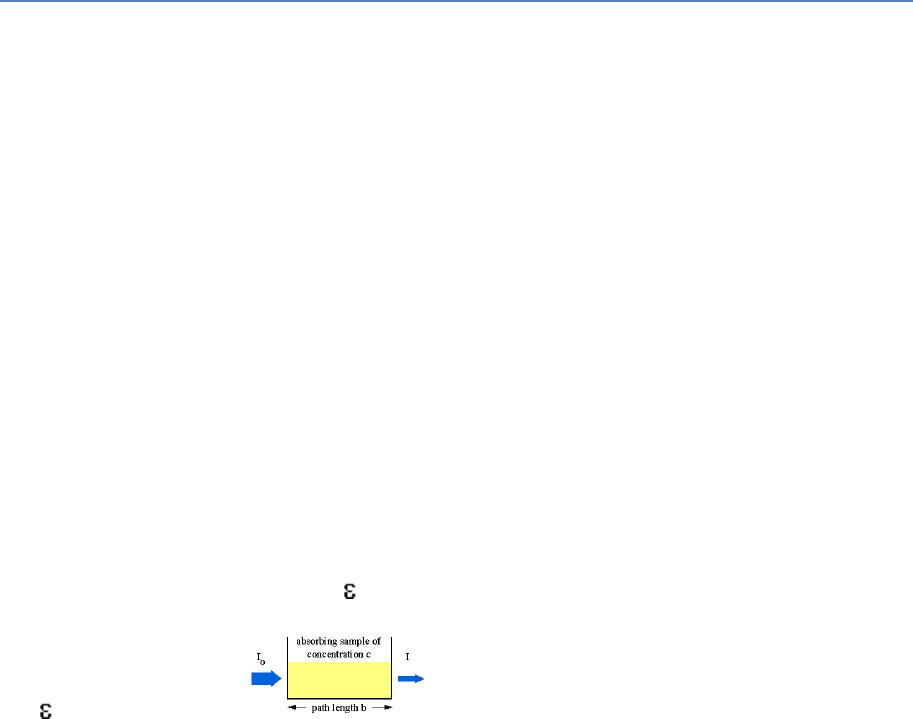
chemical compound can absorb light very well at different wavelength. Beer-Lambert law explain
the absorbance depend on length of cuvette(b), concentration of solution(c) and a constant epsilon
which is molar absorbtion coefficient( ) which is dependent to wavelength.
A = * b * c
Spectrophotometers work at the different range of wavelength not only for visible range of light but
also at UV range. There are different types of spectrophotometer exist. These are single beam and
double beam spectrophotometers. Using a single beam spectrophotometer, we need a reference
standard to standardize (a blank solution) before measure the absorbance. A double beam
spectrophotometer separate the beam of light into two, and first beam of light pass through blank
and the other pass through sample solution. And use the ratio to determine the absorbance. UV
absorbtion and flouresence absorbtion spectrophotometers also exist. BCA is a method for
colorimetric detection ad quantitation of total protein In a sample. Method based on bicinchoninic
acid and Cu++ ions reactions. Cu ions cleated with BCA so the color of solution turn from green to
purple at 562nm is best wavelength to observe. The advantages of BCA reaction are high range and
sensitivity. Color formation depend on the peptide bond number and existence of some specific

amino acids. These are cysteine, cystine, tryptophan and tyrosine. And alkaline conditions is also
needed.
RESULTS and CALCULATIONS:
Dilution table;
Vial
Volume of Diluent (µl)
Volume of BSA (µl)
Final BSA
Concentration (µg/ml)
A
0
300 of stock (2mg/ml)
2000
B
125
375 of stock (2mg/ml)
1500
C
C 325
325 of stock (2mg/ml)
1000
D
175
175 of vial B dilution
750
E
325
325 of vial C dilution
500
F
325
325 of vial E dilution
250
G
325
325 of vial F dilution
125
400
100 of vial G dilution
400
0
0=Blank
vial
Final BSA concentration(µg/ml)