Research Proposal for Apple Inc.
Date: December 13, 2016
To: Johny Srouji, Vice President of Apple’s Hardware Technologies
Dan Riccio, Senior Vice President of Apple’s Engineering Team
From: Panagiota Merron, Hardware Engineering Employee
Subject: Research Proposal for advancing the MoVR for our AR Headset
Summary
Augmented reality gives us the ability to view a physical space or environment without
actually being there through elements supplemented by computers or cellphones. Many
companies have begun shaping their own brand of virtual reality with few successes. The bugs
and problems revealed in these headsets provides Apple with the knowledge and clarity on how
to shape their own headset and become the gold standard. A recent technology development
known as the MoVR has given us a new means to developing augmented reality headsets. The
purpose of the MoVR is to allow high end data transfer from computers or cellphones to user
interfaces. It is a fairly new hardware but has shown success in the tests done by MIT
researchers. My proposal is to not only research the other augmented reality headsets and how
well they perform but also how well those headsets work with the MoVR technology
implemented and morph the MoVR so that we can use it for future Apple products. To do so
there are standards each virtual reality headset will be tested for in three phases. The project will
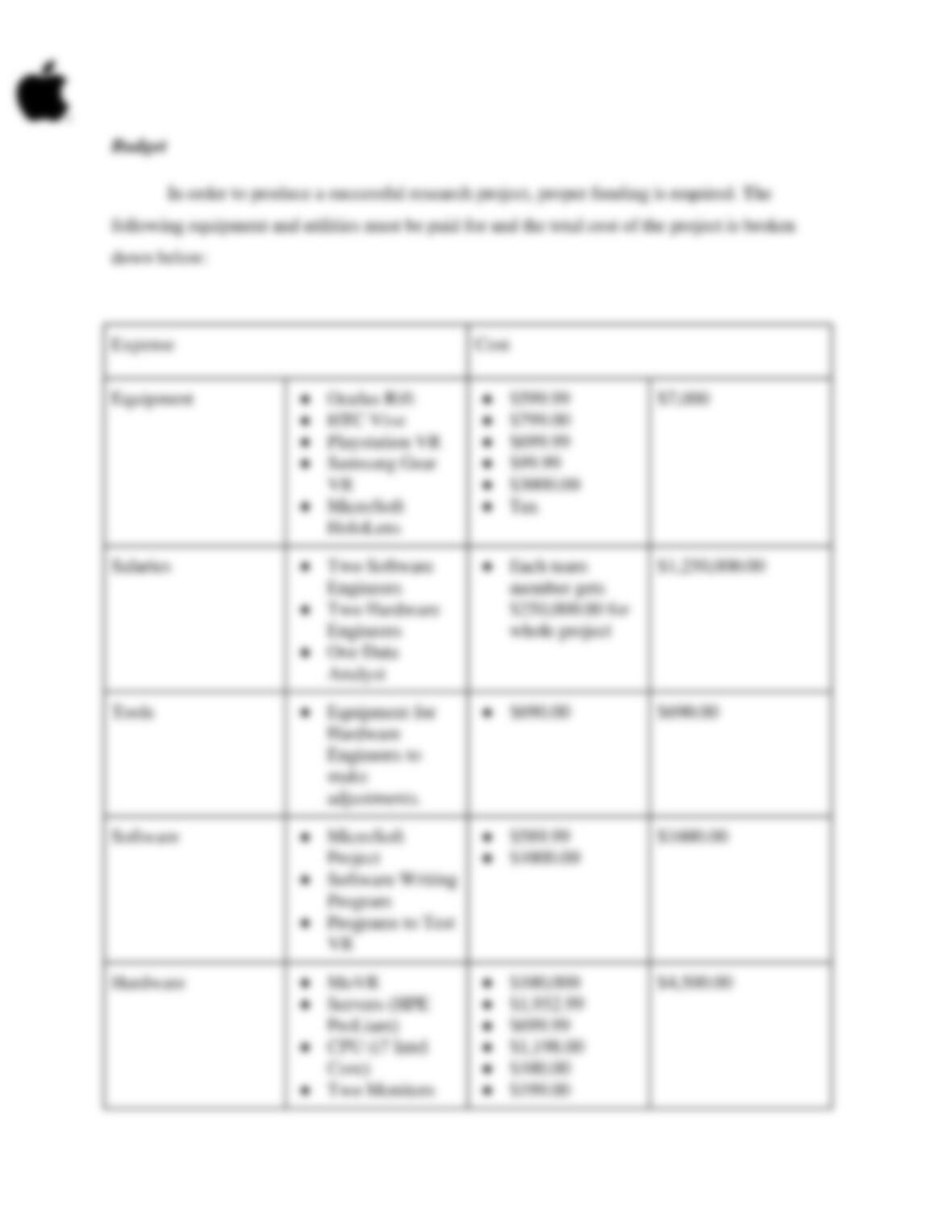
cost a total $1,763,790.00 and take a year to complete. Success of the project will be shown in
the prototype of Apple’s augmented reality headset.
Introduction

Augmented reality and virtual reality have captured the interest of millions of people
across the globe. Yet the stations or people who have access to the new reality is limited and
strapped down. Cords and wires must be hooked up to high end computer or system to
experience virtual reality. Those type of set ups can easily cost thousands of dollars for one
customer. The MoVR changes that for users and companies alike. It allows high end data
transfer from antennas that receive data from computers and cellphones. To make a product
commercial the technology within it must be easily constructed and cheap. The MoVR uses
technology we already have to receive data like a phone receives incoming calls or texts. It can
be implemented into current gaming virtual reality and with some alterations it can potentially be
put into augmented reality headsets.
Apple has yet to confirm if any virtual reality headsets are being produced or tested.
Rumors have circulated about the research team put together but that won’t provide enough data
or possible technologies our company can use. Being a part of the Hardware Engineering
Department at Apple, I see the potential the MoVR has as a useful and viable means to
producing our own augmented reality headset. My research proposal will collect data from five
augmented reality headsets without the MoVR, it will collect data from the same augmented
reality headsets with the MoVR implemented, reveal the strengths and weaknesses of the MoVR
and whether or not it can be used in Apple’s augmented reality headset. My research will also
reveal which hardware and software developments are the most advanced for our headset and
can provide the current innovative form of virtual reality.
Systematic Process

Apple has been hinting at developing a working and immersive augmented reality
headset by the year 2020. My research proposal intends to collect as much data and produce an
improved version of the MoVR within a year. The project would be divided into three phases
with data reports at the end of each phase. The greatest advantage Apple has is the failures of
other virtual reality headsets. By collecting and using that data, Apple can improve upon its own
headset and bring a new leading technology to the table.
Each phase will consist of four months and the first phase will consist of data collection
from current augmented and virtual reality headsets. Five virtual reality headsets will be tested
and be broken down. Those five virtual reality headsets will be the: Oculus Rift, HTC Vive,
MicroSoft HoloLens, Samsung Gear VR, and the Playstation VR. By using four programs
designed for virtual reality and augmented reality, each headset will be tested with those
programs. It will be determined how much data is transmitted for each set, what are the errors
within the code, and how is the overall experience for the user. For this phase generic standards
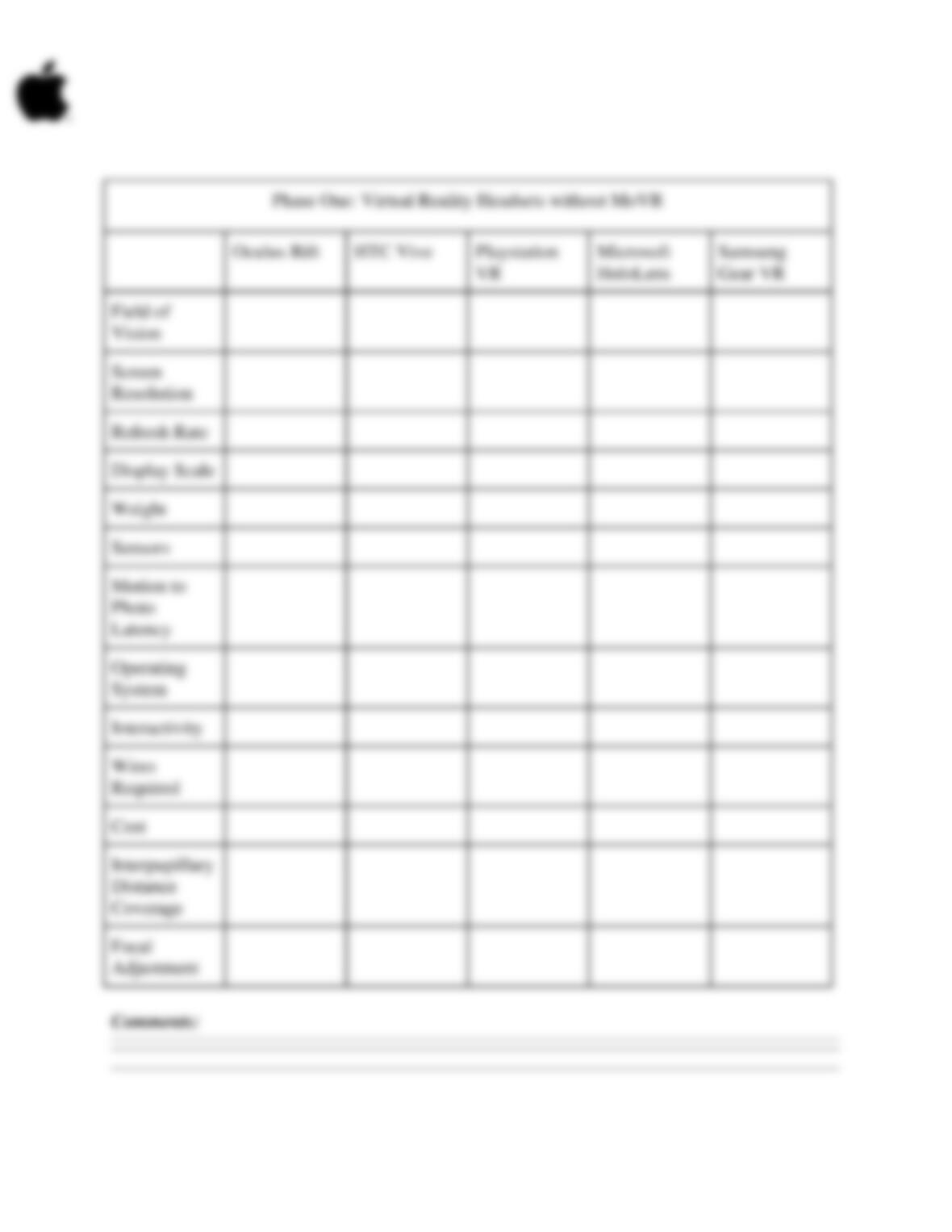
will be tested, evaluated and rated. The provided charts will be the main manner in rating and
collecting the data. There will also be audio recordings of the tests to verify the reports. After
every virtual reality headset has been tested and the data collected, reports for each headset will
be submitted to show our progression. These reports will be a collection of all the trials and
comparisons between each headset. It will clarify what pieces of hardware are best suited for
virtual reality and how well these headsets can handle the coded programs they were tested with.
For the second phase the MoVR will be analyzed and tested with the same virtual reality
headsets used in the first phase. By using the methods tested by the MIT research graduates, the
MoVR can be easily implemented into each headset. The four programs will be used again and
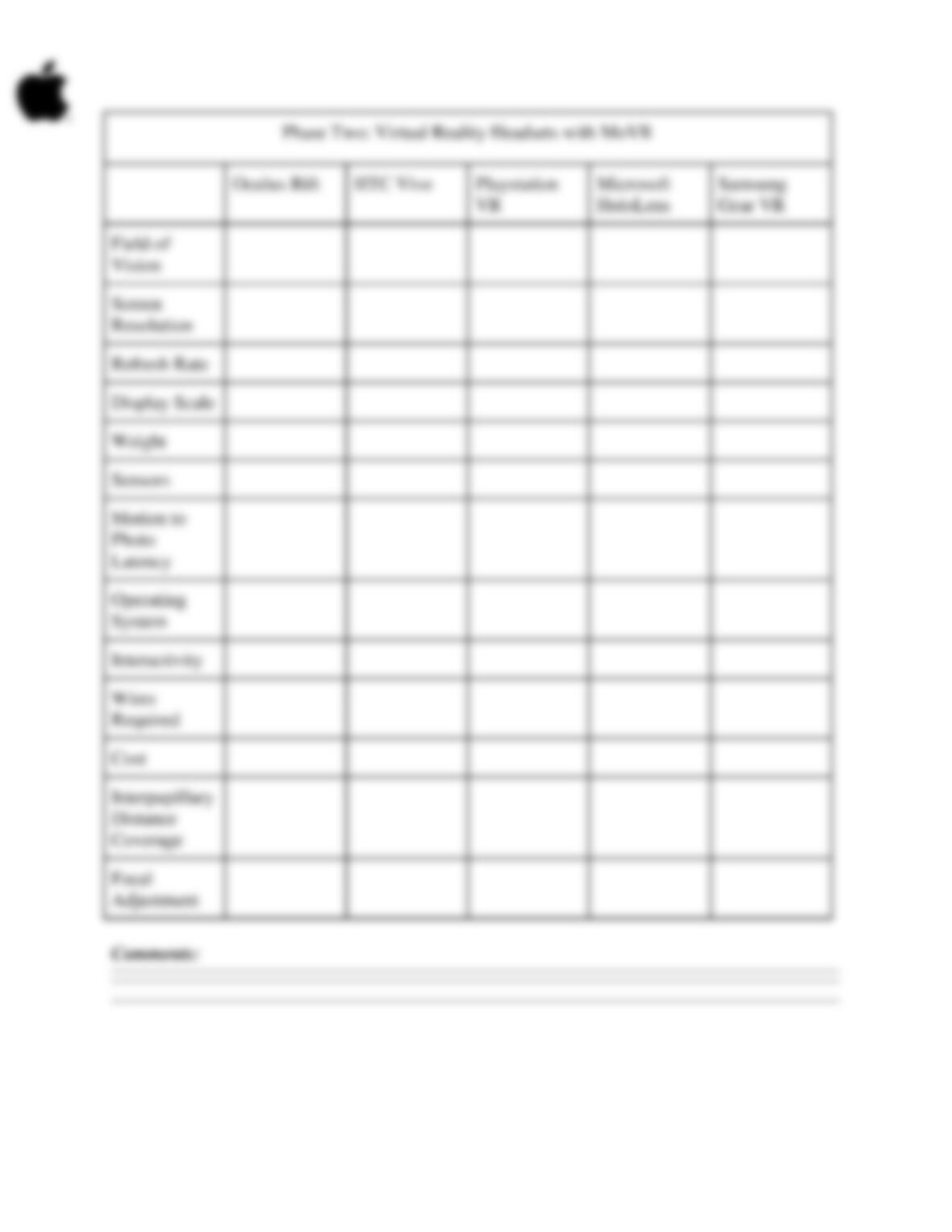
each headset tested. The charts used in the first phase will have slight alterations to accommodate
the MoVR but the same content will be tested. This second phase will allow us to visually see if
the MoVR can handle high end computing and can truly provide a user the same experience if
hooked up to a computer. This phase will be concluded with reports on all the data collected and
what are the bugs with the MoVR. It will clarify how strong of a hardware the MoVR is and to
what extent does it need improvement.
The third and final phase of the research project would be improving the MoVR and the
programs used to test the virtual reality headsets. The MoVR is the main focus of this task
because it is a powerful piece of hardware that can transmit data fast and efficiently. By using the
data collected and improving upon its weak points, Apple’s own augmented reality headsets can
have the latest innovative technology that provides the best results. While the hardware
engineer’s (of the team) focus on improving the MoVR, the software engineers that were testing