Problem Statement
How can the environmental issues of carbon emissions, water pollution and deforestation,
as well as the social issues of peat land development and RSPO certification associated
with palm oil production be addressed while considering the potential economic
implications of change to the rapidly growing palm oil production industry?
GAP Analysis
Palm oil production is a rapidly increasing industry in the global export market due to its
popularity for food production (human consumption) accounting for 80% of its use, as
well as 20% being used for personal care and biofuel sources. The vast majority of palm
oil production plantations are located in Indonesia and Malaysia. This accounts for 42%
of the workforce and 15% of the GDP in Indonesia and employing 1.5M people and
representing 85% of exports and 65% or agriculture in Malaysia.
Although the palm oil industry has a potentially positive economic value in both
of these countries it is also facing significant issues. In Indonesia the government is
leasing land that is sacred and home to indigenous people to large production companies
without warning. Another social issue is that local farmers wishing to buy land for palm
oil production are indebted so highly that the larger companies essentially own them.
There are also several environmental issues surrounding the industry. Malaysian forests
are the only natural habitats on earth for the orangutan. The industry is postponing the
release of 600 orangutans into the wild for re-population, 80% of their habitat has already
been destroyed and 75% of the remaining population is trapped in plantations. Water
pollution is also an issue, resulting in clean water shortages for locals. Lastly the CO2
emissions from production along with the destruction of forests, which are the most
effective method of CO2 removal, are having a powerful net effect on global pollution.
Accreditations for sustainable palm-oil production have been created by the
RSPO but are not shown to be effective on actually utilizing sustainable practices nor
increasing consumer awareness. Members of the palm oil production industry,
government, and consumers must commit to action in order to address these social,
political and environmental issues.
Key Decision Criteria
There are multiple parties involved in this issue, the Malaysian and Indonesian
Governments, the shareholders in large palm oil production companies, and
environmental activist groups such as Greenpeace. The decision criteria will reflect
aspects of the alternatives that are applicable to the involved parties. The end goal is to
pick the alternative that will have the most substantial positive impact on the issues
surrounding the palm oil production industry. These general decision criteria include the
cost and time associated with the implementation of the proposed alternative, the ease of
implementation, which goes hand in hand with cost and time, the criteria will also focus
on the level of supporting research relating to the proposed alternative, and the ROI for
the involved parties. It is important to note that return on investment may be less
important to stakeholders like environmental organizations who would rather have
outcomes such as reduced carbon emissions and lower levels of deforestation. The
decision criteria will also take into consideration the potential economic impact
pertaining to each alternative, as well as the potential improvement on the sustainability
of palm oil production, which is more difficult to estimate in a hypothetical industry
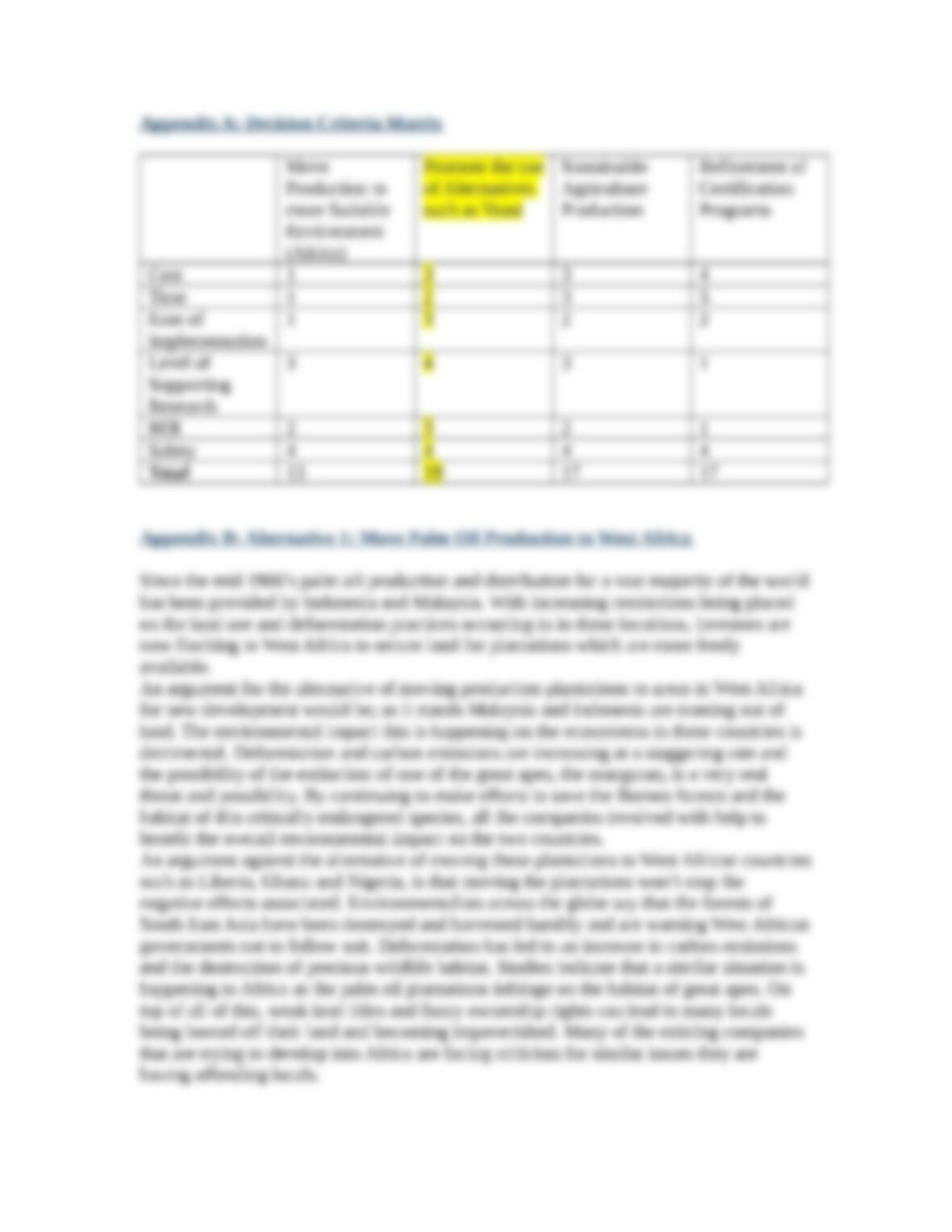
analysis. See Appendix A for decision criteria scoring
Alternatives
Based on the objectives outlined in the GAP analysis, we have selected four potential
alternatives to be considered for implementation. The first is moving the production
facilities to another possible region to mitigate the social and environmental issues in
Malaysia and Indonesia. This proposal would be applicable to the current production
companies who may run out of space or may face increased government regulations in
their current regions. This alternative does address some social issues in those countries
but does not solve the environmental issues; it simply mitigates them to another region
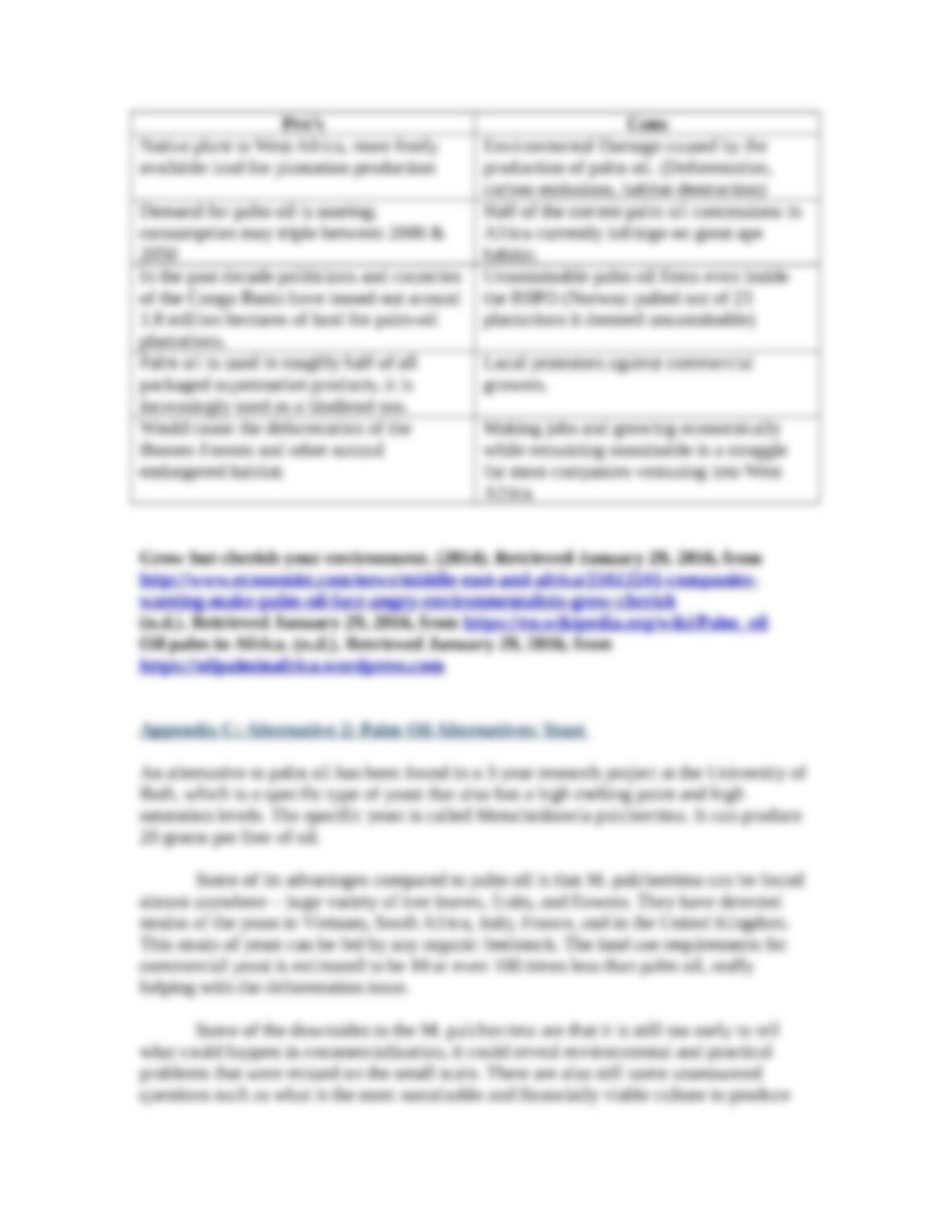
that will also eventually be affected. See Appendix B for details.
The next proposal is the promotion of palm-oil alternatives such as yeast by
environmental groups. The end results of lower palm-oil production and higher
alternative production could be reduced environmental and social impacts outlined in the
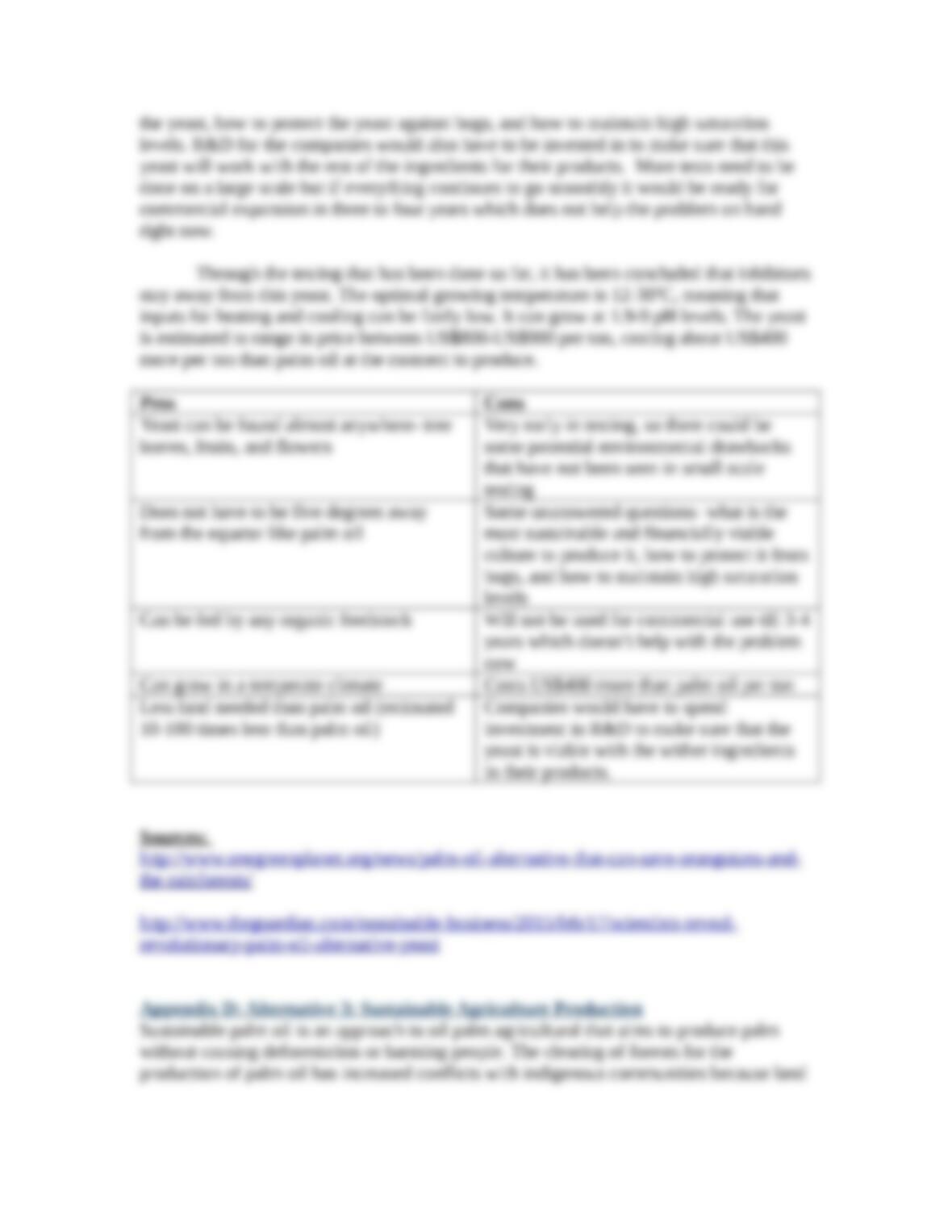
GAP analysis. There are several potential benefits and issues with this alternative, see
Appendix C for details.
Next is the idea to refine agriculture processes to make palm oil production more
efficient. Which would maximize the limited potential land left for production, and
increase production volume from current facilities. The companies in the industry would
have to implement this alternative. See appendix D for details.
The last and most simplistic alternative is refining current, or creating a new