The Osborne Effect On Tesla
By:
AshankAswath
CWID:50193125

ECO 595 APPLIED BUSINESS RESEARCH 2
Table of Contents
Introduction……………………………………………………………………………………..3
• A case of Tesla…………………………………………………………………………4-9
• Significance and need for study………………………………………………………..10
Gap Analysis……………………………………………………………………………………11
Methodology and Data Sources………………………………………………………………….12
• Secondary Data…………………………………………………………………………12
• Primary Data……………………………………………………………………………12
Research framework of the study……………………………………………………………….13
• Variables…………………………………………………………………………………13
▪ Dependent Variables…………………………………………………………………………………..13
▪ Independent Variables……………………………………………………………………………………....13
The survey questionnaire……………………………………………………………………..14-16
ECO 595 APPLIED BUSINESS RESEARCH 3
Introduction
The Osborne effect is a term referring to the unintended consequences of the announcement of a
future product ahead of its availability and its impact upon the sales of the current product.
Pre-announcement is done for several reasons: to reassure current customers that an
improvement or lower cost is coming, to increase the interest of the media and investors in the
company’s prospects, and to intimidate or confuse competitors. When done correctly, the sales or
cash flow impact to the business is minimal, as the revenue drop the current product is replaced
by orders or completed sales of the new product as it becomes available.
The Osborne effect occurs when this pre-announcement is made either unaware of the risks
involved or when the timing is misjudged. Customers react immediately by canceling or
deferring orders for the current product, knowing that it will soon be obsolete. Inventories
increase, and the company must respond by either discounting or lowering production of the
current product. Either of these choices depresses cash flow. In the actual case of Osborne
Computer corporation, the company took more than a year to make its next product available. It
ran out of cash and went bankrupt in 1985.
Pre-announcing products in a way that incurs the Osborne Effect is an example of a self-
defeating prophecy, as the announcement of the new product is ultimately responsible for its
abandonment.
At the very least, any unexpected delays may mean the new product comes to be perceived as
vaporware, further damaging the company’s credibility and thus profitability.
(Wikipedia LLC), (Osborne & Dvorak, 1984)&(Grindley, 1985)
ECO 595 APPLIED BUSINESS RESEARCH 4
A case of Tesla
Tesla is a name almost synonymous with electric vehicles (EV) category. Tesla may not have
invented the EV, but it indeed did pioneer the type. Tesla has taken the development of EV to an
extent no other competitor could make. A few advancements in the technology apart from
proving that EVs can be as good as ICE in terms of luxury and speed are, auto drive or the self–
drive, though it is controversial it is the current state of art, the falcon wing doors, bioweapon
defense mode where you go from breathing customarily filtered air to inhaling hospital-grade
atmosphere and many more features when observed it detail that set them apart from a
conventional car.
Tesla, breaking the stereotypes of the fuel powered engine had started to dominate the luxury
market competing with the automobiles using Internal Combustion Engine(ICE) with its electric
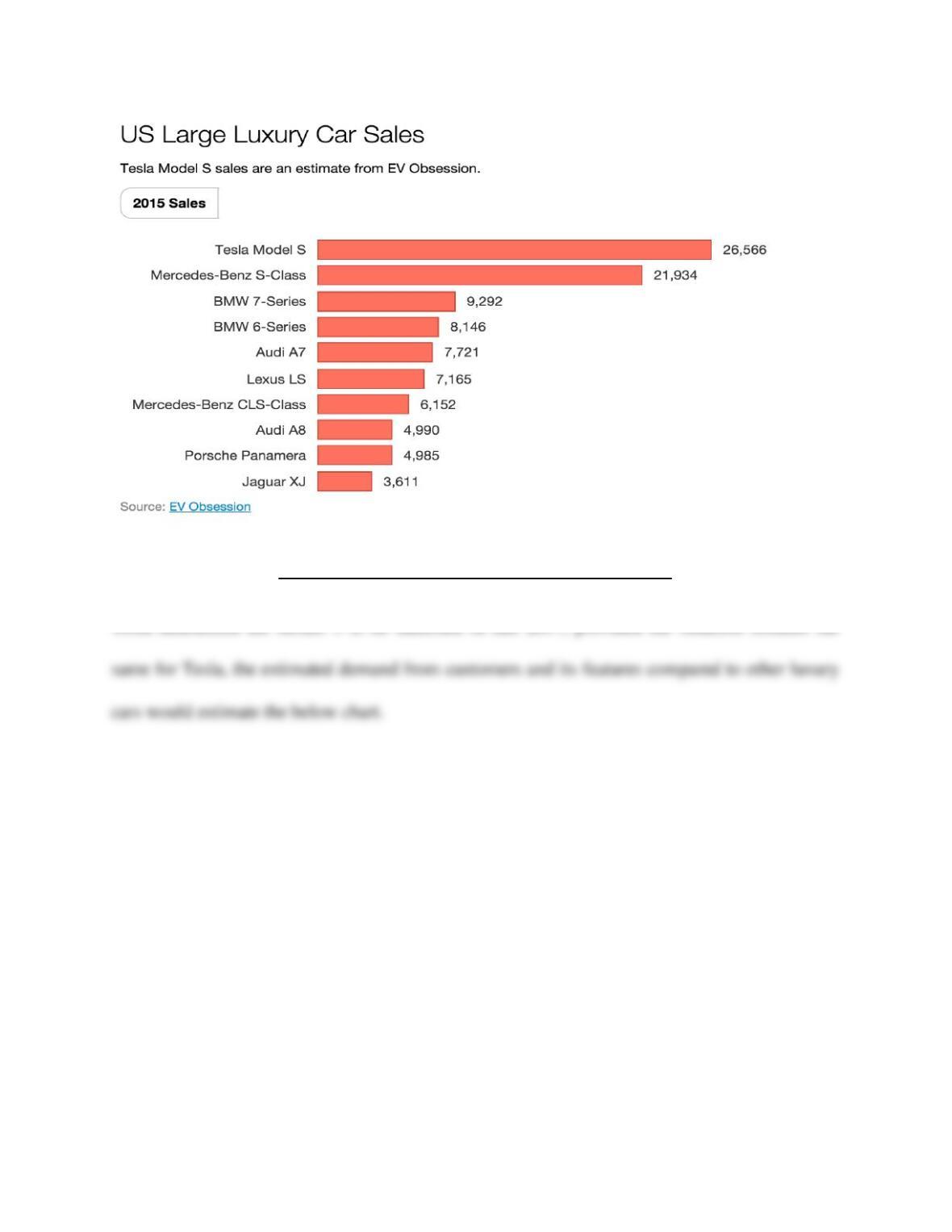
vehicles(EV). The statistics of the luxury market sales is as shown below.
ECO 595 APPLIED BUSINESS RESEARCH 5
Image 1: Statistics of Luxury Car Market Sales 2015