6Chapter
Organizational
Design and
Structure
6-1
1

Learning Outcomes
After studying this chapter, you will be able to:
•Describe six key elements in org design.
•Identify the contingency factors that favor either the mechanistic model
or the organic model of organizational design.
•Compare and contrast traditional and contemporary organizational
designs.
•Discuss the design challenges faced by today’s organizations.
6-2
After studying this chapter, you will be able to:
•Describe six key elements in organizational design.
•Identify the contingency factors that favor either the mechanistic model or
the organic model of organizational design.
•Compare and contrast traditional and contemporary organizational designs.
•Discuss the design challenges faced by today’s organizations.
2
6-3
3

Elements in Organizational Design
Six key elements:
•Work specialization
•Departmentalization
•Authority & responsibility
•Span of control
•Centralization v.
decentralization
•Formalization
6-4
Organizing is the management function that creates the organization’s structure.
When managers develop or change the organization’s structure, they’re engaging in
organization design, which is the process of making decisions about how specialized
jobs should be, the rules to guide employees’ behaviors, and the level at which
decisions will be made.
Organizing and organizational structure have undergone much change in the 80 years
since the basic concepts of organization design were formulated by management
writers such as Henri Fayol and Max Weber.
Let’s now look a the six basic elements of organizational structure:
•Work specialization
•Departmentalization
•Authority and responsibility
•Span of control
•Centralization versus decentralization, and
•Formalization.
4
Work Specialization
6-5
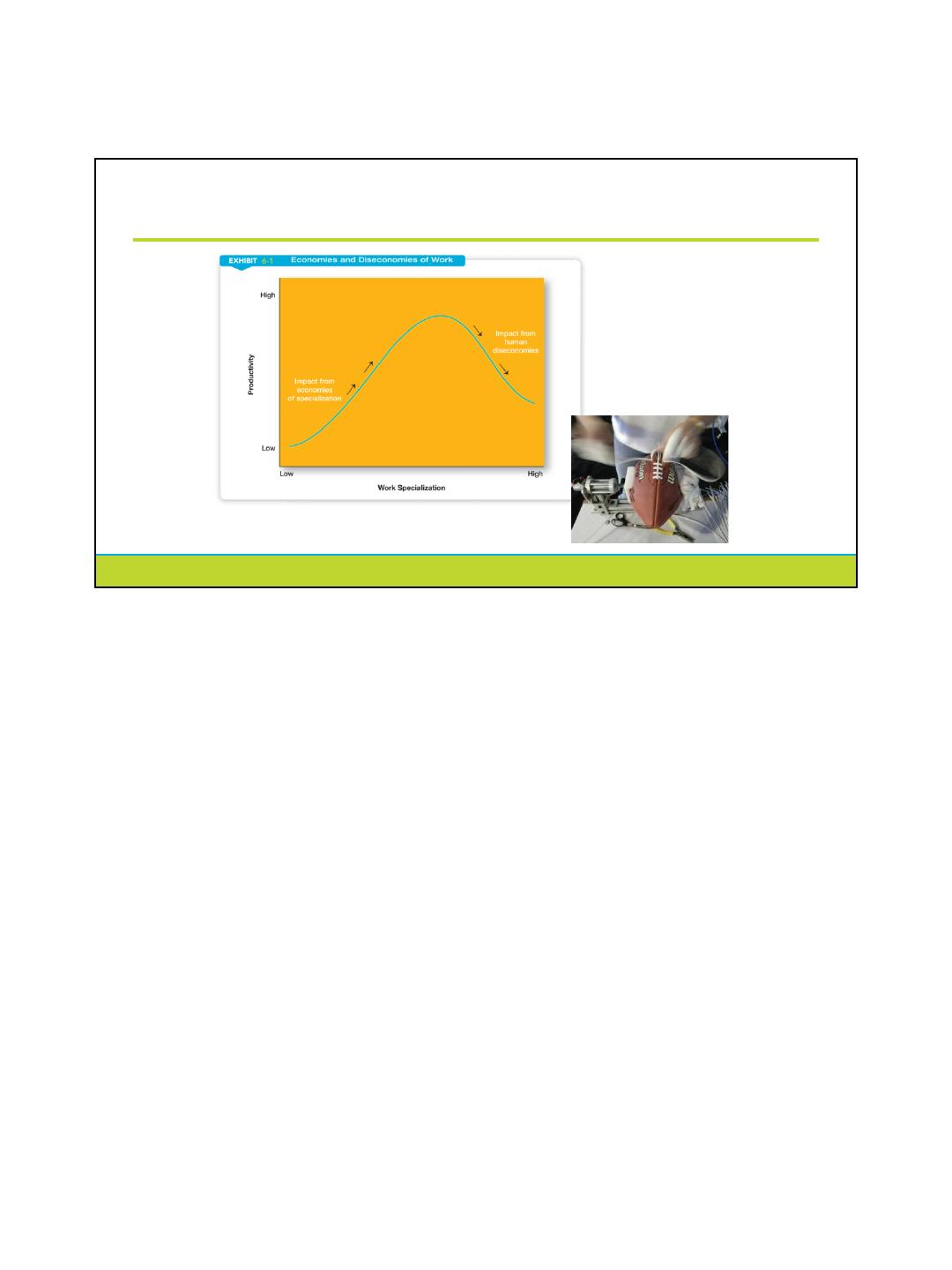
Work specialization is the division of work activities into separate job tasks. At the
Wilson Sporting Goods factory in Ada, Ohio, workers making NFL footballs specialize
in job tasks—such as molding, stitching and sewing, and lacing—to increase work
output.
When first introduced, specialization almost always generated higher productivity.
But at some point, the human diseconomies—boredom, fatigue, stress, low
productivity, poor quality, increased absenteeism, and high turnover—exceed the
economic advantages, as seen here in Exhibit 6–1.
Most managers today see work specialization as an important organizing mechanism
because it helps employees to be more efficient.
5
Departmentalization
6-6
Early management writers argued that common work activities needed to be grouped together to get them done in a
coordinated and integrated way.
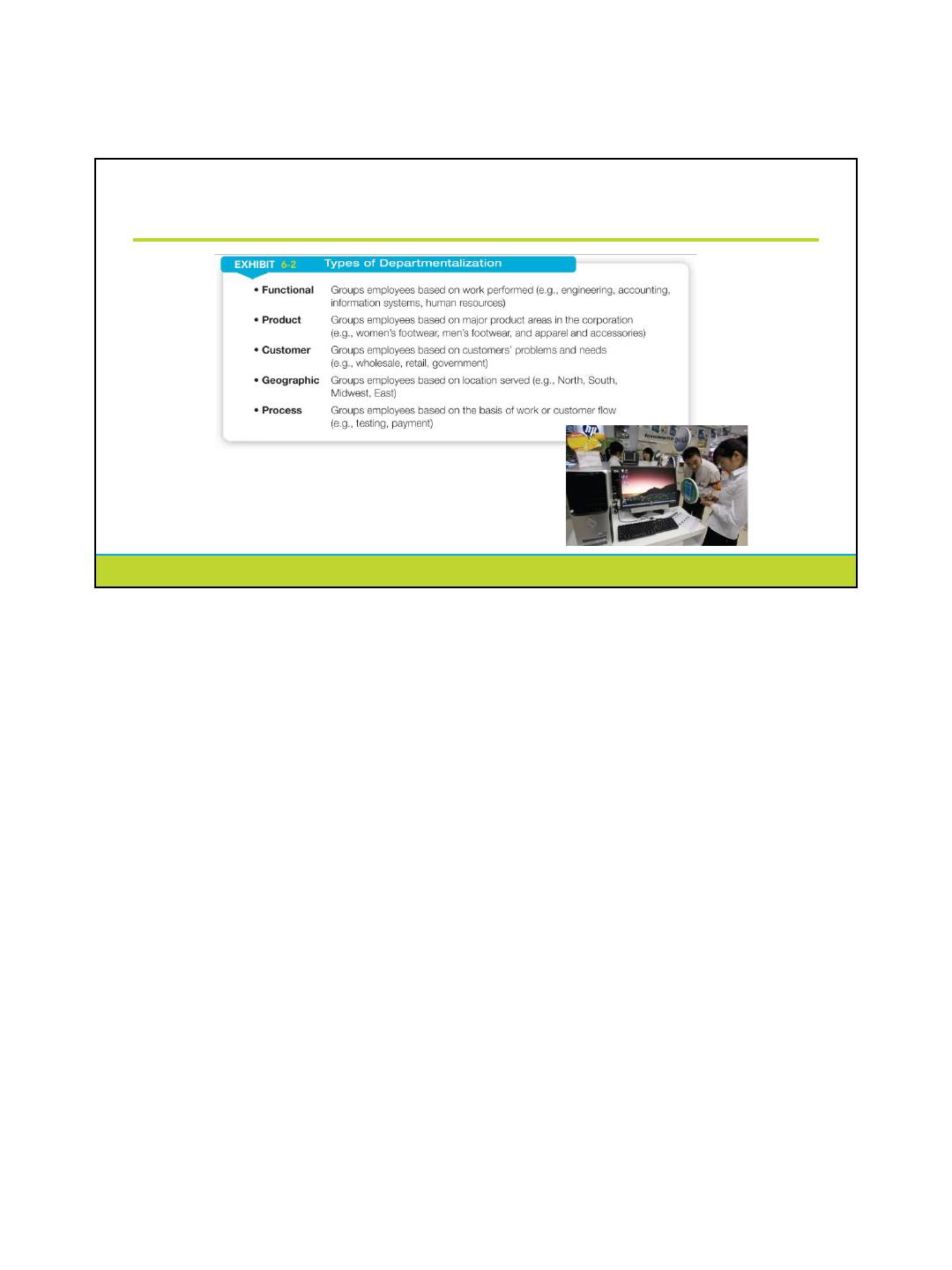
How jobs are grouped together is called departmentalization. There are five common forms of departmentalization (as seen in
Exhibit 6-2), although an organization may use its own unique method.
1. Functional departmentalization, or grouping activities by function—such as engineering, accounting, information
systems, and human resources—is one of the most popular ways of organizing the workplace. Its major advantage is
that it achieves economies of scale by placing people with common skills and specializations into common units.
2. Product departmentalization groups employees according based on a corporation’s major product areas. Each
product is under the authority of a senior manager who is a specialist in, and is responsible for, everything related to
his or her product line. The advantage of product grouping is that it increases accountability for product
performance because all activities related to a specific product are under the direction of a single manager.
3. Employees can also be grouped by the type of customer an organization seeks to reach. For example, the sales
activities in an office supply firm can be divided into three departments that serve retail, wholesale, and government
customers, respectively. The assumption underlying customer departmentalization is that customers in each
department have a common set of problems and needs that can best be met by specialists.
4. Another way to departmentalize is on the basis of geography or territory, which is called geographic
departmentalization. The sales function might have western, southern, midwestern, and eastern regions.
5. Process departmentalization groups activities on the basis of work or customer flow. Examples of process
departmentalizaiton can be found in many states’ motor vehicle offices and in health care clinics. Units are
organized around common skills needed to complete a certain process.
It is interesting to note that some companies, such as Black & Decker, organize their divisions along functional lines, their
manufacturing units around processes, their sales around geographic regions, and their sales regions around customer
groupings.
Still other organizations use cross-functional teams, which are teams comprised of individuals from various departments who
6

tackle complex tasks in which diverse skills are needed.
Note also that today’s competitive environment has refocused the attention of management on its customers, so many