Organizational Culture, Innovation and
Creativity
Organizational culture innovation and creativity are interrelated. Organizational culture plays a
vital role for encouraging innovation and creativity in any company. Organizational culture is
also an important determinant of organizational success.
Organizational Culture:
Organizational culture is culture starts with leadership, is reinforced with the accumulated
learning of organizational members and is powerful set of forces that determine human behavior.
There is no exact definition for organizational culture it is explained with mere examples. For
example in an organization, the way we do things around here i.e. consistent way of performing
tasks, solving problems , resolving conflicts, interaction with customers and treating employees
all these tasks comes together to form organizational culture.
Work culture is a totality of various levels of interaction among organizational factors and
organismic factors interact among themselves at various levels.
Functions of organizational culture are behavioral control, encouraging stability and provide
source of identity.
Nature of organizational culture:
The culture of an organization may reflect in various forms adopted by the organizations these
could be
physical infrastructure
routine behavior, language, ceremonies
gender equality, equality in payment
dominant values such as quality, efficiency
Philosophy that guides the organization’s policies towards it employees and
customers like customer first and customer is king and manner in which employee’s deals
with customers.
Individual factors wont reflect organizational culture but combined together
reflect organizational culture. Large organization has a dominant culture and also sub
cultures exist.
Dominant culture is followed by every one in organization and sub culture is
followed by only particular department or group.
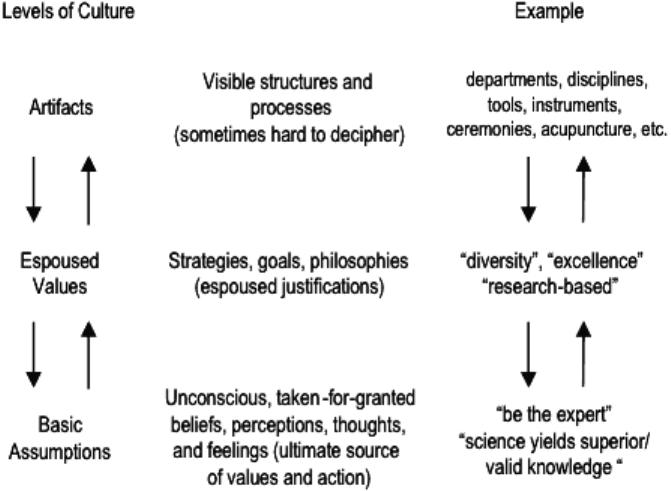
Levels of organizational culture:
At level-1: organizational culture can be observed in the form of physical objects,
technology and other visible forms of behavior like ceremonies and rituals.
At level -2: there is greater awareness and internalization of culture values. people
in the organization try solutions of a problem in ways which have been tried and tested
earlier.
At level-3: a process of conversion, where the group repeatedly observes that the
method that was tried works most of the time, it becomes the preferred solution and get
converts into dominant value orientation.
Common Myths about organizational culture:
Organizational culture is same as organizational climate: these are not same but
two different concepts in organization. Organization culture is a macro phenomenon
which deals with beliefs, assumptions, values and behaviors
reflecting commonality in people working together. Where as organizational
climate is micro phenomenon and reflects how employees in an organization feel about
the characteristics and quality of culture like morale, goodwill, employee relations, job
satisfaction etc.
Culture is same as group think: culture refers to shared assumptions and beliefs; it
is likely to cause confusion, it is characterized by symbols, beliefs and artifacts. Where
as group think refers to group member hiding any differences in how they feel and think
and behave in a certain way, it is mostly happened in face to face situations.
Culture is same as organization: culture is a result of sustained interaction among
people in organization and exists commonly in thoughts, feelings and behavior of people.
Where as organization consists of a set of expectations and a system of rewards and
punishment substained by rules, regulation and norms of behavior.
Culture is a social structure: social structure in various collectives exhibit tangible
and specific ways in which people relate to one another overtly. However, culture
operates on a system of unseen, abstract and emotionally loaded forms which guide
organizational members to deal with their physical and social needs.
Types of organizational culture:
Types are explained easily with the help of competing value frame work.
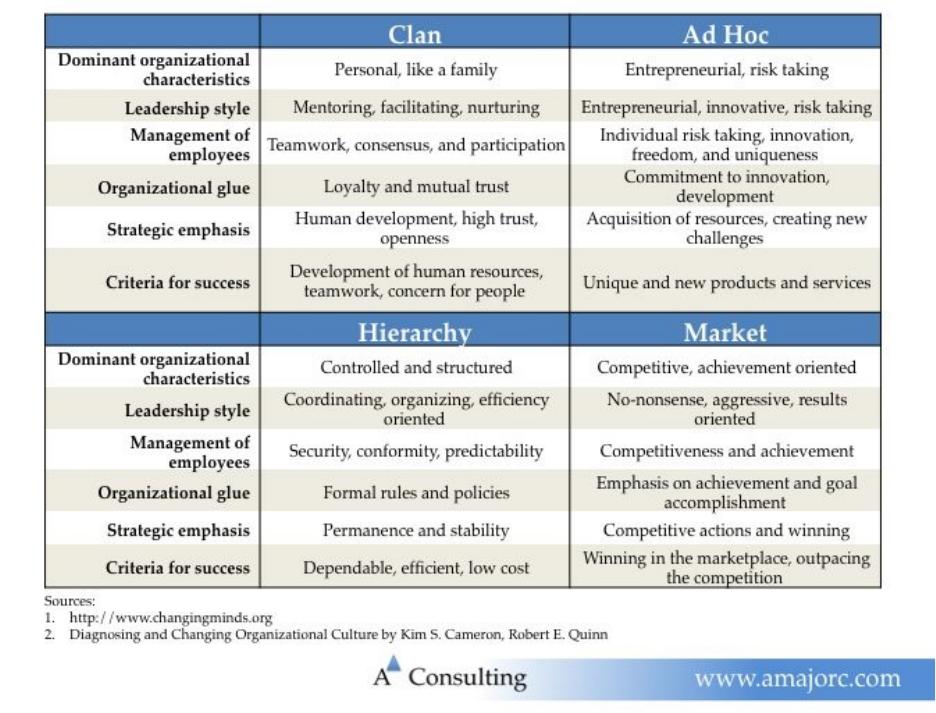
Competing value frame work has proven to be a helpful framework for assessing and profiling
the dominant cultures of organization. The first dimension places the values of flexibility,
discretion and dynamism at one end of the scale with stability, order and control on the other.
That means it emphasis on adaption and effectiveness. The second dimensions is marked by
internal orientation, integration and unity at one end of the scale with external orientation,
differentiation and rivalry on the other.
Hierarchy:
Hierarchical organizations share similarities with the stereotypical large bureaucratic corporation.
They are defined by stability and control as well as internal focus and integration. They value
standardization, control and well defined structure for authority and decision making.
Examples are MC Donald’s and government agencies like department of motor vehicles .
Market:
These companies are similar to hierarchical companies in terms of stability and control but differ
in terms of focus. These organizations have external orientation and they value differentiation
over integration. This began largely because of the competitive challenges from overseas. These
focused on relationships with suppliers, customers, contractors, unions, legislators, consultants
and regulators. These organizational feel that through external relations they can achieve success.
Organizations are more concerned on competitiveness and productivity.
Examples are General electric (GE), during leadership of former CEO jack wetch.
Clan:
Clan is similar to hierarchy in terms of inward focus with concern for integration but they
emphasis on discretion rather than the stability and control of control. The organizations