CHAPTER I
INTRODUCTION
1.1 Concept of Motivation
The term ‘motivation’ has been derived from the word motive. Motives are expression of
a person’s goal or need. They give direction to human behavior to achieve goals or fulfill
need, motive arouse and energize persons activities. Motivation is defined as a process of
stimulating to adopt a course of action. It refers to the way in which urges, derive,
desires, striving, aspirations or needs direct control or explain the behavior of human
being. Motivation initiates, guides and maintains goal-oriented behaviors. It involves the
biological, emotional, social and cognitive forces that activate behavior. It is the
processes that account for an individual’s intensity, direction, and persistence of effort
toward attaining a goal. In everyday usage, the term motivation is frequently used to
describe why a person does something.
The process of motivation consists of three stages:-
A felt need or drive
A stimulus in which needs have to be aroused
When needs are satisfied, the satisfaction or accomplishment of goals.
Therefore, we can say that motivation is a psychological phenomenon which means
needs and wants of the individuals have to be tackled by framing an incentive plan.
Motivation can be divided into two types: internal, or intrinsic motivation, and external,
or extrinsic motivation.
Intrinsic motivation
Intrinsic motivation refers to motivation that is driven by an interest or enjoyment in the
task itself, and exists within the individual rather than relying on any external pressure.
1

Intrinsic motivation is based on taking pleasure in an activity rather than working towards
an external reward. Intrinsic motivation has been studied since the early 1970s. Students
who are intrinsically motivated are more likely to engage in the task willingly as well as
work to improve their skills, which will increase their capabilities. Students are likely to
be intrinsically motivated if they:
attribute their educational results to factors under their own control, also known as
autonomy,
believe they have the skill that will allow them to be effective agents in reaching
desired goals (i.e. the results are not determined by luck),
if they are interested in mastering a topic, rather than just rote-learning to achieve
good grades.
Extrinsic motivation
Extrinsic motivation refers to the performance of an activity in order to attain an
outcome, which then contradicts intrinsic motivation. It is widely believed that
motivation performs two functions. The first is often referred to as the energetic
activation component of the motivation construct. The second is directed at a specific
behavior and makes reference to the orientation directional component. Extrinsic
motivation comes from outside of the individual. Common extrinsic motivations are
rewards like money and grades, and threat of punishment. Competition is in general
extrinsic because it encourages the performer to win and beat others, not simply to enjoy
the intrinsic rewards of the activity. A crowd cheering on the individual and trophies are
also extrinsic incentives. The concept of motivation can be instilled in children at a very
young age, by promoting and evoking interest in a certain book or novel. The idea is to
have a discussion pertaining the book with young individuals, as well as to reward them.
There are a number of different views as to what motivates workers. The most commonly
held theories are Theory of Scientific Management, Cognitive Dissonance Theory,
Maslow’s Hierarchy of Needs, Alderfer’s ERG Theory, Goal Setting Theory, Theory X
2

and Theory Y, Three Needs Theory, Equity Theory, Self-Determination Theory,
Achievement Motivation Theory, Expectancy Theory, Hygiene Factor Theory, and Self-
Determination Theory.
1.2 Maslow’s Hierarchy of Need
Maslow’s Hierarchy of Need is a general theory of motivation. It is a theory
in psychology proposed by Abraham Maslow in his 1943 paper “A Theory of Human
Motivation”. His theory focuses on describing the stages of growth in human needs.
Indeed, Maslow’s ideas surrounding the Hierarchy of Needs concerns about the
responsibility of employers to provide a workplace environment that encourages and
enables employees to fulfill their own unique potential (self-actualization). This hierarchy
suggests that people are motivated to fulfill basic needs before moving on to other, more
advanced needs. The Hierarchy of Needs theory remains valid today for understanding
human motivation, management training, and personal development.
Maslow has developed three assumptions to underlie this theory. They are:
Unsatisfied needs stimulate behavior, while satisfied needs are not motivators.
People’s needs range from the most basic (e.g., physiological) upward to more
complex need levels (e.g., self-esteem).
Individuals must, at least minimally, satisfy a lower level of need before moving
upward and activating a new area of need.
Maslow has classified people’s need into five categories, which act as motivators. These
needs are stated below:
(1) Physiological needs
(2) Safety and Security needs
(3) Social and Belongingness needs
(4) Ego, Status, and Self-esteem needs
(5) Self-actualization needs
3
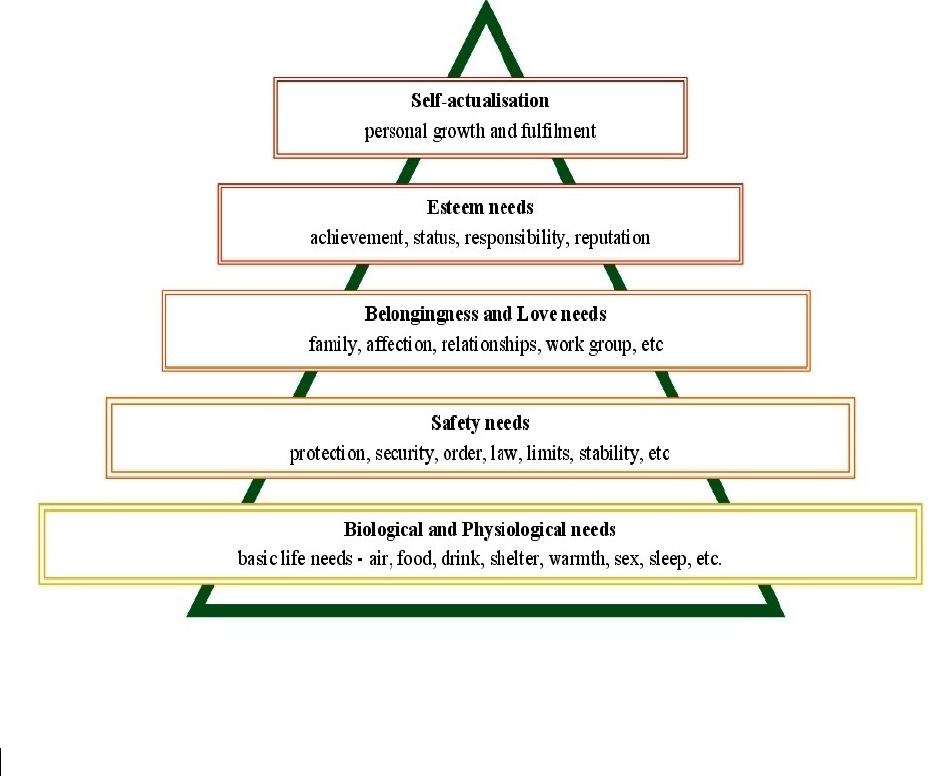
Maslow’s hierarchy of needs is often portrayed in the shape of a pyramid with the largest,
most fundamental levels of needs at the bottom and the need for self-actualization at the
top. It can be shown as:
Figure: Maslow’s Hierarchy of need;
(1) Physiological Need
These needs include the most basic needs that are vital to survival, such as the need for
water, air, food, and sleep. Maslow believed that these needs are the most basic and
instinctive needs in the hierarchy because all needs become secondary until these
physiological needs are met. If these requirements are not met, the human body cannot
4

function properly, and will ultimately fail. It can be fulfilled by providing higher pay,
accommodation, etc.
(2) Safety and Security Need
With their physical needs relatively satisfied, the individual’s safety needs take
precedence and dominate behavior. In the absence of physical safety – due to war, natural
disaster, childhood abuse, etc, people may (re-)experience post-traumatic stress
disorder or transgenerational trauma. In the absence of economic safety – due to
economic crisis and lack of work opportunities – these safety needs manifest themselves
in ways such as a preference for job security, grievance procedures for protecting the
individual from unilateral authority, savings accounts, insurance policies, reasonable
disability accommodations, etc. This level is more likely to be found in children because
they generally have a greater need to feel safe.
Safety and Security needs include:
Personal security
Financial security
Health and well-being
Safety net against accidents/illness and their adverse impacts
(3) Social and Belongingness Need
After physiological and safety needs are fulfilled, the third level of human needs is
interpersonal and involves feelings of belongingness. This need is especially strong in
childhood and can override the need for safety as witnessed in children who cling to
abusive parents. Deficiencies within this level of Maslow’s hierarchy – due to
hospitalism, neglect, shunning, ostracism, etc. – can impact the individual’s ability to
form and maintain emotionally significant relationships in general, such as:
5

Friendship
Intimacy
Family
According to Maslow, humans need to feel a sense of belonging and acceptance among
their social groups, regardless if these groups are large or small. For example, some large
social groups may include clubs, co-workers, religious groups, professional
organizations, sports teams, and gangs. Some examples of small social connections
include family members, intimate partners, mentors, colleagues, and confidants. Many
people become susceptible to loneliness, social anxiety, and clinical depression in the
absence of this love or belonging element. This need for belonging may overcome the
physiological and security needs, depending on the strength of the peer pressure. Hence
organizations can fulfill these needs by encouraging the employees to form formal and
informal relationship, work in a team etc.
(4) Ego, Status, and Self-esteem Need
After the first three needs have been satisfied, esteem needs becomes increasingly
important. These include the need for things that reflect on self-esteem, personal worth,
social recognition, self respect, appreciation, prestige etc. People often engage in a
profession or hobby to gain recognition. These activities give the person a sense of
contribution or value. It can be fulfilled by providing recognition, promotion, awards,
appreciation etc. Maslow noted two versions of esteem needs: a ‘lower’ version and a
‘higher’ version. The ‘lower’ version of esteem is the need for respect from others. This
may include a need for status, recognition, fame, prestige, and attention. The ‘higher’
version manifests itself as the need for self-respect. For example, the person may have a
need for strength, competence, mastery, self-confidence, independence, and freedom.
This ‘higher’ version takes precedence over the ‘lower’ version because it relies on an
inner competence established through experience. Deprivation of these needs may lead to
an inferiority complex, weakness, and helplessness.
6
(5) Self-actualization Need
“What a man can be, he must be.” This quotation forms the basis of the perceived need
for self-actualization. It is a drive to become what a person is capable of becoming. This
level of need refers to what a person’s full potential is and the realization of that potential.
Maslow describes this level as the desire to accomplish everything that one can, to
become the most that one can be. It includes needs like goal achievement, highest post
etc. In an organizational setting, it can be fulfilled by providing highest post, allowing to
involve in challenging decision making etc. As previously mentioned, to understand this
level of need, the person must not only achieve the previous needs, but master them.
One must satisfy lower level basic needs before progressing on to meet higher level
growth needs. Once these needs have been reasonably satisfied, one may be able to reach
the highest level called self-actualization.
Maslow states that individual needs arise in a hierarchical order i.e. physiological need