Assignment 3
Case 7.1
(a) Use any available linear programming soware to solve the model for this problem as
formulated in Sec. 3.4. In addi#on to the op#mal solution, obtain the addi#onal output provided
for performing postop#mality analysis (e.g., the sensitivity Report when using Excel). This output
provides the basis for the following steps.
Answer: The case aims at determining which abatement methods to be used and how these methods
contribute in reducing the emissions from blast and open hearth furnaces. We have to determine how
e,ec#vely a given method can be exploited by its stated technological limit to obtain required reduction
in annual emission rates.
X1 = Fraction of maximum feasible use of taller smokestacks abatement method for Blast Furnaces.
X2 = Fraction of maximum feasible use of taller smokestacks abatement method for Open- Hearth
Furnaces.
X3 = Fraction of maximum feasible use of 7lters abatement method for Blast Furnaces.
X4 = Fraction of maximum feasible use of 7lters abatement method for Open Hearth Furnaces.
X5 = Fraction of maximum feasible use of Be9er fuels abatement method for Blast Furnaces.
X6 = Fraction of maximum feasible use of Be9er fuels abatement method for Open Hearth furnaces.
The op#mal solution obtained from solver is
Value of objective function Z = 32.15 and the decision variables are X1 = 1, X2 = 0.622, X3 = 0.343, X4 =
1, X5 = 0.047, X6 = 1
Changes in objec#ve function coe?cient:
We look for the range of values for the coe?cient for which the plan remains constant.
Changes in right hand side constraints:
Focus on binding constraints.
Iden#fy a range of values for each in which the constraints stay binding.
Shadow Price:
Shadow Price associated with a resource tells you how much profit you would get by increasing
the amount of that resource by one unit.
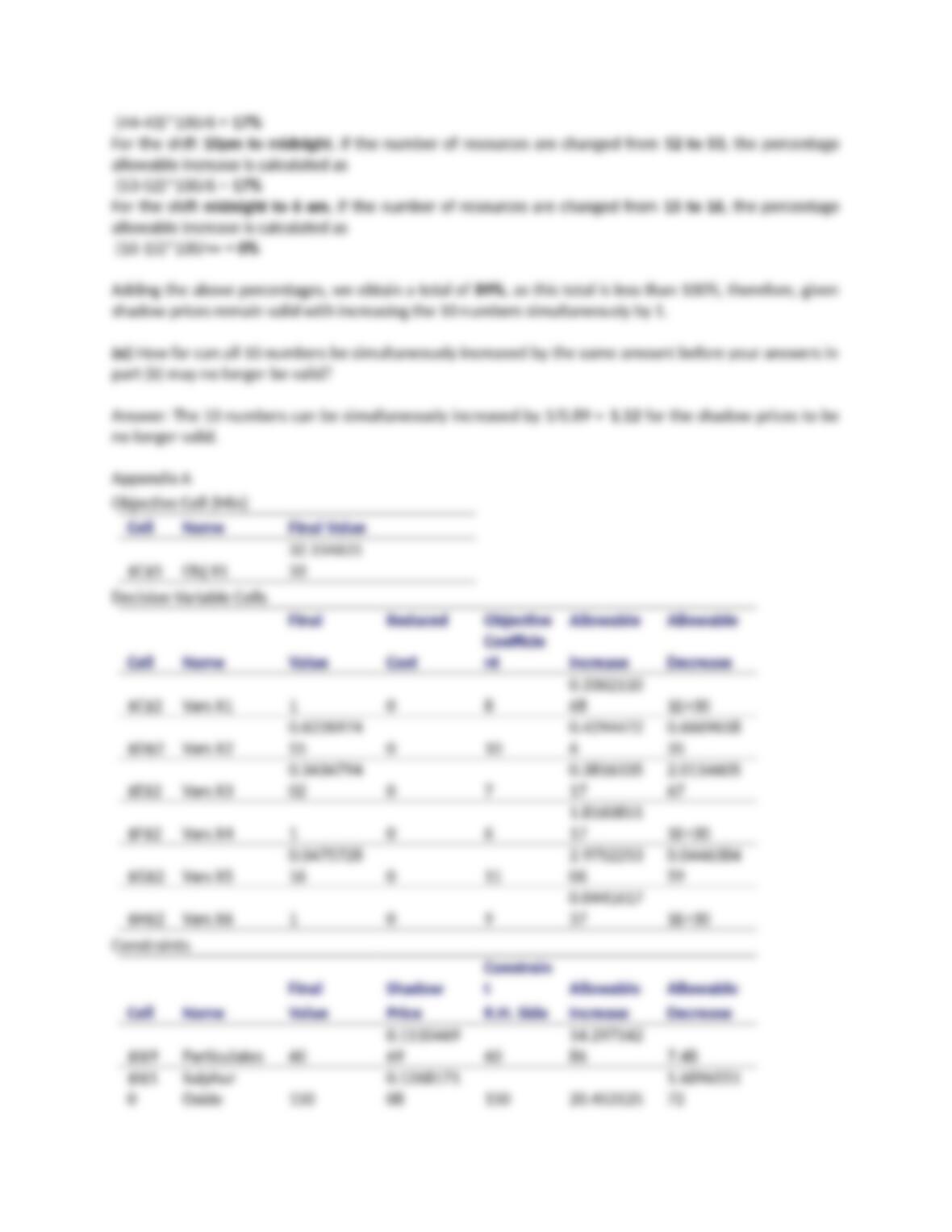
According to sensitivity Analysis report
If reduction in emission rates by tall smokerstacks abatement method for blast furnace falls in
the range [8.33, ∞] the abatement method plan will not change assuming no change in emission
rates for the remaining en##es don’t change.
If reduction in emission rates by tall smokerstacks abatement method for open hearth furnace
falls in the range [9.334, 10.42] the abatement method plan will not change assuming no change
in emission rates for the remaining en##es don’t change.
If reduction in emission rates by 7lters abatement method for blast furnace falls in the range
[4.989, 7.38] the abatement method plan will not change assuming no change in emission rates
for the remaining en##es don’t change.
If reduction in emission rates by 7lters abatement method for open hearth furnace falls in the
range [-∞, 7.81] the abatement method plan will not change assuming no change in emission
rates for the remaining en##es don’t change.
If reduction in emission rates by fuels abatement method for blast furnace falls in the range
[10.956, 13.97] the abatement method plan will not change assuming no change in emission
rates for the remaining en##es don’t change.
If reduction in emission rates by fuels abatement method for open hearth furnace falls in the
range [-∞, 9.044] the abatement method plan will not change assuming no change in emission
rates for the remaining en##es don’t change.
(b) Ignoring the constraints with no uncertainty about their parameter values (namely, xj _ 1 for j _
1, 2, . . . , 6), iden#fy the parameters of the model that should be classified as sensive
parameters. (Hint: See the subsection “sensitivity Analysis” in Sec. 4.7.) Make a resul#ng
recommenda#on about which parameters should be es#mated more closely, if possible.
Answer: The right hand side of constraints with non zero shadow prices are sensi#ve as change in its
value will impact the total cost. This makes the three required reductions in emission rates sensi#ve
parameters. The objective coe?cients also have a range around which they remain op#mal and are not
as sensi#ve. objective functions for fuels abatement method need to be es#mated carefully as for fuel
abatement for blast furnace the allowable decrease is 0.044 and for fuel abatement for open hearth