COMPETITIVENESS
– Important factor in determining whether a
company prospers, barely gets by, or fails
MARKETING INFLUENCES ON COMPETITIVENESS
1. Identifying consumers wants and/or needs
– Basic input in an organization’s decision making
process and central to competitiveness
– Achieve a perfect match between those wants and
needs and the organization’s goods and/or
services.
2. Price and quality
– Key factors in consumer buying decision
– Important to understand the trade-off decision
consumers make between price and quality.
3. Advertising and promotion
– Ways organization can inform potential customers
about features of their products or service, and
attract buyers
OPERATIONS INFLUENCE ON COMPETITIVENESS
1. Product and service design
– Should reflect joint efforts of many areas
– Characteristics or features of a product or service
can be a key factor in consumer buying decisions
– Other key factors are innovation and the time-to–
market for new products and services
2. Cost
– Key variable that affects pricing decisions and
profits
– Cost-reduction efforts are generally ongoing in
business organizations
3. Productivity
– Important determinant of cost
– Higher productivity rates than their competitors
have a competitive cost advantage
4. Location
– Important in terms of cost and convenience for
customers
– Location near inputs result in lower input costs
– Location near markets can result in lower
transportation cost and quicker delivery times
– Convenient location is particularly important I the
retail sector.
5. Quality
– Refers to material, workmanship, design and
service
– Consumers judge quality in terms of how well they
think a product or service will satisfy its intended
purpose
6. Quick response
– Can be competitive advantage
– Quickly bringing new or improved products or
services
– Quickly deliver existing products and service to a
customer
– Quickly handling customer complaints
7. Flexibility
– Ability to respond to changes
– High flexibility can be a competitive advantage in a
changeable environment
8. Inventory management
– Can be a competitive advantage by effectively
matching supplies of goods with demand
9. Supply chain management
– Involves coordinating internal and external
operations (buyers and supplier) to achieve timely
and cost-effective delivery of goods throughout
the system
10. Service
– Might involve after-sale activities
– Might involve extra attention while work in
progress
– Service quality can be a key differentiator
11. Managers and workers
– The people at the heart and soul of organization
– If they are competent and motivated they can
provide a distinct competitive edge via their skills
and the ideas, they create.
WHY SOME ORGANIZATION FAILS
1. Neglecting operations strategy
2. Failing to take advantage of strengths and
opportunities, and/or failing to recognize
competitive threats
3. Putting too much emphasis on short term financial
performance at the expense of research and
development
4. Placing too much emphasis on product and service
design and not enough on process design and
improvement
5. Neglecting investment in capital and human
resources
6. Failing to establish good internal communication
and cooperating among different functional areas
7. Failing to consider customer wants and needs
KEY TO SUCCESFULLY COMPETING
– Determine what customers want and then
directing efforts toward meeting customer
expectations
– What do customers want?
– What is the best way to satisfy those wants?
– Operation must work with marketing to obtain
information on the relative importance of the
various items to each major customer or target
market.
– Understanding competitive issues can help
managers develop successful strategies.
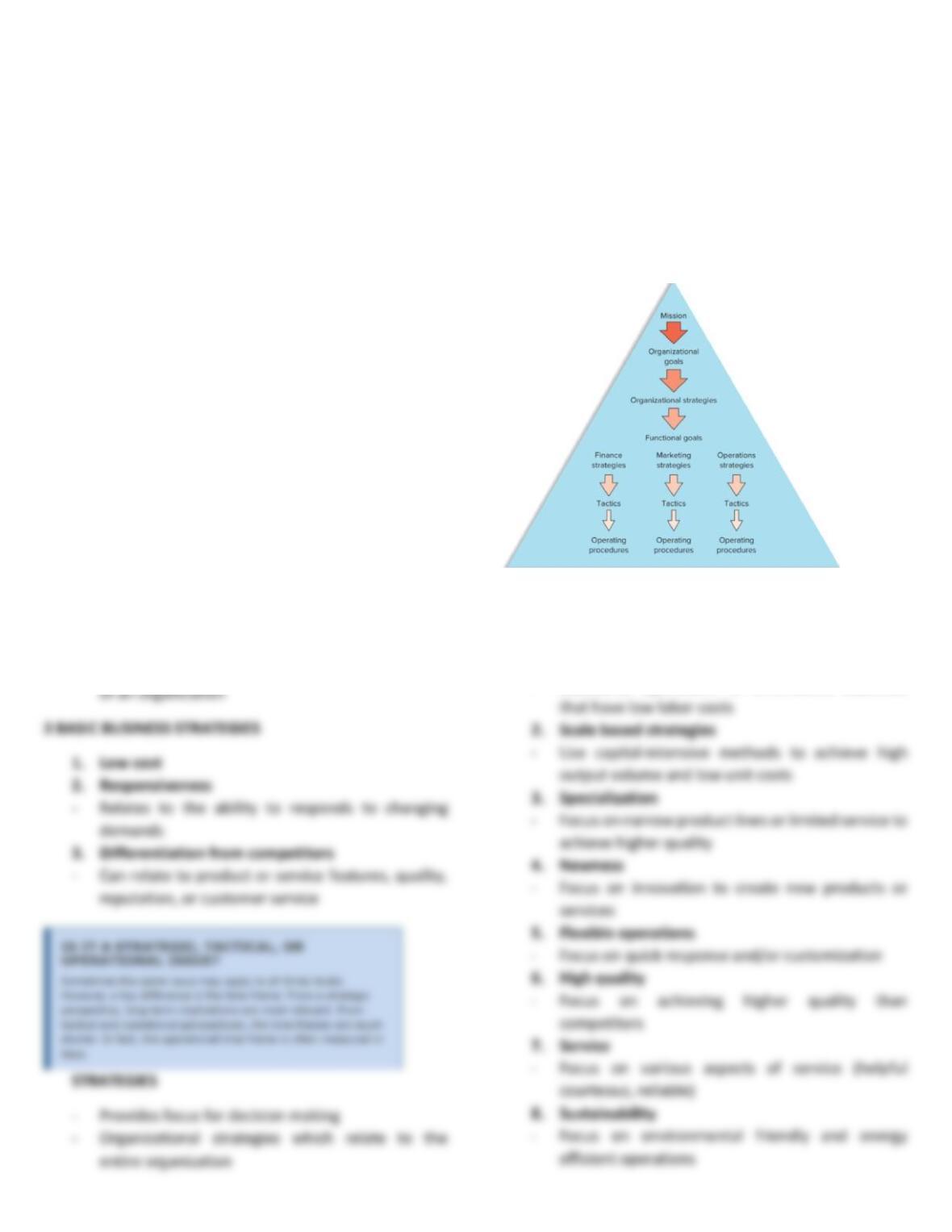
MISSION
– Organization’s mission is the reason for its
existence. (Mission statement)
– Should answer “What business are we in?”
– Serves as the basis for organizational goals.
GOALS
– provide more detail and describe the scope of the
mission
– serve as a foundation for the development or
organizational strategies
STRATEGIES
– plans for achieving organizational goals
– can be the main reason for the success or failure
of an organization
– Functional strategies which relate to each of the
functional areas of the organization
TACTICS
– Methods and actions used to accomplish
strategies
– More specific than strategies
– Provide guidance and direction for carrying out
actual operations
– How to part of the process
DIFFERENT STRATEGIES
1. Low cost
– Outsource operations to third-world countries